Chess Openings For Beginners, Backed By 1,000,000+ Real Games

We analyzed over 1,000,000 real chess games to find the 36 openings beginners actually face, then built an interactive way to learn them.

their reply A their reply B their reply C

What is Chess Opening Strategies?

Chess Opening Strategies is an interactive way to learn chess openings, built specifically for beginners and casual players who are tired of opening books that assume you already know how to play.

Instead of one long list of moves to memorize, every opening here is broken into a decision tree, and every move has the whole theory behind it. Here's what your opponent usually does, and here's exactly what you do about it, explained in simple steps.

You practice against real opponent replies pulled from real games, not a predictable bot, so you're building an actual feel for the opening, not just recall.

How it Works

Three simple steps, and you'll already understand more than most players who've spent years half-memorizing lines.

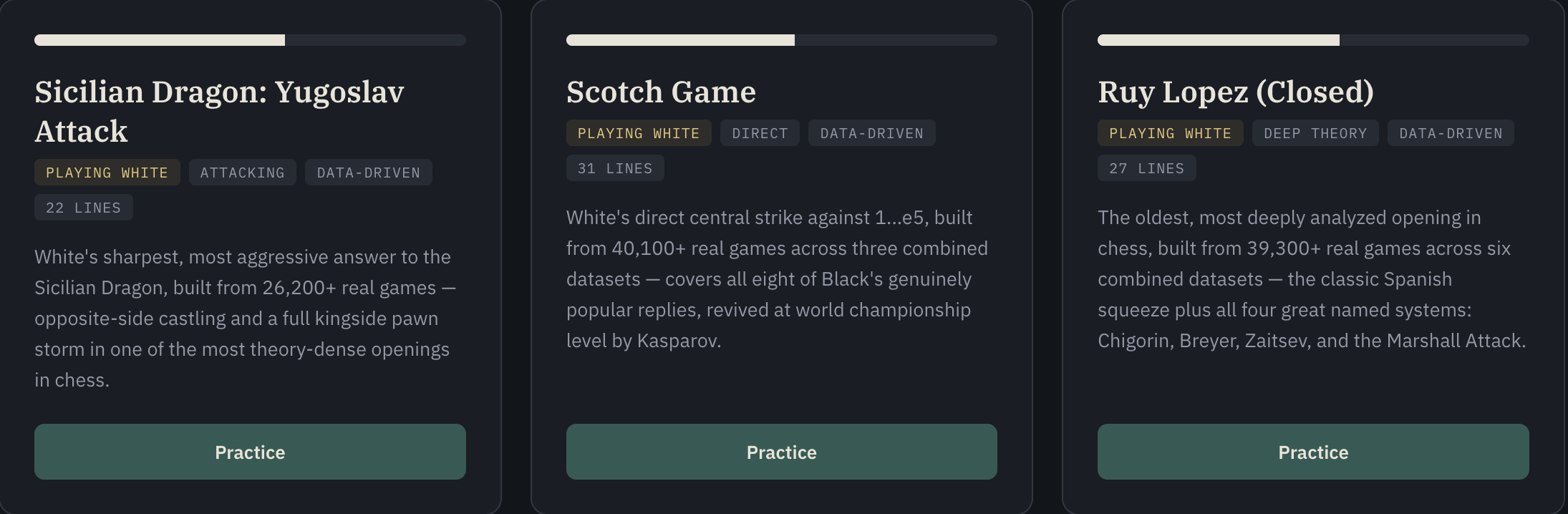
Real opening cards from the site's opening finder, showing progress bars, rating and style tags, and Practice buttons
1
Pick an Opening
Pick an opening that fits your rating, your color, and your style, or let the built-in opening finder recommend one.
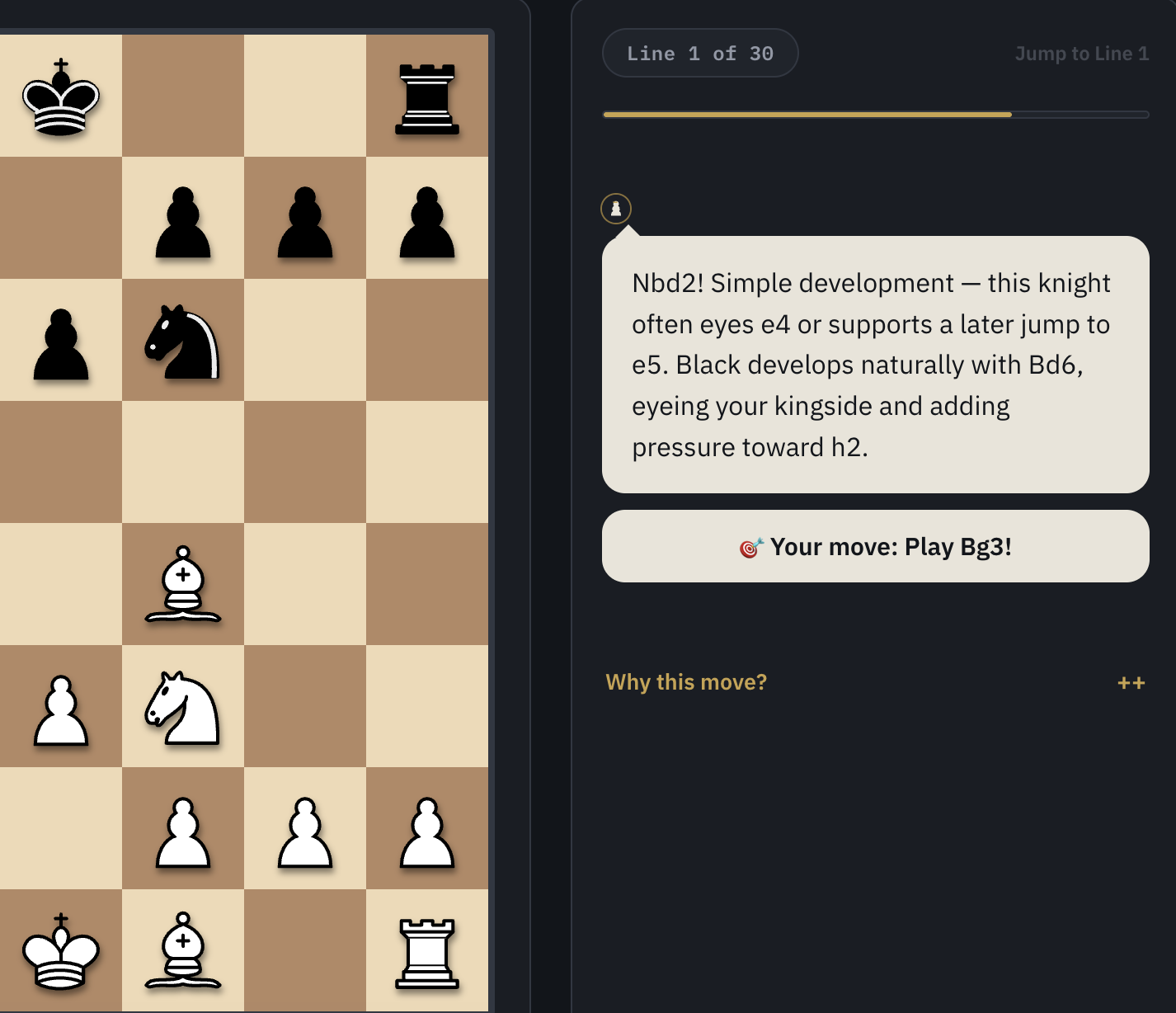
A real practice screen from the site, showing half the board and the coach's plain-English explanation of the move
2
Play Every Line
Play out each opening, move by move, with a plain-English explanation of why each move works.
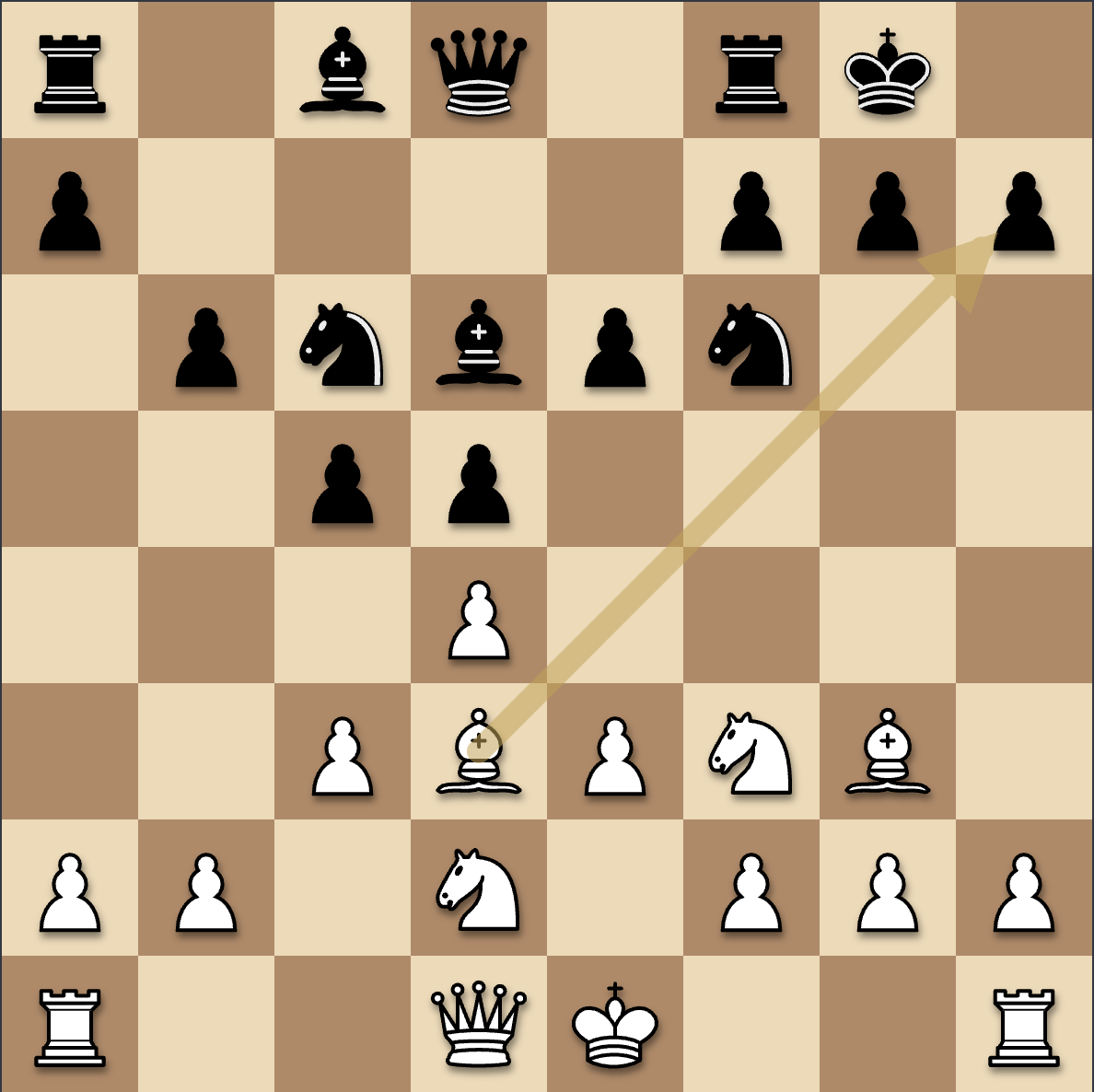
A real board from the site mid-practice, showing a gold arrow highlighting the move
3
Practice Until it Sticks
Practice openings against real opponent replies drawn from actual games, not scripted responses.
You didn't quit chess. Chess openings quit on you

Sound familiar?

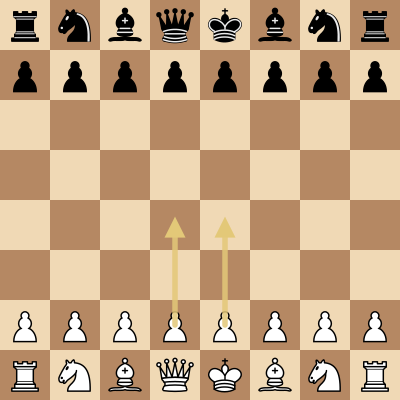
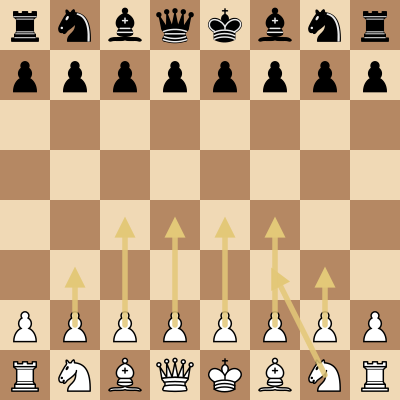
Chess starting position with arrows showing 1.e4 and 1.d4, White's two main opening choices
Opening anxiety
You know the first move. Then your opponent does something you've never seen, and you're improvising by move 3. Every game starts with the same quiet dread: what if they don't play the "book" line?
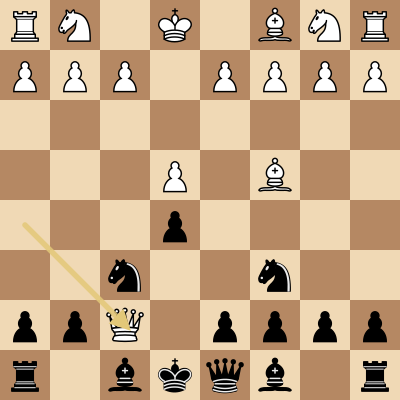
The Scholar's Mate checkmate position shown from Black's side of the board, with an arrow showing the queen's final move to f7
You keep walking into the same traps
Scholar's Mate. The Fried Liver. A random queen fork on move 6 that somehow always finds you. You're not bad at chess. You just never learned the patterns that catch beginners 90% of the time.
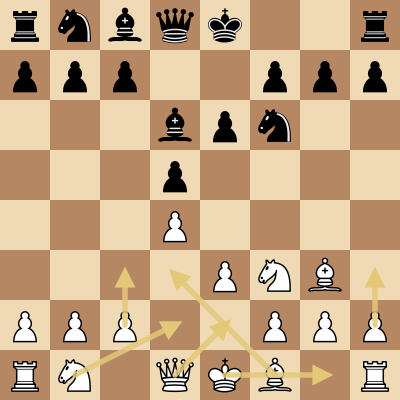
A London System middlegame position with many arrows pointing to different possible continuations, representing information overload
Memorization fatigue
You bought the course. You watched the first video. It's 30 moves deep into a line a 2400-rated player might see once a decade. You closed the tab and never came back.
Chess starting position with seven different arrows pointing in every direction, representing too many opening choices and no clear guidance
You genuinely don't know what to study
Should you learn the Sicilian? The London? The Caro-Kann? Everyone online has a different "best" answer, usually because they're a strong player who forgot what it's like to not know anything yet.

None of this is your fault. You were handed the wrong map. Almost every opening resource on the market is built for players who already know how to play, not for someone who needs to know which 36 things actually matter before they touch the rest.

The data-backed method

The old way vs. the Chess Opening Strategies way

The old wayChess Opening Strategies
How openings are chosen"Best openings" picked by one strong player's opinionThe 36 openings that show up most often and matter most, pulled from over 1,000,000 real games
Depth20–30 move "complete" lines memorized move-for-moveThe critical first 6–15 moves, exactly as deep as beginners actually need, no deeper
StructureOne giant PGN dump or a wall of theory textOne tree per opening, branch by branch, with the why explained at every move
VerificationTrust the authorEvery line checked against a real chess engine. Every check, every trap, every claim confirmed, not assumed
What you're left withA notebook of half-memorized lines you're afraid to deviate fromAn actual understanding of why the moves work, so you're never lost when your opponent goes off book

The headline number, explained

We didn't sit down and guess which 36 openings beginners should learn. We pulled over 1,000,000 real games, not engine self-play, not a curated "best games" collection, real games played by real people, and let the data tell us what actually shows up on the board.

01
Find what's common
Which openings and variations actually appear, over and over, in real games at real ratings?
02
Cut the dead weight
If a line shows up once in ten thousand games, it doesn't make the cut, no matter how "important" some course insists it is.
03
Verify everything
Every line, every claimed trap, every "you're winning a pawn here" moment, checked against a real chess engine before it ships.
04
Teach the why
Every move comes with a plain-English explanation, so you still know what to do when your opponent goes off script.

The honest version: most beginners don't lose games because they don't know enough openings. They lose because they half-know 15 of them. We'd rather you fully know the 36 that matter than vaguely recognize 60 that don't.

The research behind Chess Opening Strategies

We pulled over 1,000,000 real chess games, not engine self-play, not a curated "greatest hits" collection, real games played by real people, and used them to find which openings and variations actually show up, over and over, at the ratings beginners and casual players actually play at.

If a line only appears once in ten thousand games, it doesn't matter how theoretically "correct" it is, it's not worth your limited study time, so it didn't make the cut.

1,000,000+
real games analyzed
36
openings that made the cut
100%
of lines engine-verified
Curriculum

Before the openings: the 3 ideas every one of the 36 is built on

You'll see these three principles inside every single opening we teach, not as a separate theory chapter you skip, but woven into the actual moves.

Center control
Why the first few moves of almost every good opening fight over the same four central squares, and what happens to your position when you ignore them.
Rapid development
Getting your pieces off the back rank and into the game faster than your opponent, so you're never the one still "setting up" on move 10.
King safety
When to castle, why waiting too long is one of the most common ways beginners lose material outright, and how every opening here gets you there safely.

How the 36 openings are organized

Every opening follows the same format, so once you've learned how to use one, you already know how to use all 36.

01Pick your side. Playing White or Black. Every opening is taught from the perspective you'll actually be sitting behind.
02Branch by branch, not move by move. Instead of one long memorized sequence, you see the real decision points: here's what your opponent usually plays, and here's what you do about each option.
03A reason for every move. No move appears without a plain-English explanation of what it accomplishes and why it's the right response right now.
04Practice against the real thing. Every line is drilled against real opponent replies pulled from the same million-game dataset, not a predictable bot playing the same 3 moves every time.

Explore our chess openings

All 36 openings, organized by style. Click any opening to see the full breakdown, or use the opening finder to get matched automatically. New to this? See our full guide to the best openings for beginners, grouped by rating instead of style.

You don't need to know 60 openings.

You need to know the 36 that actually decide your games, and know them well enough that you're never guessing. That's Chess Opening Strategies, in one sentence.

No credit card. No 90-day contract. Just the board.
Why only 36 openings? Isn't more always better?
Not when "more" means memorizing lines you'll face once a year while never truly learning the ones you'll face every single game. We picked 36 because that's what the million-game dataset actually showed beginners need, not a round number we liked the sound of. Depth beats breadth when you're starting out.
How did you actually pick these 36, and is this just your opinion?
No opinion involved in the selection. We processed over 1,000,000 real games to see which openings and variations genuinely show up at the ratings beginners play at, then built full, verified, move-by-move trees for the ones that cleared the bar. If a line is in this course, it's because the data said it matters.
I'm a total beginner. Will I actually be able to follow this?
This was built for you specifically. Every single move comes with a plain-English explanation, not chess notation you have to decode, not "theory" you're expected to already understand. If you know how the pieces move, you're ready to start.
Should I play 1.e4 or 1.d4 as White?
There's no objectively correct answer here, it's a genuine style choice. 1.e4 tends to open the position quickly, so games get sharp and tactical fast, and you'll need to know your way around some forcing lines. 1.d4 usually keeps things more closed and maneuvering for longer, rewarding patience and a feel for structure over memorized tactics. Neither wins more at the beginner level. Pick the one that sounds like more fun to play, since you'll actually study it if you enjoy it.
What's the difference between an "open" and a "closed" opening?
It comes down to what happens to the central pawns. In an open opening, the central tension resolves early, pawns get traded off, and the position opens up for bishops, rooks, and queens to work along long diagonals and files. That usually means sharper, more tactical chess. In a closed opening, the central pawns lock into place instead of trading, and both sides maneuver pieces around that structure over many moves. That tends to reward patience and planning over quick tactical shots. Most openings aren't purely one or the other, they can go either way depending on what both players choose.
What is a gambit, and should beginners actually play them?
A gambit is a deliberate sacrifice, usually a pawn, offered early in exchange for faster development or a lead in the race to control the center. Whether beginners should play them is genuinely debated. The case for: gambits force you to actually attack and calculate, rather than just develop pieces safely, which sharpens real tactical skill fast. The case against: many gambits are objectively slightly worse if the defender knows the right response, so you can end up a pawn down with nothing to show for it against a well-prepared opponent. Neither side is wrong. It depends on whether you'd rather learn to attack first or learn solid structure first.
What happens if my opponent doesn't play the "book" move?
Nothing goes wrong, and this is worth actually believing rather than just reading. A "book" move is simply the move that's been most thoroughly analyzed and tested, not the only legal or reasonable one. If your opponent plays something else, it usually just means they're now playing a slightly less accurate move, one you can often punish if you understand why the book move was good in the first place, rather than having only memorized that it was good. That's exactly why this site explains the reasoning behind every move instead of just listing them: the reasoning is what still works when the position goes off-script.
What does "opening theory" actually mean?
It's the accumulated, tested knowledge of which opening moves and plans actually work, built up over centuries by strong players and, in the last couple of decades, checked and refined by chess engines. When someone says a line is "well known in theory," they mean it's been played and analyzed enough times that its strengths, weaknesses, and best responses are well understood, not that it's some kind of secret rulebook. It grows and shifts over time as engines find new ideas, which is also why some lines considered strong decades ago are now known to be less accurate.
Do strong players actually still play these classical openings?
Yes. The Ruy Lopez and the Queen's Gambit have been fixtures of top-level chess since the 19th century, and the Sicilian Defense, despite a slower start, was firmly established as elite players' go-to response to 1.e4 by the mid-20th century and has stayed there ever since. Engines have deepened the analysis and shifted some of the finer move-order details, but they haven't retired the openings themselves. That's a big part of why this site is built around openings like these rather than something trendier: the ideas you're learning are the same ones that hold up at every level above yours, not a beginner-only simplification you'll have to unlearn later.
Practice chess openings for free

Practice