The Ruy Lopez (Closed): A Complete Guide
The Ruy Lopez arises after 1.e4 e5 2.Nf3 Nc6 3.Bb5, and it's the oldest continuously-analyzed opening in chess, a genuine test of Black's setup that's been studied for centuries and is still played at the very highest level today. This guide covers the Closed main line, built from 39,367 real games across six combined datasets, handling Black's critical Marshall Attack decision plus all of the other great named defensive systems, with the opening's foundational tactical idea checked precisely rather than repeated as folklore.
Quick facts
| Moves | 1.e4 e5 2.Nf3 Nc6 3.Bb5 a6 4.Ba4 Nf6 5.O-O Be7 |
| Played as | White |
| Best for | Roughly 1600–2400 rated players, especially those ready for deep study |
| Style | Positional overall, with a genuinely sharp option available for Black to consider |
| Games analyzed | 39,367 real games, every leaf line backed by 40+ real examples across six combined datasets |
| Lines covered here | 27 (across the Marshall fork and all named systems) |
What is the Ruy Lopez?
After 1.e4 e5 2.Nf3 Nc6, White plays 3.Bb5, developing the bishop to a square that lines up against Black's knight on c6, the piece currently defending the e5 pawn. This isn't the simple "the knight is paralyzed" pin it's sometimes described as. Black's knight genuinely can move, to a5 or b8, for instance, without doing anything illegal. What it can't do is move away for free: the c6 knight is the only thing defending e5, so if it leaves, White's own knight on f3 simply captures the pawn. That's the real mechanism behind the pressure, not king safety but material, and it's exactly why Black's most common response, 3...a6, exists: putting the question to the bishop immediately, before that pressure can build any further, and forcing White to make a real decision rather than simply maintaining the tension indefinitely.
It's called "the Ruy Lopez" after Ruy López de Segura, a 16th-century Spanish priest whose 1561 treatise was one of the first serious chess books published in Europe. He didn't invent the opening itself. The underlying moves appear in an earlier manuscript from around 1490, but his systematic analysis of it is exactly why his name stuck to it, a genuine link between the game as played today and some of its very earliest documented theory.
The line covered in this repertoire is the Closed Ruy Lopez, the classical main line where White retreats the bishop, castles, and builds patient pressure with c3 and a slow knight maneuver, rather than trading the bishop off early or racing into open tactics. It's called "the Spanish squeeze" for a reason: nothing about it is sudden, but the accumulated pressure over many moves is real and has been tested at every level of chess for well over a century, from 19th-century master play through to today's elite grandmaster tournaments.
How to play the Ruy Lopez: move by move
Every line below starts 1.e4 e5 2.Nf3 Nc6 3.Bb5 a6 4.Ba4 Nf6 5.O-O Be7 6.Re1 b5 7.Bb3, reaching a genuine fork in Black's move order that shapes everything that follows. 4.Ba4 keeps the pin alive rather than trading the bishop off, 6.Re1 defends e4 in advance of the coming central tension, and 7.Bb3 tucks the bishop safely onto its most useful diagonal, still aimed at f7, after Black gains a tempo on it with 6...b5.
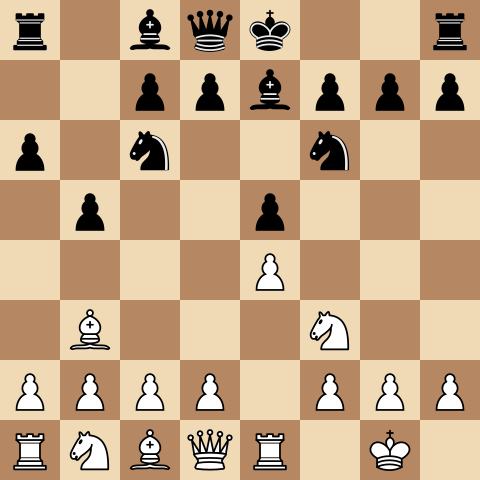
The critical fork: 7...O-O 8.c3, Marshall or not
Rather than settling the center immediately, Black can castle right away, "keeping the option of the sharp Marshall Attack alive." After 8.c3, "the same key idea as the main move order," Black makes the real decision, one that shapes the entire character of the rest of the game:
- 8...d5, the Marshall Attack, Black offers a full pawn for a dangerous, long-lasting initiative. This is genuinely sharp enough that some White players use entirely different move orders earlier in the game specifically to avoid ever facing it, which is itself a real signal of how much respect this particular try commands.
- 8...d6, declining the Marshall Attack in favor of the calmer, more traditional path, transposing into the same structures reached by the alternative move order below.
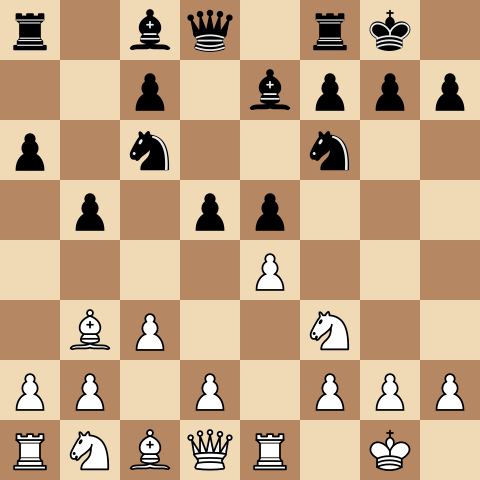
The traditional path: 7...d6 8.c3 O-O 9.h3
If Black settles the center first with 7...d6, "supporting the center, preparing to complete development," the game continues 8.c3 O-O 9.h3, White's "key preventive move, ruling out ...Bg4 before continuing." This small move matters more than it looks. Without it, Black could pin White's own knight and create real complications before White's setup is fully ready. This is where Black's other three great named systems genuinely branch, each a real, deeply studied plan in its own right:
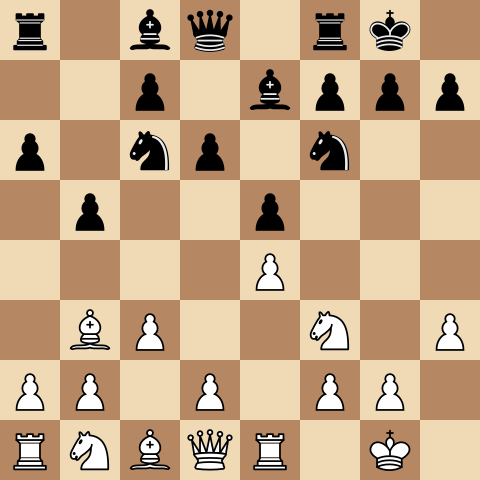
- 9...Na5, the Chigorin Variation, Black repositions the knight, preparing ...c5 and ...Qc7 to gain queenside space and pressure White's light-squared bishop, one of the most aggressive ways Black can meet the Closed Ruy Lopez's patient buildup.
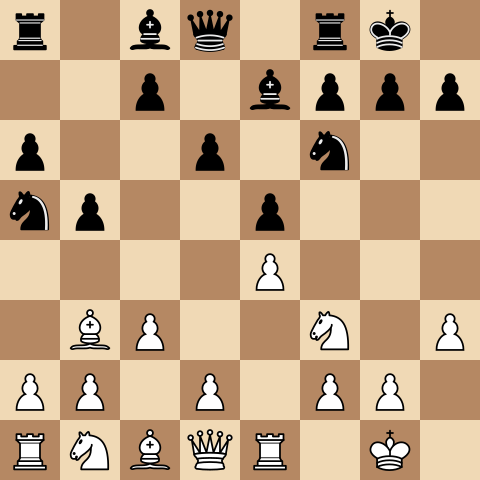
- 9...Nb8, the Breyer Variation, the knight retreats to reroute toward d7, "a paradoxical-looking but deeply sound idea," one of the most respected, patient setups in the entire opening, favored historically by players who prize flexibility over immediate activity.
- 9...Bb7, the Zaitsev Variation, Black develops the bishop flexibly, adding pressure toward e4 while keeping options open, a modern favorite at the elite level precisely because of how adaptable it is.
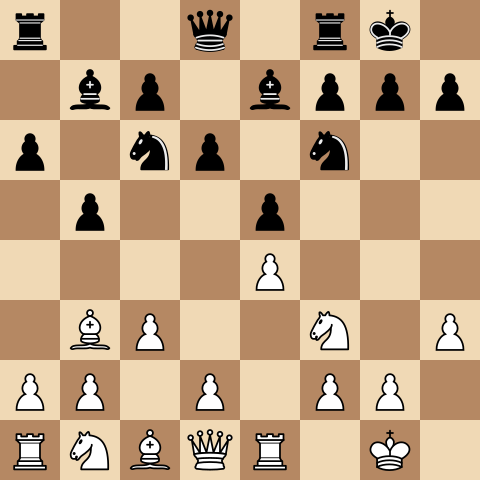
A fourth real setup, 9...Nd7, repositions the knight early and is part of the systems associated with Karpov, Smyslov, and Kholmov, real, tested theory in its own right, not just a footnote to the three named systems above, and a reminder that even the "other" options in an opening this deeply studied still carry serious historical weight.
Each of these branches is fully covered in this repertoire with its own real, tested continuations, not just a summary, because in the Ruy Lopez, more than almost any other opening, which specific system Black chooses genuinely changes the character of the whole game.
Strategic ideas in the Ruy Lopez
A handful of ideas repeat across this entire repertoire:
- The bishop's pressure on c6 is real but not absolute, especially early on. Understanding exactly what it does and doesn't accomplish at each stage matters more than treating it as a fixed, unchanging threat throughout the whole game. The pressure genuinely grows as the position develops, rather than being at its maximum from the very first moment the bishop lands on b5.
- a6 exists to force a decision, not just to gain a tempo. By putting the question to the bishop immediately, Black makes White choose between retreating (keeping long-term pressure alive) and trading (giving up the bishop pair for simpler pressure) right away, rather than letting White choose the moment on their own terms.
- c3 before d4 is the entire strategic core of the Closed Ruy Lopez. Preparing the central break properly, rather than rushing it, is what separates the patient "Spanish squeeze" from a more direct, less thoroughly supported central strike, and it's the single idea that most defines this repertoire's whole identity.
- White's signature piece maneuver is Nbd2-f1-g3 (or f1-e3), not a fixed plan but the standard way to convert space into an attack. Once the center settles, the b1-knight typically re-routes through d2 and f1 toward g3, defending e4, eyeing f5, and adding real weight to a coming kingside attack, or toward e3 instead, aiming at d5. Recognizing this maneuver on sight is part of understanding what all the patient early moves are actually building toward.
- Which path Black chooses genuinely changes the game. Whether Black keeps the Marshall Attack alive with an early castle, or settles the center with ...d6 and picks between the Chigorin, Breyer, Zaitsev, or Karpov/Smyslov/Kholmov setups, these aren't cosmetic variations on the same idea. They lead to real, different structures, which is why this repertoire treats each one as its own real subject rather than a footnote.
Who should play the Ruy Lopez?
The Ruy Lopez is a strong fit for players roughly 1600 to 2400 rated, with a style best described as positional. If you want the single most deeply tested, most respected way to meet 1...e5 as White, an opening with genuine, centuries-long pedigree that's still played and refined at the elite level today, the Ruy Lopez is about as serious a choice as exists in all of chess. Very few openings offer this combination of historical depth and continued elite-level relevance at the same time.
It's a weaker fit if you're newer to chess or specifically want a lower-theory opening. The Ruy Lopez carries some of the deepest, most thoroughly analyzed theory of any opening in the game. It genuinely rewards players who already have a real positional foundation and are ready to study several distinct systems in real depth, rather than one simple plan that covers everything.
Common mistakes in the Ruy Lopez
- Trading the bishop for the knight too early without a specific reason. Retreating with 4.Ba4 keeps real, long-term pressure alive. Giving up the bishop pair early gives away a genuine long-term asset for very little in return, especially against a player who knows how to use the resulting open lines.
- Rushing the central d4 break before c3 and full development are in place. The entire point of the Closed Ruy Lopez's patient approach is preparing that break properly. Playing it too early trades a real structural advantage for a quicker but weaker version of the same idea.
- Treating the pressure on c6 as an absolute, permanent restriction. Early on, the c6 knight can genuinely move without doing anything illegal. What overestimating the pressure actually costs is missing that moving the knight loses the e5 pawn outright, since it's the only thing defending it. Knowing the real mechanism matters more than treating the whole idea as a vague, fixed threat.
- Preparing for only one of Black's real options. The Marshall Attack, Chigorin, Breyer, Zaitsev, and the Karpov/Smyslov/Kholmov setups are all genuinely common, genuinely different. Being ready for only the most familiar one leaves real gaps against the others.
Frequently asked questions
Is the Ruy Lopez good for beginners?
It's better suited to players roughly 1600 and up. Its appeal is depth and long-term strategic reward, but that same depth means genuinely mastering it takes real study. Newer players are often better served starting with lower-theory openings first and returning to the Ruy Lopez once they have a stronger positional foundation to build on.
Why is it called "the pin" if the knight can still move?
Because the common short description oversimplifies a real, more precise idea. The knight genuinely can move, to a5 or b8, without doing anything illegal. What it can't do is move for free: the c6 knight is the only piece defending e5, so if it leaves, White's own knight on f3 simply wins the pawn. That's the actual mechanism, a material threat rather than a literal pin, and getting it right matters for understanding what the position actually allows Black to do, rather than assuming the knight is simply stuck from the very first move.
What are Black's main options in the Closed Ruy Lopez?
The first real decision is whether to keep the Marshall Attack alive by castling immediately, or settle the center first with ...d6. Declining the Marshall leads to three further named systems, the Chigorin (...Na5 and ...c5), the Breyer (...Nb8, rerouting the knight), and the Zaitsev (...Bb7), plus a fourth real setup, ...Nd7, associated with Karpov, Smyslov, and Kholmov. Each leads to a real, distinct kind of middlegame, and all are fully covered in this repertoire.
What is the Marshall Attack, and should White worry about it?
It's Black's sharpest try in the whole Closed Ruy Lopez, a real pawn sacrifice in exchange for fast, dangerous piece activity. It's well-tested enough that some White players specifically use alternate move orders just to sidestep it. This repertoire covers it directly rather than avoiding it, which means having a real, tested answer ready rather than needing to work one out for the first time in an actual game.
Do all four of Black's named systems require completely different preparation from White?
The core early moves (a6, Ba4, O-O, Re1, b5, Bb3, c3) stay the same regardless of which system Black eventually chooses, so the genuinely new material only starts once Black's specific plan becomes clear. That's a meaningful amount of shared preparation before any real divergence, which makes learning all of Black's options more manageable than the total line count alone might suggest.
Related openings
- Italian Game — A lower-theory White answer to 1...e5 for comparison -- useful context for how the Ruy Lopez's patient, long-term pressure differs from the Italian's faster development.
- Scotch Game — Another major White try against 1...e5, opening the center immediately on move three rather than building the slow Spanish squeeze.
Practice every real line against master-game replies, with a plain-English explanation on every move.
Practice Ruy Lopez (Closed) free →