How to Play the Scotch Game
The Scotch Game arises after 1.e4 e5 2.Nf3 Nc6 3.d4, and it's one of the most direct ways for White to meet 1...e5. Rather than developing a piece first, White strikes in the center immediately. This guide covers a complete White repertoire, built from 40,145 real games across three combined datasets, answering all eight of Black's genuinely popular replies with real, tested continuations rather than generic advice.
Quick facts
| Moves | 1.e4 e5 2.Nf3 Nc6 3.d4 |
| Played as | White |
| Best for | Roughly 900–1800 rated players, including improving club players |
| Style | Aggressive, with real historical pedigree at the highest level |
| Games analyzed | 40,145 real games, every leaf line backed by 100+ real examples across three combined datasets |
| Lines covered here | 31 (across all eight of Black's real replies) |
What is the Scotch Game?
Most classical replies to 1...e5 develop a piece before challenging the center. The Italian Game plays 3.Bc4, the Ruy Lopez plays 3.Bb5, and both keep the central pawns in tension for several more moves. The Scotch Game does something more direct: 3.d4, striking in the center immediately, "the whole point of the Scotch Game." After 3...exd4 4.Nxd4, White reaches what this repertoire calls "the true starting point of the Scotch," a genuinely open position with real central control and rapid development, in exchange for releasing the central tension earlier than the Italian or Ruy Lopez would. This trade-off is worth understanding rather than just accepting: White gives up the chance to keep Black guessing about the center for a few more moves, in exchange for pieces that come out faster and more actively than they otherwise would.
The Scotch has a real, well-documented history worth knowing: it was popular in the 19th century, fell out of favor for most of the 20th as players considered it strategically shallow, and then was genuinely revived at the very highest level by Garry Kasparov, who played it against Anatoly Karpov in their 1990 World Championship match and continued using it successfully in later championship matches too. That's not a marketing claim. It's real chess history, and it's exactly why the Scotch carries more respect today than its reputation a century ago might suggest. Kasparov's specific innovation, the Nxc6/e5 plan covered as this repertoire's main line, is the exact idea that turned a once-neglected opening back into a serious weapon at the highest level of the game.
How to play the Scotch Game: move by move
Every line below starts 1.e4 e5 2.Nf3 Nc6 3.d4 exd4 4.Nxd4, reaching the real starting point of the opening. From here, the data reveals eight genuinely popular replies from Black, each covered in full detail below.
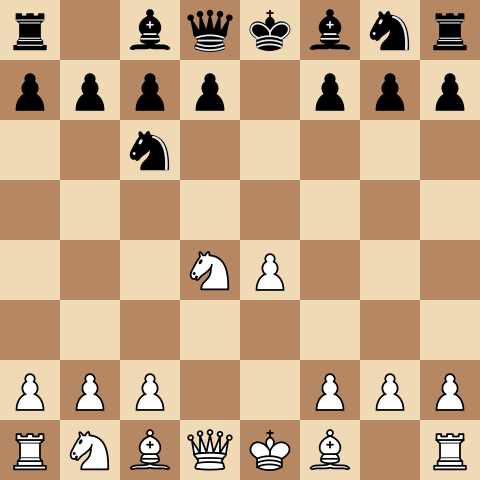
The main try: 4...Nf6, the Schmidt Variation
Black develops the knight, attacking e4 immediately. White's modern main response is 5.Nxc6, trading knights and preparing to push e5, "the modern main try, revived by Kasparov himself," matching the exact idea Kasparov used against Karpov. After 5...bxc6 6.e5, kicking the f6-knight and gaining real central space, Black has three genuinely common tries: 6...Qe7, developing the queen to defend the knight and prepare to meet White's central push; 6...Nd5, retreating to a strong central square, the most popular response; or 6...Ne4, jumping forward instead of retreating, a sharper, more active try that keeps the position tense rather than settling into a quieter structure.
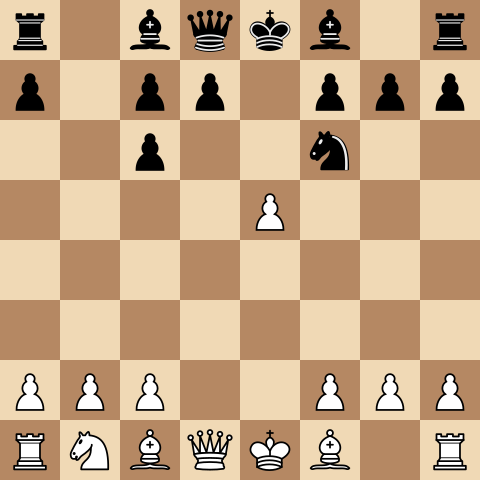
6...Qe7, precisely. This isn't just development, it's a genuine tactical device. Queen, pawn, and king all sit on the open e-file: Black's queen on e7, White's pawn on e5, and White's own king still on e1. That means the e5 pawn is pinned. If White tries to simply grab the knight with exf6, the pawn moving away exposes the king to a direct check along the file, so the capture isn't available at all. White has to deal with the pin first, and the real, verified answer is 7.Qe2, interposing on the same file and physically blocking the check before the knight can be rerouted to d5.
The Classical Variation: 4...Bc5
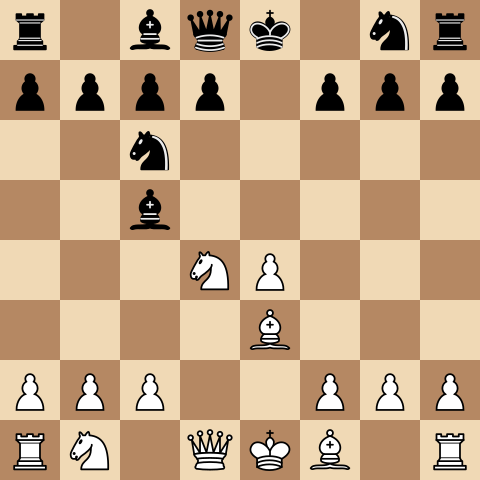
Black develops the bishop with immediate pressure. White continues 5.Be3, and here's a detail worth getting exactly right: this move does not directly attack Black's bishop, since White's own knight on d4 sits on that same diagonal and blocks it. But Be3 isn't purely defensive either. It sets up a real, concrete threat of its own: if the knight ever moves, 6.Nxc6!, the bishop's line to c5 opens up as a genuine discovered attack, and the knight itself forks the queen on d8 in the process. Play it out and it's not subtle: 5...Nf6? 6.Nxc6 dxc6 7.Bxc5 simply wins the bishop for nothing. Black's real replies all take this into account: 5...Qf6 is the point, not just active development. It keeps the option of recapturing on c6 with the queen instead of a pawn if White ever plays Nxc6, and a queen sitting on c6 genuinely defends c5, taking the whole idea off the table, while also adding pressure of its own against d4 and f2. 5...Bb6 retreats the bishop to a safe square, sidestepping the tension entirely, and 5...Nxd4 trades knights and offers to simplify the position instead.
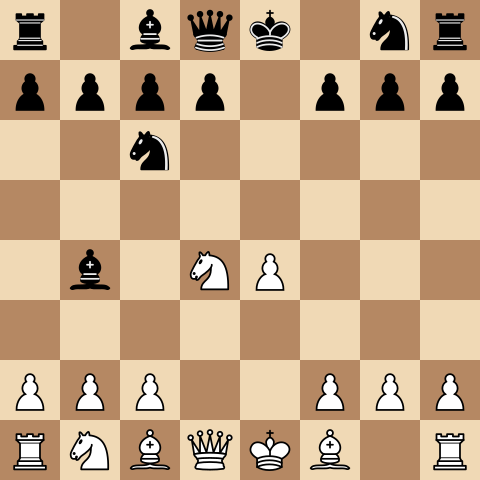
The sharp try: 4...Bb4+, the London Defense
Black checks immediately: a genuine, forcing check, not just an inconvenient developing move. White responds 5.c3, forcing the bishop to make a decision immediately, and Black has two real choices: retreating with ...Bc5 or ...Be7, each leading to its own real, tested continuation in this repertoire.
Five more real replies, each fully covered
- 4...Qf6, the Intermezzo Variation, Black develops the queen actively before committing the bishop, keeping options flexible for a move rather than settling on a plan immediately.
- 4...Qh4, the Steinitz Variation, Black brings the queen out aggressively, genuinely hitting e4 (verified: the queen on h4 does attack e4 directly along the open rank, not just a loosely aggressive-looking placement).
- 4...Nxd4, the Lolli Variation, Black trades knights immediately, "generally considered a small inaccuracy" rather than a mistake outright, since it helps White's development more than it helps Black's.
- 4...d6, a solid, modest response rather than immediately developing a piece, prioritizing structure over speed.
- 4...g6, a quieter, more positional fianchetto approach, aiming the bishop at the long diagonal rather than developing it actively toward the center.
Strategic ideas in the Scotch Game
A handful of ideas repeat across this whole repertoire:
- 3.d4 releases the central tension immediately, and that's a deliberate trade-off, not a weakness. White gives up some of the slow-building tension the Italian Game or Ruy Lopez would keep, in exchange for faster development and a genuinely open position to work with, which suits an aggressive, activity-focused style better than a patient, tension-building one.
- The Nxc6/e5 plan against 4...Nf6 is the modern, well-respected main line, not just one option among many. This is specifically the idea Kasparov used to revive the whole opening at world championship level, worth knowing as a signal of how thoroughly tested it is, not just trivia.
- Be3 against the Classical Variation is about defense, and it sets up a real threat of its own. Getting it backwards, thinking the bishop move directly threatens Black's bishop, misses what's actually happening: it's defending the knight while quietly preparing Nxc6, a discovered attack on that same bishop the moment the knight moves.
- Bb4+ is a real, forcing check that has to be met precisely, not brushed off. c3 is the standard, correct response.
Who should play the Scotch Game?
The Scotch Game is a strong fit for players roughly 900 to 1800 rated, with a style best described as aggressive. If you want a direct way to meet 1...e5 that opens the position quickly and leads to genuine piece activity, rather than the slower, more theory-heavy buildup of the Italian Game or Ruy Lopez, the Scotch offers real, well-tested chances for an advantage backed by decades of practical results, not just theoretical assessment from analysts who never had to play it under tournament conditions.
It's also a strong match if you're drawn to openings with real, documented history and modern relevance. The Scotch isn't just an old idea nobody plays anymore; its revival by one of the greatest players in chess history at the very highest level of competition is exactly why it's still taken seriously today. Openings with that kind of pedigree tend to reward deeper study, since real grandmaster games exist to learn from rather than just theoretical analysis, and there's a genuine well of practical, tested experience to draw on beyond just this repertoire's own data.
It's a weaker fit if you specifically want to keep maximum central tension for as long as possible, the way the Italian Game or Ruy Lopez do. The Scotch's whole identity is resolving that tension early and playing an open position instead.
Common mistakes in the Scotch Game
- Thinking Be3 directly attacks Black's bishop in the Classical Variation. It doesn't. White's own knight blocks that diagonal. The real point is defending the knight, which is already under attack from Black's bishop, while setting up Nxc6 as a genuine discovered-attack threat for later.
- Underestimating Bb4+. This is a genuine, forcing check, not a minor inconvenience. Meet it precisely with c3 rather than scrambling to find the right response under time pressure, since ignoring a check outright simply isn't legal.
- Treating all eight of Black's replies as equally likely to require the exact same response. The data shows real, different frequencies and real, different correct plans for each. Knowing which of Black's eight tries you're actually facing matters more than having one generic reaction ready for whatever shows up.
- Assuming an open position means simple, tactic-free play. The Scotch trades central tension for activity, not for safety. Real precision is still required, especially in the sharper lines like the Nf6/Nxc6/e5 main try that Kasparov himself used at the highest level, where a single inaccuracy can hand back the advantage White worked to build.
Frequently asked questions
Is the Scotch Game good for beginners?
It's a strong fit slightly above absolute-beginner level, rated well for roughly 900 to 1800. Its direct, principled plan (strike the center, develop rapidly, use the resulting open lines) is genuinely learnable, though the sharper lines reward real tactical awareness rather than pure memorization alone.
Did a world champion actually play the Scotch Game?
Yes, Garry Kasparov revived the Scotch at the highest level, playing it against Anatoly Karpov in their 1990 World Championship match and continuing to use it successfully in later championship matches as well, after it had fallen out of favor for most of the 20th century. His specific innovation in that match is the exact main line this repertoire teaches against 4...Nf6.
What's the difference between the Scotch Game and the Italian Game?
Both start 1.e4 e5 2.Nf3 Nc6, but the Italian Game continues 3.Bc4, developing a piece first, while the Scotch plays 3.d4, striking the center immediately and releasing the tension earlier in exchange for faster development and a more open position. Neither approach is objectively better, they simply lead to different kinds of positions suited to different playing styles.
Does Be3 attack Black's bishop in the Scotch Game's Classical Variation?
No, despite how it might look. White's own knight on d4 blocks that diagonal. The real point of Be3 is defending the knight, which is already under attack from Black's bishop on c5, while also setting up a genuine threat of its own: if the knight moves, Nxc6 opens a discovered attack on that same bishop.
How many different replies does Black have against the Scotch Game?
Eight genuinely popular ones show up with real frequency in the data behind this repertoire: 4...Nf6, 4...Bc5, 4...Qf6, 4...Bb4+, 4...Nxd4, 4...Qh4, 4...d6, and 4...g6. Each is fully covered here with its own real, tested continuation rather than a generic fallback response that treats every reply the same way.
Is 4...Bb4+ a dangerous check for White to face in the Scotch Game?
It's a genuine, forcing check that has to be met precisely, not just a loosely aggressive-looking move. It's also a well-known, well-tested try with a clear, standard response (5.c3) that this repertoire covers in full, so there's no need to work it out over the board for the first time in a real game.
Related openings
- Italian Game — White's other major answer to 1...e5 -- a good comparison for how the Scotch's immediate central strike differs from the Italian's slower buildup with 3.Bc4.
- Ponziani Opening — Another White try against 1...e5 built around preparing d4 -- useful context for comparing different ways of fighting for the center against the same defense.
Practice every real line against master-game replies, with a plain-English explanation on every move.
Practice Scotch Game free →