The Ponziani Opening: A Complete Guide
The Ponziani Opening arises after 1.e4 e5 2.Nf3 Nc6 3.c3, and it's one of the least-explored ways to meet 1...e5 as White, a classical opening that sidesteps the enormous, well-trodden theory of the Italian Game and the Ruy Lopez in favor of a quiet, flexible plan built around a big central push. This guide covers a complete White repertoire, built from 4,773 real games, including one genuine tactical trap worth knowing precisely, not just vaguely, plus the calmer main line that shows up far more often in practice.
Quick facts
| Moves | 1.e4 e5 2.Nf3 Nc6 3.c3 |
| Played as | White |
| Best for | Roughly 600–1500 rated players |
| Style | Flexible, solid |
| Games analyzed | 4,773 real games, every leaf line backed by at least 15 real examples |
| Lines covered here | 27 |
What is the Ponziani Opening?
After the classical start 1.e4 e5 2.Nf3 Nc6, most players reach for 3.Bc4 (the Italian Game) or 3.Bb5 (the Ruy Lopez), both extensively analyzed, both carrying decades of accumulated theory. The Ponziani takes a different route: 3.c3, quietly preparing a big d4 push to build a genuinely large classical center, rather than developing a piece toward an immediate attack. The opening is actually far older than its name suggests. It was already being discussed in chess literature by 1497, making it one of the oldest documented openings in the game. It takes its modern name from Domenico Lorenzo Ponziani, an 18th-century Italian priest and law professor who analyzed the position and contributed a specific countergambit idea, even though he wasn't the one who first discovered it.
This low-theory profile is the opening's whole appeal. Because so few players study the Ponziani in real depth, opponents are far more likely to be relying on general principles than specific memorized preparation, which matters more than it might sound, since it means the practical, over-the-board decisions in this opening get tested far more often than the deep theoretical ones.
How to play the Ponziani Opening: move by move
Every line below starts 1.e4 e5 2.Nf3 Nc6 3.c3. From here, Black has two genuinely common replies in the data.
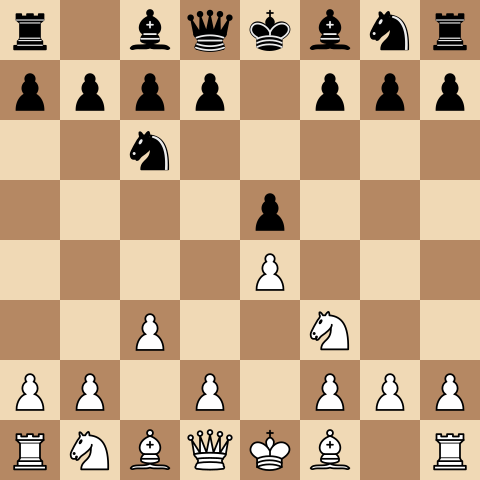
Black's main try: 3...Nf6, the Jaenisch Counterattack
Rather than waiting, Black hits White's e4 pawn immediately. White's response is direct: 4.d4, ignoring the attack on e4 and grabbing the center anyway. From here, Black has three real replies in the data, and the most common, principled one is 4...exd4, simply taking the pawn on offer rather than grabbing on e4.
The main line: 4...exd4 5.e5. White pushes forward, kicking the f6-knight and gaining real space in the process. Black's main and most popular retreat is 5...Nd5, and White continues 6.cxd4, recapturing the pawn and restoring a full, healthy center. It's a clean, comfortable position with real central space and no weaknesses. Black's two other tries here are 5...Ne4, jumping the knight forward into White's territory instead of retreating, and 5...Qe7, developing the queen to defend the wandering knight rather than moving it again.
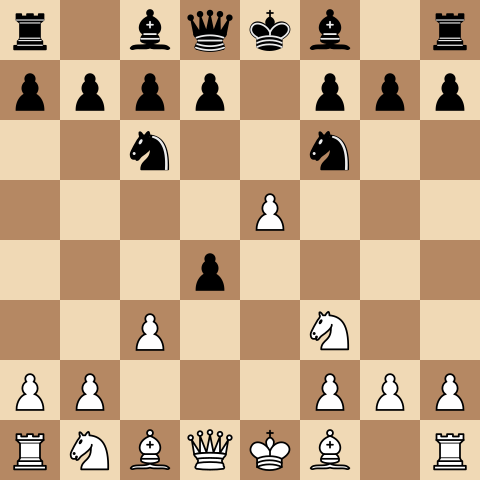
The tactical alternative: 4...Nxe4. Taking the free-looking pawn instead leads to sharper waters. White continues 5.d5, kicking the c6-knight and gaining even more space while Black's pieces scatter across the board. This is where the position gets genuinely sharp, and where Black's best try leads directly into this repertoire's signature trap.
The trap, precisely: Black's most critical try here is 5...Bc5, offering the c6-knight in exchange for tactics on f2. White's correct response is 6.dxc6, simply taking the knight. The bishop's coming check on f2 doesn't actually save it. Black plays 6...Bxf2+, the only real follow-up try after losing the knight, and here's the exact point worth knowing cold: Kxf2 is illegal here, not just bad. The knight Black already has sitting on e4 covers the f2 square, so the king cannot legally move there at all. The only legal square is 7.Ke2.
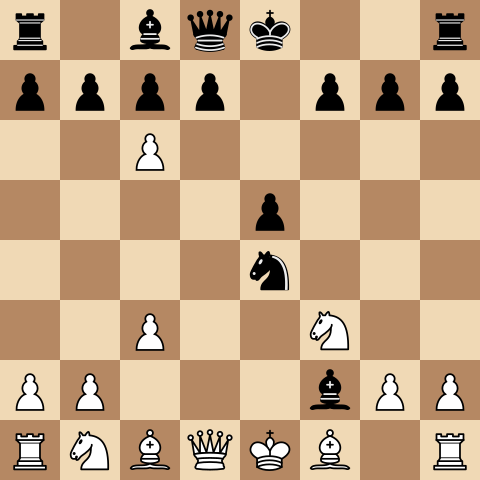
From here, Black has two real tries, and White has a precise, winning answer to each. Against 7...bxc6, recapturing the knight, White plays 8.Qa4!, a genuine double attack hitting both the pawn that just landed on c6 and the knight still sitting on e4, a real, verified way to come out of the tactics with a material and structural advantage. Against 7...Bb6, retreating the bishop to safety instead, White has an even sharper answer: 8.Qd5!, again a genuine double attack, this time hitting f7 and the e4 knight at once. Either way, White emerges from the tactics with a real, verified material and structural advantage, not just vague compensation for the earlier exchanges.
Black's third option after 4.d4 is the quieter 4...d6, playing it safe with a solid, unambitious pawn move rather than resolving the central tension either way, a reasonable, low-risk choice for a Black player who'd rather avoid both the sharp tactics and the space-conceding main line entirely.
Black's alternative try: 3...d5, the principled central counter
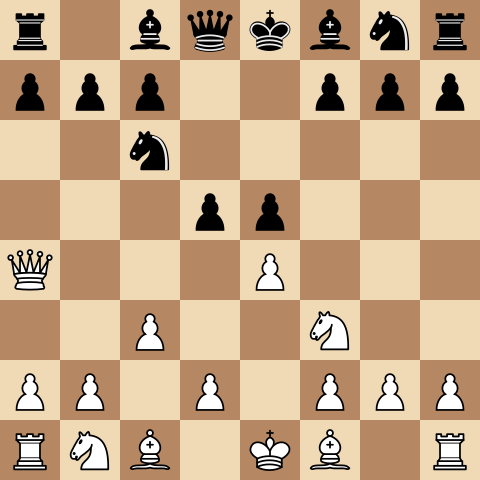
Rather than attacking the pawn directly, Black strikes back in the center immediately. White's response is 4.Qa4, a genuinely dual-purpose move: it pressures the center while also pinning the c6-knight to Black's king along the a4-e8 diagonal, a real pin, not just an inconvenience, since moving the knight would expose the king to check. Black has three real tries here: 4...f6 (the Steinitz Variation, defending e5 solidly while living with the pin), 4...Bd7 (the Caro Gambit, offering a pawn to free the pinned knight via a discovered attack), or the simple 4...dxe4, just taking the pawn on offer.
Strategic ideas in the Ponziani Opening
A handful of ideas repeat across both of Black's replies:
- The real main line (4...exd4) isn't the flashy one, and that's fine. It's tempting to think of the Ponziani purely in terms of its trap, but the most common position in the actual data is the calm 5.e5/6.cxd4 structure, a genuinely comfortable, space-gaining position that doesn't depend on Black walking into anything, and it's worth studying just as seriously as the sharper line.
- c3 exists for one specific reason: preparing a genuinely big d4 push. This isn't a generically "solid" move the way it might look, it's specifically setting up a larger central presence than White would get from 3.Bc4 or 3.Bb5.
- When Black grabs the e4 pawn, ignoring the recapture and pushing d5 instead is the correct, principled response. Chasing the knight immediately gives up the center; letting Black's pieces scatter first and cashing in on the resulting weaknesses is the real point of this whole line, even though it can feel counterintuitive to leave a pawn en prise for a move.
- The Bxf2+ trap only works if White knows the position cold. Kxf2 isn't available at all, so knowing that in advance, rather than working it out over the board, is what separates confidently navigating this trap from stumbling into a mistake under time pressure.
- Qa4's pin after 3...d5 is a genuine, real pin, not a loose threat. Black's knight on c6 physically cannot move without exposing the king to check, which is exactly why Black's three real replies all revolve around either living with the pin or breaking it deliberately, rather than simply ignoring it as a minor annoyance.
Who should play the Ponziani Opening?
The Ponziani Opening is a strong fit for players roughly 600 to 1500 rated, with a style best described as flexible and solid. If you're tired of facing opponents who have memorized deep Italian Game or Ruy Lopez theory against your 1.e4, the Ponziani offers a genuine way to sidestep that entirely. Most opponents simply won't have specific preparation against it, which shifts games toward genuine, over-the-board understanding rather than a memorization contest. That practical edge has real historical precedent too: even Magnus Carlsen has used the Ponziani for a tournament win, precisely as a surprise weapon against an opponent unlikely to be prepared for it.
It's also a strong match if you enjoy having one concrete, memorizable trap in your back pocket while still having a genuinely sound main line to fall back on. The Bxf2+ sequence is a real, verified tactical resource that shows up with genuine frequency whenever Black chooses the sharper 4...Nxe4 try, but even when Black plays the calmer, more common 4...exd4 instead, White still reaches a comfortable, space-gaining position, meaning there's no scenario where knowing this opening leaves you without a real plan.
It's a weaker fit if you specifically want the deepest, most thoroughly analyzed theoretical battle available after 1.e4 e5. The Ponziani's low profile is a deliberate trade-off, giving up some theoretical depth in exchange for practical unfamiliarity working in your favor.
Common mistakes in the Ponziani Opening
- Recapturing the e4 pawn immediately instead of pushing d5. This gives up the entire point of the line. Letting Black's pieces scatter with d5 first is what sets up the real advantage, not rushing to restore material equality.
- Playing Kxf2 after Black's Bxf2+ check. It's not on the table. The e4 knight rules it out entirely, and Ke2 is the only legal response.
- Treating the Qa4 pin as a minor inconvenience. It's a genuine, verified pin. The c6-knight cannot move without exposing Black's king to check, which meaningfully restricts Black's options and should shape White's follow-up plans.
- Assuming "low theory" means "low precision." The Ponziani's whole practical value in the Bxf2+ line comes from knowing one exact sequence cold. Treating the trap as something to improvise gives up the one piece of memorization that actually matters here.
- Overemphasizing the trap at the expense of the actual main line. Since 4...exd4 is the more common, more principled reply in real games, treating the Bxf2+ sequence as the "point" of the whole opening means being less prepared for what you'll actually face most often.
Frequently asked questions
Is the Ponziani Opening good for beginners?
It's a strong fit for players roughly 600 to 1500, offering genuine practical value from unfamiliarity. Most opponents at this level won't have specific preparation against it, unlike the well-studied Italian Game or Ruy Lopez. Even at the elite level it has real precedent as a surprise weapon, not just a beginner's curiosity.
What is the Ponziani Opening's main trap?
After 1.e4 e5 2.Nf3 Nc6 3.c3 Nf6 4.d4 Nxe4 5.d5 Bc5 6.dxc6 Bxf2+, White answers 7.Ke2, the only legal king move in the position. From there, 8.Qa4 or 8.Qd5 (depending on Black's reply) leaves White with a real, verified advantage.
Why is Kxf2 illegal in the Ponziani trap, not just a mistake?
Because Black's knight, already sitting on e4 from an earlier capture, directly covers the f2 square. A king can never legally move into check, so capturing the bishop with the king isn't an option to weigh against Ke2. It simply isn't available.
Does 3...d5 avoid the Ponziani's main tactics?
Yes, it's a completely different plan from the Jaenisch Counterattack, leading to a genuine pin on the c6-knight after 4.Qa4 rather than the Bxf2+ tactics. Both of Black's replies are fully covered in this repertoire with their own distinct, verified lines.
What is Black's most common reply to the Ponziani Opening?
In this repertoire's data, 3...Nf6 (the Jaenisch Counterattack) is the main try covered, and within that line, 4...exd4 is flagged as the most common and principled continuation, not the sharper 4...Nxe4 that leads to the well-known trap. Knowing the calm main line matters just as much as knowing the tactics, since it's what you'll actually face most often in real games.
How should White meet 3...d5, the principled central counter?
With 4.Qa4, a genuinely dual-purpose move. It pressures the center while pinning the c6-knight to Black's king along the a4-e8 diagonal, a real pin confirmed by the fact that moving the knight would expose the king to check, not just an inconvenient placement.
Related openings
- Italian Game — White's more heavily-analyzed answer to 1...e5 -- a good comparison point for how the Ponziani's low-theory, surprise-value approach differs from the mainstream main line.
- Alapin Variation — The same philosophy -- a low-theory, principled system -- applied to the Sicilian Defense instead of 1...e5.
Practice every real line against master-game replies, with a plain-English explanation on every move.
Practice Ponziani Opening free →