The Italian Game, Explained for Beginners
The Italian Game begins 1.e4 e5 2.Nf3 Nc6 3.Bc4, developing the bishop to its most natural attacking square and aiming straight at f7, Black's weakest point. It's one of the oldest openings in chess still played at every level today. When Black mirrors White's bishop with 3...Bc5, the position becomes the Giuoco Piano ("the quiet game" in Italian). The specific repertoire covered on this page takes that one step further: White meets it with the calm 4.c3 and 5.d3 plan, known more precisely as the Giuoco Pianissimo ("the very quiet game"), widely considered one of the best starting points for a new player learning to attack as White.
Quick facts
| Moves | 1.e4 e5 2.Nf3 Nc6 3.Bc4 |
| Also known as | Giuoco Piano, specifically the Giuoco Pianissimo (4.c3 and 5.d3) |
| Played as | White |
| Best for | Roughly 400–1400 rated players |
| Style | Positional, classical, flexible |
| Games analyzed | 57,001 real master games |
| Lines covered here | 28 |
What is the Italian Game?
The Italian Game is one of the oldest documented openings in chess, with recorded analysis going back to 16th-century Italian players, hence the name. Its whole idea is direct and easy to understand even for a total beginner: the bishop on c4 points straight at f7, the single most fragile square in Black's starting position, since it's defended only by the king. Nothing else in the opening move-order defends a weaker square this early.
The line covered here follows the classical, patient approach: rather than rushing d4 immediately, White plays c3 and d3 first, building a stable central structure before deciding whether to expand later. This is the more modern, positionally sound way to handle the Italian. It avoids some of the sharpest, most memorization-heavy tactical complications of older 4.d4-style lines, while keeping the bishop's attacking idea fully intact. You get real strategic potential without needing to memorize twenty moves of forced tactics to survive it.
This classical approach has also seen a genuine resurgence at the top level in the last decade. Strong grandmasters, including world-class players, have returned to it as a serious weapon, not just a beginner's tool. It's low-theory relative to many other 1.e4 openings, but that doesn't mean it's shallow; it means the ideas matter more than the memorization. The opening's roots run deep too. It was already being analyzed by Italian players in the 16th century, and it reached its first great peak of popularity in the 19th century in the hands of players like Paul Morphy, widely regarded as the strongest player of his era.
How to play the Italian Game: move by move
Every line below starts the same way: 1.e4 e5 2.Nf3 Nc6 3.Bc4 Bc5 4.c3 Nf6 5.d3. Get the bishop to its best square, support the center with c3, add a second central pawn with d3, and only then decide the rest based on what Black does. From here, Black has three main plans in the real-game data, and each one leads somewhere genuinely different.
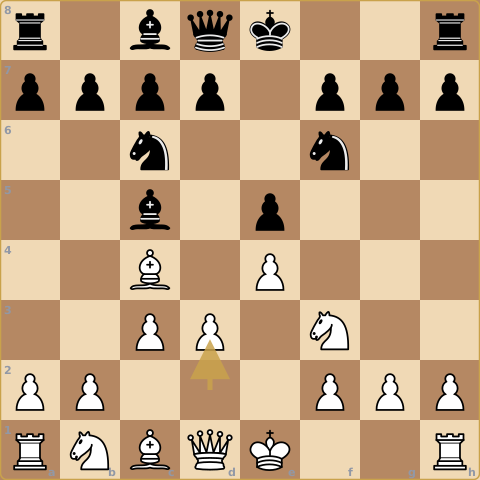
Plan 1: The immediate center, 5...d6
The single most common continuation in the entire dataset. Black solidifies the center immediately rather than deciding on king safety first. White's response is close to automatic from here: castle (6.O-O), and then a long sequence of small, precise preventive moves, Re1 (extra support for e4), h3 (ruling out any future ...Bg4 or ...Ng4 pin ideas before they can happen), and Nbd2 (simple development, often rerouting later to f1-g3). Black typically mirrors these ideas move for move, ...O-O, ...h6, ...a6 or ...a5, and the resulting position is one of the deepest, most heavily tested structures in the whole repertoire: both sides fully developed, every preventive move played, and a position that's been reached in real games again and again. One line runs a full 11 moves deep into this exact mirrored structure, ending with White beginning to expand on the queenside with b4 once everything else is finished.
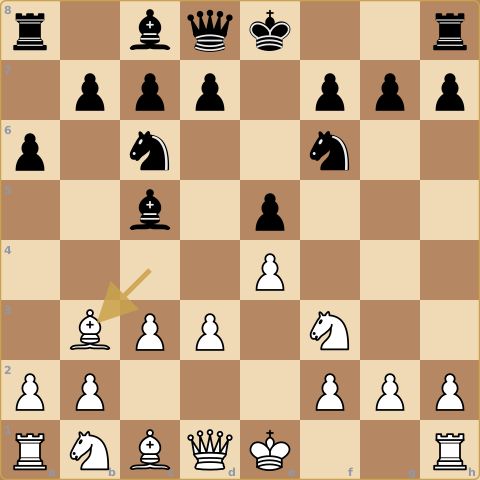
Plan 2: The flexible wait, 5...a6
Instead of committing the center immediately, Black rules out any future Nb5 or Bb5 tricks and keeps the position flexible. White's most natural response here is 6.Bb3, tucking the bishop safely away from any future ...Na5 ideas of its own, followed by the same core development plan (Nbd2, and eventually O-O). This transposes into very similar structures to Plan 1, just reached in a different move order. It's a good example of how, in this classical approach, White's actual plan barely changes regardless of Black's move order, which is part of why this opening is so approachable to learn.
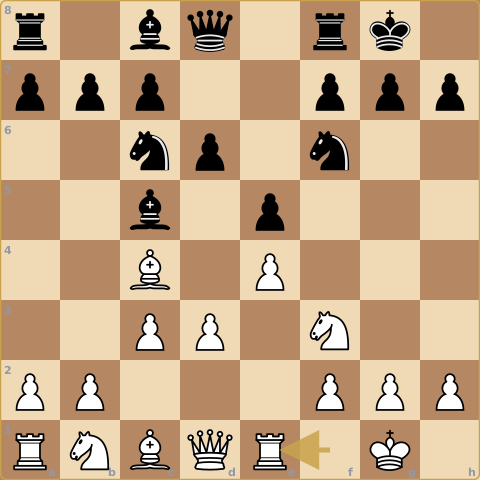
Plan 3: Castle first, 5...O-O, the real tactical branch
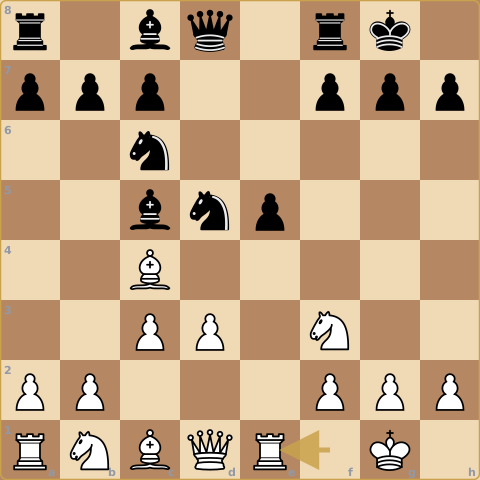
This is where the sharpest, most instructive line in the whole repertoire lives. Black castles immediately rather than settling the center first. White follows with 6.O-O, and now Black has a genuinely ambitious try: 6...d5, striking the center directly. After 7.exd5 Nxd5, Black's knight recaptures in the center, and White plays 8.Re1, pressuring the newly-exposed e-file. Here Black faces a real decision:
- 8...Bg4 pins White's knight on f3 against the queen, the sharpest, most tactically alive continuation in the entire repertoire.
- 8...Nb6 is an active counter-attack, not a passive retreat: the knight lands on b6 and directly attacks White's bishop on c4. White answers with 9.Bb5, repositioning the bishop to safety while keeping it active rather than trading it off or leaving it exposed.
Both are fully covered, engine-verified lines. This branch is where the repertoire's real tactical edge lives, even though the opening's overall character is patient and positional. When Black plays actively here, real tactical fireworks are only a few moves away, and this repertoire doesn't shy away from them.
Strategic ideas in the Italian Game
A handful of ideas repeat across almost every line in this repertoire, regardless of which of the three plans Black chooses:
- The bishop on c4 is the whole point. Every White idea in this opening either directly supports that bishop's pressure on f7, or clears the way for other pieces to join the attack later. Nothing here develops a piece just for the sake of development.
- c3 and d3 build a real center without overextending. Unlike sharper 4.d4 tries, this structure never gives Black an easy tactical shot at winning the bishop pair or seizing the center outright. It earns space patiently instead.
- h3 is small but essential. It's not a "wasted tempo", it specifically rules out the ...Bg4/...Ng4 pin ideas that show up constantly in Italian Game structures, before Black ever gets the chance to play them.
- Re1 supports e4 before anything else happens. In several lines, this single quiet move is what turns a potentially loose central pawn into a fully secure one, freeing White up to focus on the kingside or queenside next.
- When Black strikes with ...d5, recapturing correctly matters. The genuine tactical branch (Plan 3 above) only works because White meets ...d5 with the precise exd5/Re1 sequence, deviating from it gives up the whole point of the line.
- Move order flexibility is a real feature, not an accident. Plans 1 and 2 above transpose into very similar final structures despite starting differently, meaning you don't need to memorize a separate response for every possible Black move order, just the underlying ideas.
This classical approach has genuinely proven itself at the very highest level, not just among club players. It's appeared in World Championship match play twice in the last decade. Carlsen played it as White against Sergey Karjakin in Game 5 of their 2016 World Championship match, and it resurfaced again in the 2021 World Championship, where Ian Nepomniachtchi tried it against Carlsen in a critical Game 11. Real, continued proof that "beginner-friendly" and "seriously played at the top level" aren't opposites here.
Who should play the Italian Game?
The Italian Game is one of the most commonly recommended chess openings for beginners learning to play 1.e4 as White, and the data backs this up directly. It's rated a strong fit for players roughly 400 to 1400, with a style best described as positional, classical, and flexible. If you want real attacking chances as White without needing to memorize twenty moves of forced theory just to survive the opening, this is about as good a starting point as exists in the entire game.
It's also a good match if you're the kind of player who wants to *understand* an attack rather than just memorize one. Every idea here (the bishop's target, the preventive h3, the central tension) has a clear, learnable reason behind it, which is exactly what separates genuinely useful opening study from rote memorization.
It's also worth considering if you're coming from a different 1.e4 opening and finding it too theory-heavy to keep up with. Compared to something like the Ruy Lopez, which can require memorizing responses to a dozen different Black setups many moves deep, the Italian Game's classical approach genuinely does transpose and simplify the way described above: fewer totally distinct structures to actually hold in your head, even though the total line count looks similar on paper.
It's a weaker fit if you specifically want the sharpest, most forcing tactics from move one in every single line, with no quiet positional moments at all. The classical approach covered here is patient and strategic by design, with real tactical teeth only once Black invites them. The tactical branch under Plan 3 delivers genuine fireworks when it comes up, but not every line does.
If the slow buildup isn't to your taste, two openings from the same starting position go about it differently. The Scotch Game challenges the center immediately with 3.d4 instead of developing the bishop first, and the Vienna Game defends e4 with a knight on c3, keeping a later f4 push in reserve. If your problem is opponents who have memorized theory against you, the Ponziani Opening sidesteps it almost entirely, since very few players study it.
Common mistakes in the Italian Game
- Playing d4 too early, before c3 and d3 are in place. This is the classical approach's whole structural point. Rushing the center before it's properly supported gives up the stability that makes this version of the Italian Game sound at a beginner-friendly level.
- Skipping h3 because it "doesn't do anything." It looks like a slow move, but it's specifically there to prevent the ...Bg4/...Ng4 pin tricks that recur throughout this repertoire, skipping it invites exactly the problem it exists to solve.
- Meeting ...d5 incorrectly. The tactical branch under Plan 3 only works with the precise exd5, then Re1 sequence. Recapturing differently, or delaying Re1, gives away the point of the whole line and lets Black equalize comfortably.
- Retreating passively when Black pins with ...Bg4. This is meant to be a real, sharp moment. Treat it as an actual tactical decision (matching this repertoire's verified continuation), not a reason to panic and simplify the position away.
Frequently asked questions
Is the Italian Game good for beginners?
Yes, it's one of the most frequently recommended openings for new players, because the bishop's target (f7) is easy to understand, the classical c3/d3 setup is sound and low-risk, and it doesn't require memorizing deep forced theory to play well.
What's the main line of the Italian Game?
1.e4 e5 2.Nf3 Nc6 3.Bc4 Bc5 4.c3 Nf6 5.d3. This is the classical, patient Giuoco Pianissimo approach covered in this guide, as opposed to sharper 4.d4 tries.
Is the Italian Game still played at a high level?
Yes. The classical, patient approach covered here has seen a genuine resurgence among strong grandmasters in the last decade, not just as a surprise weapon but as serious, well-respected preparation.
Does the Italian Game have real tactical chances, or is it just a quiet developing opening?
Both, depending on how Black responds. Most lines are patient and positional, but if Black castles and strikes with an early ...d5, the position opens into a genuinely sharp tactical fight, covered in full, engine-verified detail in this repertoire.
What if I want to develop the bishop before the knight instead?
That's the Bishop's Opening (1.e4 e5 2.Bc4), which frequently transposes directly into these same Italian Game structures, just reached in a different move order, with the added practical benefit of sidestepping the Petroff Defense entirely.
What's the difference between the Italian Game, the Giuoco Piano, and the Giuoco Pianissimo?
The Italian Game is the broadest term, the whole family of openings starting with 1.e4 e5 2.Nf3 Nc6 3.Bc4. The Giuoco Piano narrows that down to the specific line where Black mirrors with 3...Bc5, and it covers a range of White approaches from there, including sharper 4.d4 tries and the Evans Gambit (4.b4). The Giuoco Pianissimo narrows it down further still: it's specifically the calm 4.c3 followed by 5.d3 plan, avoiding an immediate central strike in favor of patient development. That's the exact repertoire covered on this page.
Related openings
- London System — A calmer, lower-theory alternative for White if you'd rather play a repeatable system than fight directly for the center after 1...e5.
- Alapin Variation — White's answer to the Sicilian Defense, for when 1...e5 isn't what you're facing, completes the picture for meeting Black's most common replies to 1.e4.
Practice every real line against master-game replies, with a plain-English explanation on every move.
Practice Italian Game free →