The Vienna Game, Explained for Beginners
The Vienna Game arises after 1.e4 e5 2.Nc3. It's one of the most flexible ways for White to meet 1...e5. Rather than developing the king's knight immediately with 2.Nf3, White defends the e4 pawn with a piece, keeping the option of a sharp f4 pawn storm in reserve for later. This guide covers a complete White repertoire, built from 25,739 real, individually validated games, answering all of Black's genuinely major replies.
Quick facts
| Moves | 1.e4 e5 2.Nc3 |
| Played as | White |
| Best for | Roughly 800–1800 rated players |
| Style | Aggressive, flexible |
| Games analyzed | 25,739 real, individually validated games |
| Lines covered here | 26 |
What is the Vienna Game?
After 1.e4 e5, most White repertoires continue with 2.Nf3, developing toward the center directly. The Vienna Game does something more flexible: 2.Nc3 defends the e4 pawn with a piece instead, keeping the option of a later f4 pawn storm without committing to it immediately. This flexibility is the whole point. White can steer toward a sharp gambit, a quiet developing setup, or an aggressive early queen sortie, all depending on how Black responds.
The opening takes its name from Vienna, Austria, and became genuinely popular through the 19th century, when the city hosted some of the era's most important international tournaments. It remains a real, respected way to meet 1...e5 without committing to the heaviest Ruy Lopez or Italian Game theory.
How to play the Vienna Game: move by move
Every line below starts 1.e4 e5 2.Nc3. From here, Black has several genuinely major replies in the real-game data, and this repertoire answers each with real, tested continuations.
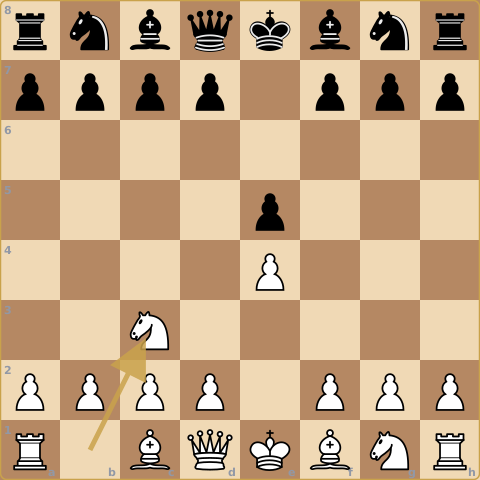
The Vienna Gambit: 2...Nf6
Black develops naturally, attacking the e4 pawn. White meets this with the opening's sharpest try: 3.f4!, striking at the center and offering a pawn for rapid development rather than simply defending passively.
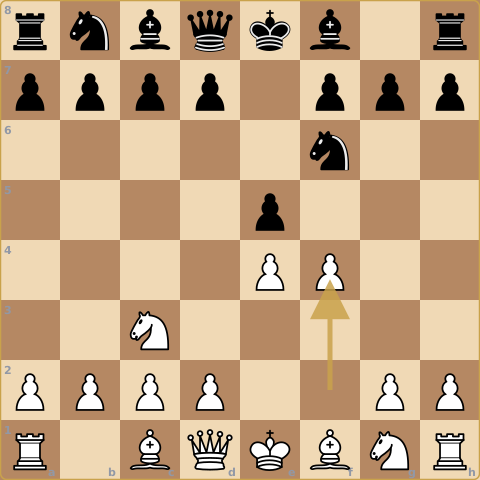
Taking the pawn here is a real trap, not a safe way to punish White for offering it. After 3...exf4?, White strikes with 4.e5!, hitting the knight on f6. Black's most natural retreats run straight into trouble: both 4...Nd5 and 4...Ne4 hang the knight to Nc3, so after 4...Qe7 5.Qe2, the knight has to fall all the way back to g8, leaving White with a winning central initiative and a huge lead in development for the pawn. Black's actual best reply is the counter-strike 3...d5!, hitting back in the center immediately: 4.fxe5 Nxe4 keeps the position genuinely balanced, trading blows rather than grabbing a pawn that isn't really free.
The quiet main line: 2...Nc6
Black develops naturally, supporting the center rather than challenging e4 directly. White continues 3.Bc4, developing actively toward the kingside and keeping the position flexible about whether to follow up with f4 or a quieter setup.
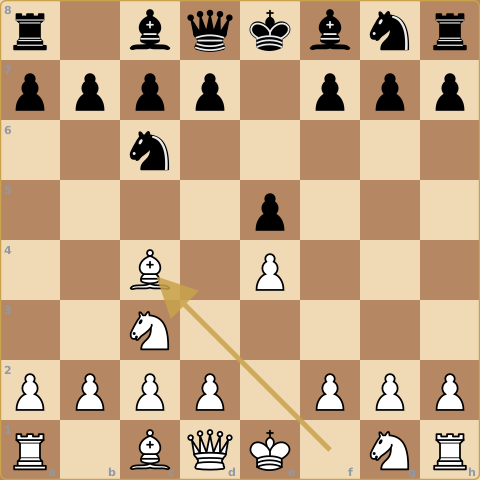
The sharp Qg4 line: 2...Nc6 3.Bc4 Bc5
Black develops the knight naturally, and after 3.Bc4, White mirrors the setup. When Black continues with 3...Bc5, developing actively toward the kingside, White has a genuinely sharp resource available: 4.Qg4!, an aggressive try that attacks g7 and offers the f2 pawn in return.
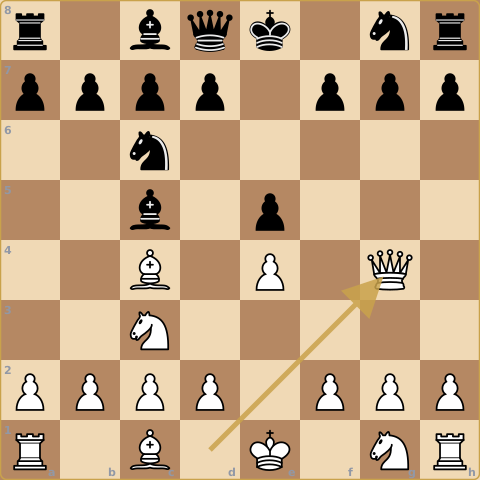
Trying to defend g7 with 4...Qf6? walks straight into a real trap. White has 5.Nd5!, and after 5...Qxf2+ 6.Kd1 Kf8 7.Nh3, Black's queen finds itself with nowhere safe to go: 7...Qd4 8.d3 traps it for good, and White still has the standing threat of a lethal fork on c7 to boot. This is exactly why the correct response to 4.Qg4 is one of the repertoire's tested defenses rather than the tempting-looking Qf6.
Strategic ideas in the Vienna Game
A handful of ideas repeat across this entire repertoire:
- 2.Nc3 is about flexibility, not just defending a pawn. Defending e4 with a piece rather than developing toward it directly keeps multiple plans available, a sharp f4 gambit, a quiet setup, or an aggressive early queen sortie, depending on how Black responds.
- The Vienna Gambit (3.f4) is a real, principled pawn sacrifice, not a reckless throw. Offering the pawn for rapid development and open lines is a genuine, well-tested trade-off, not a mistake to be avoided.
- Taking the pawn in the Vienna Gambit is a real trap, not free material. 3...exf4? runs straight into 4.e5!, kicking Black's knight all the way back to g8 and handing White a winning central initiative. The correct, tested reply is the counter-strike 3...d5! instead.
- Qg4 against the Bc5 line is a real threat, not just an aggressive-looking move. The queen genuinely attacks g7 from that square, which is exactly what makes the whole idea work, and 4...Qf6? trying to defend it walks straight into a genuine trap.
- Black's specific second move meaningfully changes White's plan. Nf6, Nc6, and Bc5 each get a different, real response, recognizing which one is on the board matters more than having one fixed reaction to all of Black's tries.
- This opening rewards comfort with flexible, non-forcing setups. Unlike some sharper 1.e4 systems, the Vienna Game's real strength is keeping options open rather than committing to one fixed plan from the first move.
Who should play the Vienna Game?
The Vienna Game is a strong fit for players roughly 800 to 1800 rated, with a style best described as aggressive and flexible. If you want a genuine alternative to 2.Nf3 that keeps real options open, a sharp gambit, a quiet developing game, or an aggressive early queen try, the Vienna Game offers real, well-tested flexibility without demanding the deepest Ruy Lopez or Italian Game theory.
It's also a strong match if you enjoy having a genuine surprise weapon in your back pocket, many Black players are less prepared for 2.Nc3 than for the more common 2.Nf3, which can shift games toward genuine, over-the-board understanding rather than deep memorized preparation.
It's a weaker fit if you specifically want the single most thoroughly analyzed way to meet 1...e5, the Vienna Game's appeal is flexibility and practical value, not the depth of theory found in the Ruy Lopez.
Common mistakes in the Vienna Game
- Avoiding the Vienna Gambit's pawn sacrifice out of caution. 3.f4 is a real, principled try, the resulting development and open lines are genuine compensation, not something to shy away from out of general pawn-grabbing instincts.
- Grabbing the pawn in the Vienna Gambit with 3...exf4?. It looks like free material but runs into 4.e5!, kicking the knight all the way back to g8 and giving White a winning initiative. 3...d5! is the correct counter-strike instead.
- Treating all of Black's replies as requiring the same response. Nf6, Nc6, and Bc5 are genuinely different tries, knowing which one is actually on the board matters more than having one fixed plan for all of them.
- Underestimating Qg4's real threat against the Bc5 line. It's not just an aggressive-looking move, the queen genuinely attacks g7, which is exactly why this try demands a precise response from Black rather than the tempting 4...Qf6?.
- Assuming 2.Nc3 is just a slower version of 2.Nf3. The whole point of the Vienna Game is the flexibility it keeps in reserve, playing it as though it were simply a delayed Italian Game or Ruy Lopez misses what makes the opening distinctive.
Frequently asked questions
Is the Vienna Game good for beginners?
It's a strong fit for players roughly 800 to 1800. Its appeal is genuine flexibility and practical surprise value rather than sharp forced tactics, making it approachable without demanding the deepest theoretical preparation.
Why is it called the Vienna Game?
It takes its name from Vienna, Austria, and became genuinely popular through the 19th century, when the city hosted some of the era's most significant international chess tournaments.
What is the Vienna Gambit?
It's White's sharpest try against 2...Nf6, 3.f4, striking at the center and offering a pawn in exchange for rapid development and open lines. It's a real, principled sacrifice rather than a reckless material giveaway. Taking it with 3...exf4? is actually a trap, running into 4.e5! and a winning initiative for White, while the correct reply is the counter-strike 3...d5! instead.
Why play 2.Nc3 instead of 2.Nf3?
2.Nc3 defends e4 with a piece while keeping the f-pawn completely unblocked, which is exactly what makes a later f4 pawn storm possible. 2.Nf3 develops toward the center too, but it commits White toward the well-mapped theory of the Ruy Lopez or Italian Game. 2.Nc3 sidesteps that depth entirely and keeps White's plans flexible for longer.
What if I want to play f4 immediately, on move two?
That's the King's Gambit (1.e4 e5 2.f4), the sharper, more forcing relative of this same underlying idea, real material for immediate, direct attacking chances rather than the Vienna's more flexible, delayed approach.
How does the Vienna Game compare to the Ruy Lopez or Italian Game?
It's a genuinely different, more flexible approach. Rather than developing the king's knight immediately and committing to well-mapped theory, 2.Nc3 keeps multiple plans in reserve. It's a real alternative for players who want practical, flexible chances rather than the deepest possible theoretical battle.
Practice every real line against master-game replies, with a plain-English explanation on every move.
Practice Vienna Game free →