The King's Gambit: A Complete Guide
The King's Gambit arises after 1.e4 e5 2.f4, one of the oldest, most fought-over openings in the history of chess. White offers a pawn immediately, opening the f-file and striking straight at Black's center and kingside. This guide covers a complete repertoire built from 16,167 real, individually validated games, every line replayed and checked move by move against the actual game record.
Quick facts
| Moves | 1.e4 e5 2.f4 |
| Played as | White |
| Best for | Players already comfortable with sharp calculation and real material imbalance, not a first opening |
| Style | Sharp, aggressive, deeply theoretical |
| Games analyzed | 16,167 real, individually validated games |
| Lines covered here | 21 |
What is the King's Gambit?
After 1.e4 e5, most systems build up slowly. The King's Gambit does the opposite: 2.f4 offers a real pawn immediately, opening the f-file for the rook and aiming to gain rapid development and a direct attack in exchange. It's one of the oldest gambits in chess, and its most famous modern chapter belongs to Bobby Fischer, who declared it "busted" in a legendary 1961 article after a painful personal loss.
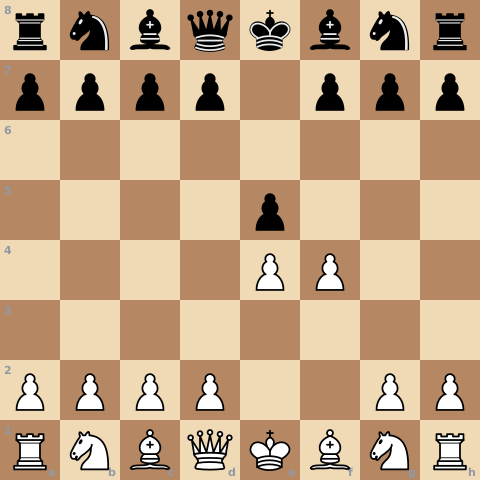
In our validated data, Black's replies split as 2...exf4, accepting the gambit (53%), 2...d5, the Falkbeer Countergambit (22%), 2...Bc5 (12%), and 2...d6 (5%), all covered here.
How to play the King's Gambit: move by move
The King's Gambit Accepted: the Kieseritzky Gambit
After 2...exf4 3.Nf3, Black's classical, sharpest reply is 3...g5, holding the extra pawn. White strikes back with 4.h4 g4, and now comes one of the most famous single moves in all of chess opening theory: 5.Ne5, the Kieseritzky Gambit, leaping the knight forward rather than retreating passively.
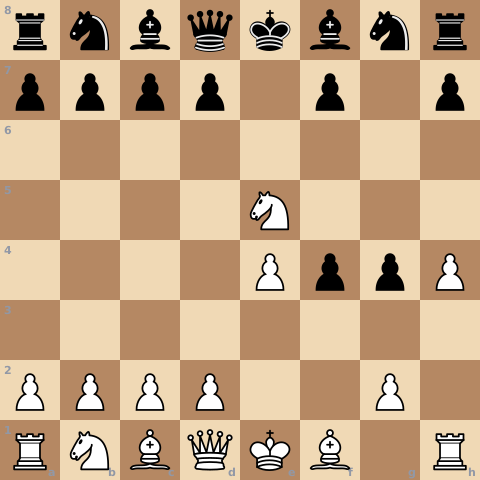
From here, real, deeply analyzed theory continues for many moves on both sides, this repertoire covers Black's main tries, 5...Nf6, 5...d6, and 5...h5, in full depth.
Fischer's Defense: 3...d6
Rather than hold the pawn with 3...g5, Black can play 3...d6, a real, historically significant move Bobby Fischer specifically recommended in his famous 1961 article "A Bust to the King's Gambit." White continues 4.d4 g5 5.h4 g4 6.Ng1, retreating the knight rather than the sharper Kieseritzky leap, this exact position is what Fischer's own analysis was built around.
The Falkbeer Countergambit: 2...d5
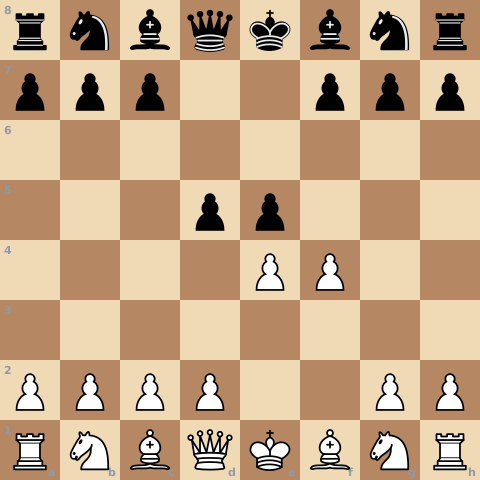
Instead of accepting the pawn, Black can strike back immediately with 2...d5. After 3.exd5, the real point of the whole countergambit is 3...e4, pushing forward rather than simply recapturing, prioritizing development and space over material.
Strategic ideas in the King's Gambit
- The open f-file and rapid development are the whole point. Every pawn given up buys real time and real attacking chances, playing passively afterward defeats the purpose of the gambit entirely.
- Know Fischer's Defense specifically. 3...d6 is the exact move modern computer analysis has confirmed as Black's strongest reply, worth understanding well from both sides.
- The Kieseritzky Gambit rewards real calculation. This is one of the most deeply analyzed sequences in chess history, real preparation matters more here than almost anywhere else.
- The Falkbeer Countergambit is a real, respected alternative, not a trick. Black's own gambit, prioritizing development and central space over material, is completely sound.
- This opening rewards understanding over memorization alone. Real tactics decide many of these lines, knowing why the moves work matters as much as knowing the moves themselves.
Who should play the King's Gambit?
The King's Gambit is a strong fit for players who want a genuinely sharp, attacking weapon and are already comfortable calculating real complications rather than following a memorized safe plan. It rewards a player who enjoys direct attacking chances and doesn't mind a real, ongoing material question.
It's a weaker fit if you're newer to chess or specifically looking to avoid complications. Modern analysis broadly supports Bobby Fischer's famous claim that accurate defense gives Black a real, lasting edge, this doesn't make the opening unplayable, but it does mean the resulting positions demand real calculation rather than a memorized plan.
Common mistakes in the King's Gambit
- Playing White and settling into a slow, passive game after the gambit. The whole point is rapid development and a direct attack, trading that away defeats the purpose of choosing this opening.
- Playing Black and grabbing every available pawn without regard for development. The King's Gambit's real compensation comes from Black falling behind while chasing material.
- Assuming this opening can be played on autopilot. Real tactics decide many of these lines, understanding the concrete ideas matters more here than in a quieter opening.
- Dismissing the opening as simply refuted and not worth learning. Modern engines support Fischer's core claim with best play, but that's very different from the opening being unplayable in practice.
Frequently asked questions
Is the King's Gambit good for beginners?
It's better suited to players already comfortable calculating sharp, forcing lines and accepting real material imbalance, rather than as a first opening. Something calmer is a gentler starting point.
Is the King's Gambit actually busted, like Fischer claimed?
Modern computer analysis broadly supports Fischer's core claim, that 3...d6 gives Black a real, lasting edge with best play. That's a genuine, verified result, but it's different from the opening being unplayable in practice, plenty of strong players have had real success with it below engine-level precision.
What's the most famous line in the King's Gambit?
The Kieseritzky Gambit, arising after 3...g5 4.h4 g4 5.Ne5, is one of the most deeply analyzed individual sequences in the whole history of chess opening theory.
How should Black meet the King's Gambit?
3...d6, Fischer's Defense, is the most well-tested, computer-verified strongest reply after accepting the gambit. The sharper 3...g5 lines and the Falkbeer Countergambit (2...d5) are also real, well-respected alternatives.
Where does the name "King's Gambit" come from?
It's named for the king's-side pawn used to open the attack, mirroring how the Queen's Gambit is named for its own queenside pawn sacrifice. It's one of the oldest openings ever analyzed in the history of chess.
Related openings
- Vienna Game — Another aggressive way to meet 1...e5 that shares the King's Gambit's willingness to keep the f-pawn active for a kingside attack.
- Danish Gambit — Another real pawn sacrifice for rapid development and attacking chances, worth comparing directly if you like this style.
- Bishop's Opening — A quieter cousin sharing the same affinity for keeping the f-pawn free, worth knowing as a calmer alternative with similar underlying ideas.
Practice every real line against master-game replies, with a plain-English explanation on every move.
Practice King's Gambit free →