The Queen's Gambit Accepted, Explained
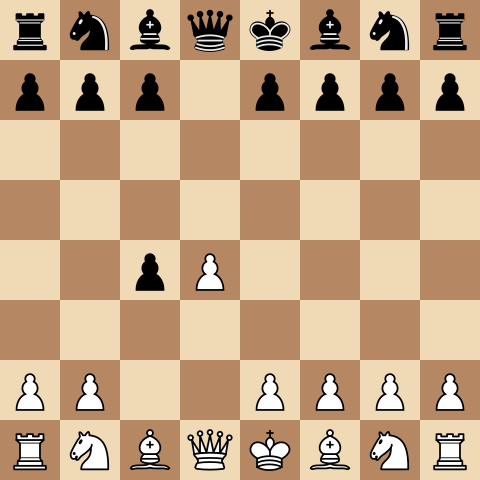
The Queen's Gambit Accepted arises after 1.d4 d5 2.c4 dxc4, and it's Black's most direct answer to the Queen's Gambit: simply take the pawn White offers. This guide covers a complete Black repertoire, built from 36,490 real games across four combined datasets, handling both the classical main line and White's sharpest try, 3.e4, with the opening's real historical pedigree checked carefully rather than assumed.
Quick facts
| Moves | 1.d4 d5 2.c4 dxc4 |
| Played as | Black |
| Best for | Roughly 900–1800 rated players, including improving club and tournament players |
| Style | Flexible, positional, with a genuinely sharp option available too for those who prefer it |
| Games analyzed | 36,490 real games, every leaf line backed by 100+ real examples across four separately-built and combined real datasets |
| Lines covered here | 29 (across the classical main line and White's sharp 3.e4 gambit try) |
What is the Queen's Gambit Accepted?
When White offers the c4 pawn with the Queen's Gambit, Black has a real choice: decline it and hold the center (the Queen's Gambit Declined or the Slav), or simply take it. The Queen's Gambit Accepted takes the direct route, 2...dxc4, "Black simply takes the offered pawn." The point isn't to hold onto the extra material; it's a temporary gain that Black trades back at the right moment for real, active piece play, open lines, and a genuinely comfortable position rather than a cramped one. This trade-off is worth understanding precisely: Black isn't gambling on holding an extra pawn against a stronger opponent's technique, and isn't accepting a passive, cramped structure either, the whole point is a fair, well-tested exchange of temporary material for lasting activity.
This isn't a minor or risky sideline. It's the third most popular response to the Queen's Gambit at every level of chess, and it carries genuine elite pedigree: world champions Max Euwe, Vasily Smyslov, and Tigran Petrosian all included it in their own repertoires, and Petrosian specifically used it against Mikhail Botvinnik in their 1963 World Championship match, all seven games featuring the QGA in that match ended in draws, a real, documented sign of just how soundly it holds up under the highest possible pressure, not simply a claim repeated without checking. Vladimir Kramnik became one of its most notable modern practitioners as well, carrying that same tradition of soundness into the modern era of chess.
How to play the Queen's Gambit Accepted: move by move
Every line below starts 1.d4 d5 2.c4 dxc4. From here, White has two genuinely distinct main plans in the data, and this repertoire answers both with real, tested continuations rather than a generic reaction to whichever one shows up.
The classical main line: 3.Nf3 Nf6 4.e3
"The most popular way to meet the Accepted", White develops naturally and prepares to recapture the pawn without rushing into anything premature. Black responds with 3...Nf6, "by far the most common and flexible response," and after 4.e3 e6 5.Bxc4, White completes "the classical Queen's Gambit Accepted plan," regaining the pawn while Black finishes development undisturbed. This is the heart of the whole opening: Black willingly gives the pawn back in exchange for smooth, natural piece play, rather than fighting to hold onto material that would only slow development down.
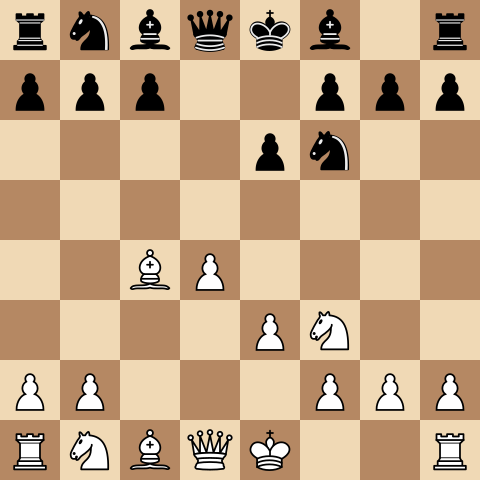
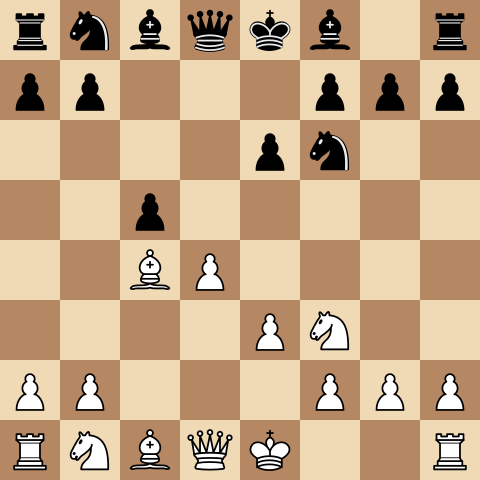
From here, Black's characteristic counter-strike is 5...c5, hitting White's center immediately rather than settling into a passive setup. White has three genuinely common responses, each covered here with its own real continuation: 6.O-O, simply castling into safety; 6.Qe2, the Furman Variation, developing the queen actively to support the center while specifically avoiding an early queen trade; or 6.Nc3, a flexible alternative to the queen move that keeps options open for a move longer.
White's sharp try: 3.e4
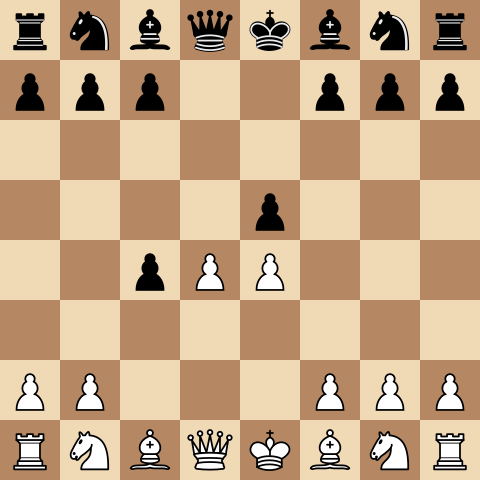
Rather than the patient classical approach, White can grab the center immediately, "the most ambitious and aggressive response to the Accepted." Black meets this head-on with 3...e5, striking back in the center immediately "rather than just developing passively." White has two real continuations here: 4.Nf3, developing while directly attacking Black's newly-advanced pawn, or 4.d5, pushing forward instead of trading, gaining space and specifically avoiding a queen trade that would otherwise simplify the position. Both lead to genuinely sharp, real theory that this repertoire covers in full rather than leaving Black to work out over the board for the first time in an actual game, which matters given how quickly this particular line can go wrong for an unprepared player.
Strategic ideas in the Queen's Gambit Accepted
A handful of ideas repeat across this entire repertoire, and recognizing them explicitly is worth more than treating each of the 29 lines here as a separate thing to memorize on its own:
- The extra pawn was never the point, active piece play is. Understanding this early prevents the single most common mistake in the whole opening: trying to cling to material that was only ever meant to be temporary, at the cost of the very activity that makes the opening work in the first place.
- ...c5 is Black's characteristic counter-strike in the classical main line. Rather than passively completing development, Black immediately challenges White's center back, keeping the position active rather than letting White dictate the pace entirely for the rest of the game.
- 3.e4 demands a direct response, not a cautious one. Meeting White's most aggressive try with the equally direct 3...e5 keeps the position balanced, playing too passively here can hand White exactly the kind of unchallenged center this line is designed to build in the first place.
- This opening has real elite pedigree, not just theoretical soundness. Multiple world champions have played it at the very highest level, including in a genuine World Championship match, that's a meaningfully different kind of endorsement than an opening merely being "considered fine" by analysts who never had to defend it under real tournament pressure.
Who should play the Queen's Gambit Accepted?
The Queen's Gambit Accepted is a strong fit for players roughly 900 to 1800 rated, with a style best described as flexible and positional. If you want an active, principled way to meet 1.d4 that avoids the sometimes-cramped structures of the Queen's Gambit Declined, and doesn't require memorizing the deep move-order subtleties of the Slav, the QGA offers genuine, well-tested activity in exchange for briefly giving up a pawn. That trade-off tends to suit players who'd rather fight for active piece play than settle for a solid but passive structure, and it rewards understanding a few clear principles more than raw memorization.
It's also a strong match if you're drawn to openings with real, documented elite history, this isn't a rarely-tested surprise weapon, it's been part of world championship-level preparation across multiple eras of chess, from the mid-20th century through to the present day, with real games to study rather than just abstract theoretical assessments.
It's a weaker fit if you're specifically uncomfortable giving up material even temporarily, even when the position fully justifies it, some players simply prefer defenses that never require handing back an extra pawn, regardless of how sound the underlying compensation is. That's a legitimate preference, not a wrong one, chess offers plenty of other well-tested ways to meet 1.d4 that keep the material balance untouched from the very first move.
Common mistakes in the Queen's Gambit Accepted
- Trying to hold onto the extra pawn for too long. This is the single most common mistake in the whole opening, the pawn was only ever meant to be temporary, and clinging to it usually means falling behind in development instead, giving up exactly the advantage this opening is built around.
- Playing passively against 3.e4 instead of striking back with 3...e5. White's most aggressive try demands a direct response, meeting it too cautiously can hand White exactly the kind of central space this line is built to seize, with no real compensation in return.
- Delaying ...c5 in the classical main line. This counter-strike is what keeps the position active rather than letting White's development go entirely unchallenged, waiting too long to play it gives up real tempo that's hard to earn back later, especially once White has finished castling and consolidated the extra central space.
- Treating the Furman Variation (6.Qe2) as just another quiet option. It's a specific, deliberate choice to avoid an early queen trade, recognizing it for what it is helps in choosing the right plan afterward, rather than reacting as if it were a generic developing move with no particular purpose.
- Assuming both of White's main plans (classical and 3.e4) require the same response. They lead to genuinely different kinds of positions, and treating them interchangeably means being unprepared for whichever one actually shows up in a real game, since the correct plan for one can be a real mistake against the other, costing real tempo or worse.
Frequently asked questions
Is the Queen's Gambit Accepted good for beginners?
It's a strong fit slightly above absolute-beginner level, rated well for roughly 900 to 1800. Its appeal is a clear, principled trade-off (give back the pawn, get active piece play) rather than deep forced memorization, and it's been proven sound at every level, including world championship play, which is a meaningful reassurance for newer players wondering if it's actually safe to rely on long-term.
Do you have to give the pawn back in the Queen's Gambit Accepted?
Not immediately, but trying to hold it for too long is the single most common mistake in the opening. The pawn was only ever a temporary gain, giving it back at the right moment in exchange for active development is the actual point of the whole opening, not a fallback plan for when holding onto it stops working, and recognizing that early changes how the whole opening feels to play.
Has the Queen's Gambit Accepted really been played at world championship level?
Yes, world champions Max Euwe, Vasily Smyslov, and Tigran Petrosian all included it in their repertoires, and Petrosian specifically used it against Mikhail Botvinnik in their 1963 World Championship match, where all seven games featuring the opening were drawn. Vladimir Kramnik was also a notable modern practitioner, extending that tradition into more recent chess history. This kind of sustained, cross-generational endorsement at the very highest level is genuinely rare among openings that are also approachable for club-level players, and it's exactly why this repertoire treats the opening as a serious long-term choice rather than a temporary curiosity.
What is White's most aggressive try against the Queen's Gambit Accepted?
3.e4, grabbing the center immediately rather than patiently preparing to recapture the pawn. This repertoire meets it with the direct 3...e5, striking back in the center rather than developing passively and letting White's space advantage grow unchallenged.
What is the Furman Variation in the Queen's Gambit Accepted?
It's White's 6.Qe2, a deliberate choice to develop the queen actively while specifically avoiding an early trade of queens. It's one of three genuinely common responses to Black's 5...c5 counter-strike in the classical main line, alongside 6.O-O and 6.Nc3, and knowing which one you're actually facing changes what Black's follow-up plan should look like.
Is the Queen's Gambit Accepted riskier than the Queen's Gambit Declined?
Not in any way that's held up under serious scrutiny, its real elite history, including a full World Championship match where every game featuring it was drawn, is a strong practical answer to that concern. The two openings simply lead to different kinds of positions: the QGA trades a temporary pawn for activity, while the Declined keeps the center intact from the start, and neither is objectively safer than the other once both are properly understood.
Related openings
- Slav Defense — Black's most popular way to decline the Queen's Gambit instead of accepting it -- a useful comparison for how differently the two approaches handle the light-squared bishop.
- Scandinavian Defense — A different Black defense built on the same core idea as the QGA -- get the light-squared bishop developed actively before the pawn chain can lock it in.
Practice every real line against master-game replies, with a plain-English explanation on every move.
Practice Queen's Gambit Accepted free →