The Queen's Gambit Declined, Explained
The Queen's Gambit Declined arises after 1.d4 d5 2.c4 e6. It's one of the most thoroughly tested openings in the history of chess. Garry Kasparov himself once called it "the opening of the world championship matches." This guide covers a complete White repertoire, built from 77,028 real games across four combined datasets. It answers Black's two main move orders with the classical Exchange Variation and the modern Harrwitz Attack.
Quick facts
| Moves | 1.d4 d5 2.c4 e6 3.Nc3 |
| Played as | White |
| Best for | Roughly 1300–2200 rated players, including improving club and tournament players |
| Style | Positional, rewarding structural understanding over sharp calculation |
| Games analyzed | 77,028 real games, every leaf line backed by 300+ real examples |
| Lines covered here | 22 |
What is the Queen's Gambit Declined?
When White offers the c4 pawn with the Queen's Gambit, Black can decline it and hold the center instead. 2...e6 is the classical way to do that, reinforcing d5 with a pawn rather than grabbing the material White offers on c4. This is a real, deliberate trade-off worth understanding: Black gives up the light-squared bishop's easiest developing square (it gets boxed in behind the e6 pawn) in exchange for a rock-solid center and a position that's been tested at the very highest level for over a century, across multiple distinct eras of elite chess.
That pedigree isn't an exaggeration. Of the 34 games in the legendary 1927 Alekhine–Capablanca World Championship match, 31 began with the Queen's Gambit Declined, a proportion that's hard to find matched anywhere else in chess history. It was the backbone of the Kasparov–Karpov World Championship matches through the 1980s. Kasparov's own description of it, "the opening of the world championship matches," is a real, documented quote.
The repertoire here follows 3.Nc3, "the traditional main line," and answers Black's two genuinely common replies with two different, real systems: the classical Exchange Variation against 3...Nf6, and the modern Harrwitz Attack against 3...Be7.
How to play the Queen's Gambit Declined: move by move
Every line below starts 1.d4 d5 2.c4 e6 3.Nc3, "the traditional main line, it develops naturally and keeps every major plan available." From here, Black's move order determines which of two real White systems this repertoire uses.
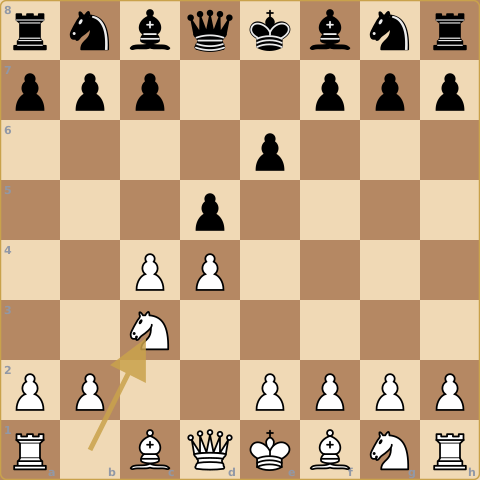
Against 3...Nf6: the Exchange Variation
4.cxd5, a plan that's actually overtaken the older Bg5 lines in modern practice. Black recaptures with 4...exd5, the standard and most solid choice (the sharper 4...Nxd5 is also fully covered), and White continues 5.Bg5, developing actively and genuinely pinning the newly-arrived knight on f6 to the queen on d8.
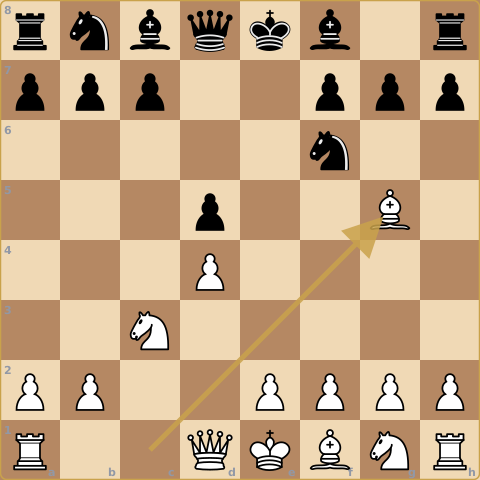
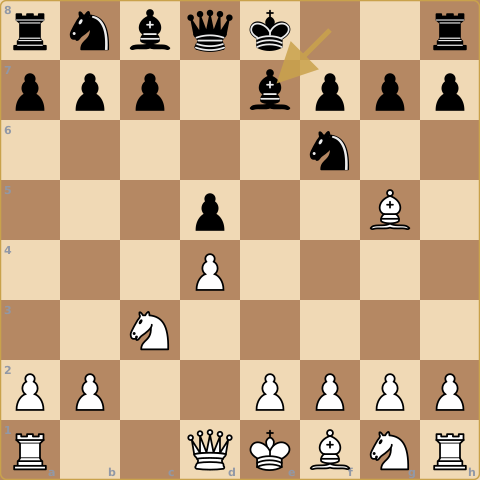
From here, Black has three genuinely common replies, each covered in full: 5...Be7, "the traditional main line of the whole Orthodox system," and the single most heavily analyzed branch in this entire repertoire; 5...c6, supporting the center before developing the bishop, a flexible move order that transposes into similar structures; or 5...Nbd7, developing the last knight first, keeping options open a move longer. Watch out for the famous "Elephant Trap" here: White cannot win a pawn with 6.Nxd5?, because Black wins a piece with 6...Nxd5! 7.Bxd8 Bb4+ 8.Qd2 Bxd2+ 9.Kxd2 Kxd8. This whole structure is known as the Carlsbad structure once the pawns lock into their characteristic shape, one of the most deeply studied pawn formations in all of chess, with well-established plans for both sides (a minority attack on the queenside for White, central and kingside play for Black).
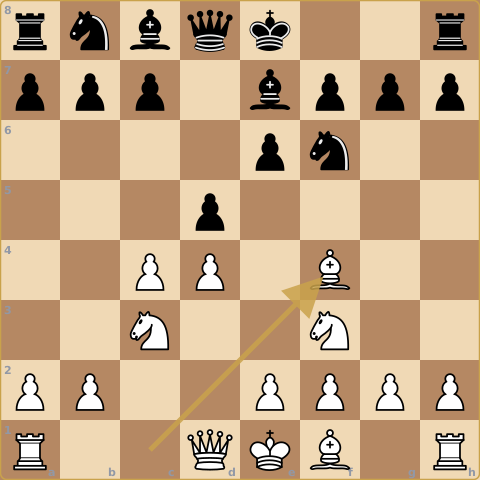
Against 3...Be7: the Harrwitz Attack
Rather than committing the knight first, Black can develop the bishop immediately. White meets this with 4.Nf3 Nf6 5.Bf4, "the Harrwitz Attack, White develops the bishop actively outside the pawn chain" rather than pinning anything. This is the modern, more fluid alternative to the older Bg5 approach: "rather than the older Bg5 pin, the position stays more fluid and piece-activity-focused." Black responds naturally with 5...O-O, castling into safety, and the resulting positions are genuinely balanced, White's small development lead is offset by Black's own actively-placed pieces, rather than one side holding a clear, lasting edge from the opening alone.
Strategic ideas in the Queen's Gambit Declined
A handful of ideas repeat across both of Black's move orders:
- The Exchange Variation isn't a "safe, boring" choice, it's the modern main line. The real-game data behind this repertoire shows it has genuinely overtaken the older Bg5-without-exchanging approach, not because it's simpler, but because it's considered objectively stronger in current practice, a distinction worth understanding rather than assuming from reputation alone.
- The Bg5 pin is real, not just a habit worth double-checking on sight. In the Exchange Variation, the bishop on g5 genuinely pins Black's knight to the queen, a detail worth getting right in an opening this deeply studied.
- The Carlsbad structure rewards knowing the plan, not memorizing moves. Once the pawns lock into their characteristic shape, White's long-term plan is the minority attack: pushing the a- and b-pawns forward, b4 followed by b5, against Black's queenside pawn majority on a7, b7, and c6, to force a trade on c6. That trade leaves Black with an isolated, backward pawn and opens the c-file for White's rooks. It's a structure worth understanding conceptually, not just playing move by move.
- The Harrwitz Attack is a genuinely different plan, not a lesser version of the Bg5 approach. Choosing Bf4 over Bg5 trades the immediate pin for a more fluid, piece-activity-focused game, a real, modern alternative rather than a fallback for when the pin isn't available.
- Black's move order (3...Nf6 vs 3...Be7) genuinely determines which system White plays. Recognizing which one is on the board matters more than having one fixed reaction to both, since the Exchange Variation and the Harrwitz Attack are real, different plans with different follow-up ideas and different resulting pawn structures.
Who should play the Queen's Gambit Declined?
The Queen's Gambit Declined is a strong fit for players roughly 1300 to 2200 rated, with a style best described as positional. If you want the single most historically tested way to meet 1...d5 as White, an opening genuinely central to World Championship chess for the better part of a century, this repertoire offers real, well-documented pedigree alongside a coherent, modern plan built from a genuinely large real-game dataset, drawing on far more practical evidence than most repertoires can offer.
It's also a strong match if you want a repertoire built on understanding pawn structures (the Carlsbad structure in particular) rather than memorizing long forced sequences, both of this repertoire's systems reward genuine positional understanding over rote memorization, and that understanding tends to transfer well into related structures elsewhere in chess.
It's a weaker fit if you're specifically looking for the sharpest, most immediately tactical way to meet 1...d5, while the Queen's Gambit Declined has real tactical resources, particularly in sharper Exchange Variation lines, its overall identity is structural and long-term, not an early forcing sequence.
Black won't always decline. The Queen's Gambit Accepted simply takes the pawn on c4 and hands it back later for active pieces, and the Slav Defense declines with ...c6 instead of ...e6, which keeps Black's light-squared bishop free rather than boxed in. You'll meet both often enough to be worth knowing. If you like this structure but want more long-term pressure, the Catalan Opening builds on the same central control with a fianchettoed bishop added.
Common mistakes in the Queen's Gambit Declined
- Treating the Exchange Variation as the "boring" choice. The real data shows it's actually overtaken the older approaches in modern practice, dismissing it as merely safe misses that it's considered objectively strong, not just simple, and underrating it can mean missing real chances to press an advantage.
- Assuming the Bg5 pin without checking it's actually there. It genuinely is in the main Exchange Variation line covered here, but not every superficially similar position holds up the same way, so it's worth confirming rather than assuming on sight.
- Playing the same system regardless of Black's move order. The Exchange Variation and the Harrwitz Attack are two real, different plans, using the wrong one for whichever move order Black actually chose wastes the specific preparation this repertoire provides.
- Rushing the minority attack in the Carlsbad structure without full preparation. This is a long-term structural plan, not a quick tactical shot, playing it prematurely, before the rest of the position supports it, gives up the advantage the structure is meant to provide.
Frequently asked questions
Is the Queen's Gambit Declined good for beginners?
It's a strong fit for players roughly 1300 and up. Its appeal is genuine structural and positional understanding rather than sharp forced tactics. That makes it a natural next step once basic opening principles are solid, though its historical depth also rewards study well beyond that level, all the way up to advanced tournament and titled play.
Did Kasparov really call the Queen's Gambit Declined "the opening of the world championship matches"?
Yes, this is a real, documented description. It reflects the opening's genuine, sustained presence at the very highest level of chess, including the 1927 Alekhine–Capablanca match (31 of 34 games) and the Kasparov–Karpov matches of the 1980s, a pedigree few other openings can match.
What is the Carlsbad structure?
It's the characteristic pawn formation that results from the Exchange Variation once the central pawns lock into place. It's one of the most deeply studied structures in chess, with well-established long-term plans for both sides, most notably White's minority attack on the queenside.
Is the Bg5 pin in the Exchange Variation a genuine pin?
Yes. The bishop on g5 pins Black's knight on f6 to the queen on d8, with nothing blocking that diagonal in this position.
What's the difference between the Exchange Variation and the Harrwitz Attack?
They're two distinct systems for two different Black move orders. Against 3...Nf6, this repertoire plays the Exchange Variation with a genuine Bg5 pin. Against 3...Be7, it plays the more modern Harrwitz Attack with Bf4, trading the immediate pin for a more fluid, piece-activity-focused game. Both are fully covered here with their own real, tested continuations, rather than one system stretched to cover both situations.
Does the minority attack in the Carlsbad structure guarantee an advantage?
No, it's a real, well-tested plan, not a forced win. Advancing the queenside pawns to create a weakness in Black's structure takes real preparation and correct timing, and Black has established, legitimate defensive resources of their own. It's a genuine long-term strategic idea worth understanding deeply, not a shortcut to a guaranteed edge.
Related openings
- Queen's Gambit Accepted — The other major way Black can meet the Queen's Gambit -- a useful comparison for how differently accepting versus declining the c4-pawn shapes the whole game.
- London System — White's other major 1.d4 repertoire on this site -- a lower-theory, more universal system, useful contrast to the QGD's deep, opponent-specific main-line theory.
Practice every real line against master-game replies, with a plain-English explanation on every move.
Practice Queen's Gambit Declined (Orthodox) free →