Alekhine's Defense: A Complete Guide
Alekhine's Defense begins 1.e4 Nf6. It's one of the most provocative ways for Black to meet 1.e4. Rather than contesting the center, Black invites White's pawns forward, planning to chip away at the resulting structure later with pieces and well-timed pawn breaks. This guide covers a complete Black repertoire, built from 41,715 real, individually validated games across five combined datasets, answering all five of White's genuinely major systems.
Quick facts
| Moves | 1.e4 Nf6 |
| Played as | Black |
| Best for | Roughly 1200–2000 rated players |
| Style | Flexible |
| Games analyzed | 41,715 real, individually validated games across five combined datasets |
| Lines covered here | 21 |
What is Alekhine's Defense?
Most defenses to 1.e4 either contest the center immediately or develop calmly toward a later confrontation. Alekhine's Defense does something more provocative: 1...Nf6 deliberately invites White to push forward with 2.e5, kicking the knight and gaining space. That space is exactly what Black plans to treat as a genuine target rather than a real, lasting advantage.
This isn't a gimmick. The opening is named after Alexander Alekhine, the future World Champion, who introduced it at the Budapest tournament in 1921, in games against Endre Steiner and Fritz Sämisch. It later became a real, respected weapon at the very highest level. Bobby Fischer used it twice against Boris Spassky in their 1972 World Championship match, and Viktor Korchnoi included it in his own repertoire as well.
How to play Alekhine's Defense: move by move
Every line below starts 1.e4 Nf6. From here, White has five genuinely major systems in the real-game data, and this repertoire answers all five with real, tested continuations.
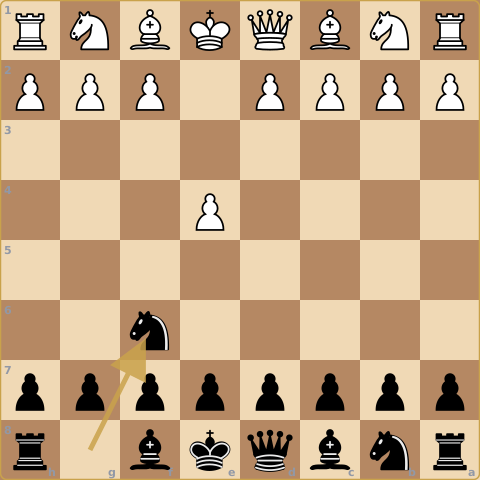
The Two Knights Variation: 2.Nc3
Rather than pushing the pawn forward, White sidesteps the sharp theory that follows 2.e5 entirely, simply developing a piece normally. Black responds with 2...d5, striking back in the center immediately rather than letting White build comfortably.
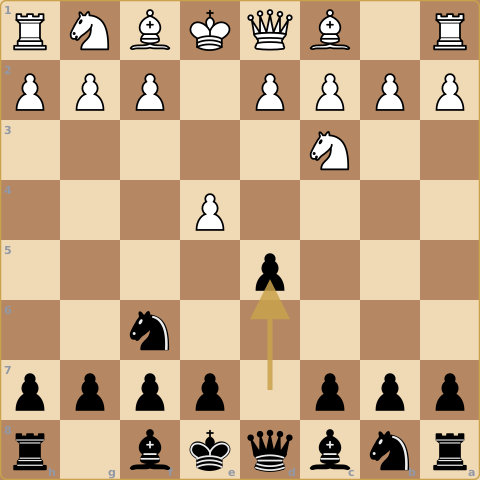
After 2.e5 Nd5, the main systems begin
The far more common continuation: 2.e5 kicks the knight, and Black retreats with 2...Nd5, hopping into the center rather than backing away passively. From here, White has several genuinely distinct real systems.
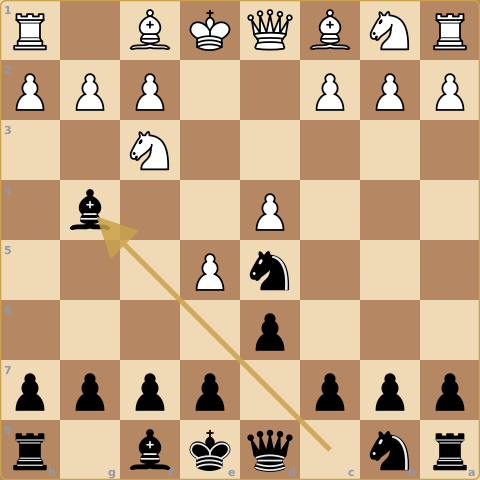
The Modern Variation: 3.d4 d6 4.Nf3
White builds a full pawn center and develops naturally, keeping every option open. Black continues to chip away at the structure with 3...d6, and after 4.Nf3, responds with 4...Bg4, developing outside the pawn chain and adding a little pressure of Black's own.
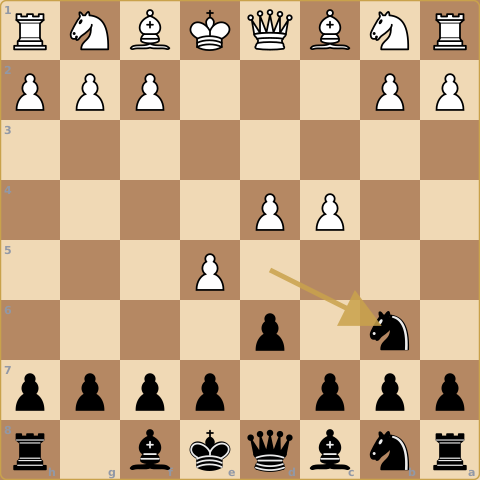
The Exchange Variation: 4.c4
Rather than developing calmly, White pushes the knight back again immediately. Black responds with 4...Nb6, rerouting the knight to a stronger, more stable square rather than allowing it to be harassed further.
The move that actually defines this system is 5.exd6, trading off the advanced e5-pawn rather than letting it become a long-term target. Black has two real recapture plans from here. 5...cxd6 leads to the sharp, asymmetrical structure known as the Voronezh Variation, opening the c-file for Black's rook in exchange for a slightly broken queenside. 5...exd6 is the calmer, more classical choice instead, keeping the pawn structure solid and symmetrical while developing naturally. Both are fully covered in this repertoire.
The Four Pawns Attack: 5.f4
The most ambitious try in the entire repertoire, rather than settling for a normal buildup, White ignores further exchanges and builds a huge pawn wall stretching across the board. Black's answer is the key idea of the whole system: 5...dxe5, striking right back at the center to prove White's massive pawn front is overextended rather than genuinely strong.
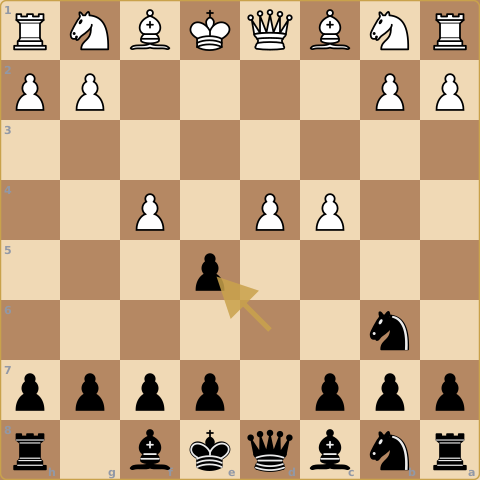
After 6.fxe5, Black keeps up the pressure with 6...Nc6, developing while attacking the pawn on d4 directly, and 7.Be3 Bf5 completes development while eyeing the light squares in White's camp. From here, Black's concrete plan is the thematic ...f6 break, chipping away at the base of White's e5-d4 pawn duo to prove the whole four-pawn structure is more fragile than it looks.
The Chase Variation: an early c4-c5
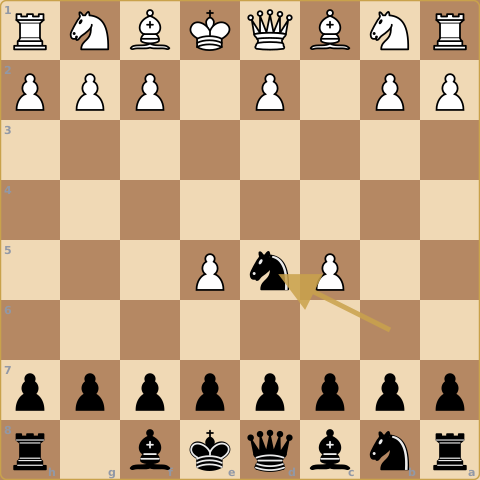
A more ambitious try within the Exchange move order, rather than settling into a normal buildup, White grabs extra queenside space and makes Black's knight move yet again with c4-c5. Black responds with ...Nd5, rerouting the knight to a stronger square once more, refusing to be rattled by the repeated harassment.
Strategic ideas in Alekhine's Defense
A handful of ideas repeat across all five of White's systems:
- Inviting White's pawns forward is deliberate, not passive. The entire point of Alekhine's Defense is that an overextended pawn center becomes a real target, this is a genuine strategic choice, not falling behind in development.
- White's space advantage is a genuine double-edged sword. Advanced pawns can't move backward, once White pushes one forward, it's committed there permanently. That's exactly what lets Black besiege them later with pieces, ...Bg4 and ...Nc6 among them, and with flank breaks like ...c5 and ...f6 that chip away at the base of the structure rather than trying to overpower it head-on.
- ...d6 and ...dxe5 are Black's characteristic ways of striking back at the center. Rather than just retreating the knight repeatedly, Black uses these central breaks to directly challenge whatever structure White has built.
- The Four Pawns Attack is White's most ambitious try, and it demands a direct response. Meeting it passively lets White's massive center simply sit there uncontested, the whole point of this system is proving that center is a weakness, which requires actually challenging it.
- Getting chased with repeated pawn advances (the Chase Variation) isn't a sign of falling behind. Rerouting the knight to a stronger square each time is a real, principled response, not damage control.
- This opening has real, sustained elite pedigree. Fischer's use of it at World Championship level, and Korchnoi's inclusion of it in his own repertoire, are a meaningfully different kind of endorsement than an opening merely being "considered playable."
Who should play Alekhine's Defense?
Alekhine's Defense is a strong fit for players roughly 1200 to 2000 rated, with a style best described as flexible. If you want a genuinely provocative way to meet 1.e4, one that invites real complications rather than settling into familiar, well-trodden structures, this opening offers a distinctive, well-tested alternative to more common replies.
It's also a strong match if you enjoy hypermodern ideas, where controlling the center with pieces rather than pawns is the whole point, and where understanding why an opponent's space advantage can become a liability matters more than memorizing forced sequences.
It's a weaker fit if you're specifically uncomfortable with your own knight getting pushed around early in the game, even when the underlying strategic point is sound, some players simply prefer openings that don't invite this kind of repeated harassment, regardless of how well-founded the resulting counterplay is.
Provoking White's centre and then attacking it is a broader idea than this one opening. The Pirc Defense and the Modern Defense apply the same hypermodern logic against 1.e4 without inviting the knight to be chased around first, which makes both gentler introductions to the approach.
Common mistakes in Alekhine's Defense
- Treating the knight's repeated retreats as a sign of falling behind. Each retreat is a real, principled response to White's pawn advances, not a symptom of a bad position, the whole opening's logic depends on trusting this trade-off.
- Meeting the Four Pawns Attack passively instead of striking back with ...dxe5. White's biggest pawn center demands a direct challenge, letting it sit uncontested gives up the entire point of provoking it in the first place.
- Treating all five of White's systems as requiring the same response. The Modern, Exchange, Four Pawns, Chase, and Two Knights variations are genuinely different plans, knowing which one is actually on the board matters more than having one fixed reaction ready for all of them.
- Underestimating the Chase Variation's extra queenside space. It's a real, ambitious try, not just repeated harassment without purpose, rerouting the knight calmly each time, rather than reacting with alarm, is the correct response.
Frequently asked questions
Is Alekhine's Defense good for beginners?
It's a strong fit for players roughly 1200 to 2000. Its appeal is a genuinely distinctive, principled plan: invite the center, then attack it. That's a real alternative to passive development, though understanding why each central break matters rewards some existing positional foundation.
Why is it called Alekhine's Defense?
It's named after Alexander Alekhine, the future World Champion, who introduced it at the Budapest tournament in 1921, in games against Endre Steiner and Fritz Sämisch. It later became a real weapon at the highest levels of chess.
Did any other world-class players use Alekhine's Defense?
Yes. Bobby Fischer used it twice against Boris Spassky in their 1972 World Championship match, and Viktor Korchnoi included it in his own repertoire. That gives the opening real, sustained elite pedigree beyond just its namesake.
How many different systems does White have against Alekhine's Defense?
Five genuinely major ones show up with real frequency in the data behind this repertoire: the Modern Variation, the Exchange Variation, the Four Pawns Attack, the Chase Variation, and the Two Knights Variation. This repertoire covers all five with real, tested continuations.
What is the Four Pawns Attack, and how does Black meet it?
It's White's most ambitious try, building a huge pawn wall across the board rather than settling for a normal structure. Black's answer is 5...dxe5, striking directly at the center to prove that massive pawn front is overextended rather than genuinely strong.
Practice every real line against master-game replies, with a plain-English explanation on every move.
Practice Alekhine's Defense free →