The Petroff Defense: A Complete Guide
The Petroff Defense (also called Petrov's Defense or the Russian Game) arises after 1.e4 e5 2.Nf3 Nf6. Rather than defend the attacked e5 pawn the more common way, Black counter-attacks White's e4 pawn right back. This guide covers a complete Black repertoire against all three of White's real tries, built from 50,005 real, individually validated games, every single line replayed and checked move by move against the actual game record.
Quick facts
| Moves | 1.e4 e5 2.Nf3 Nf6 |
| Played as | Black |
| Best for | Players who want a genuinely solid, well-tested answer to 1.e4 |
| Style | Solid, symmetrical, counter-attacking rather than defensive |
| Games analyzed | 50,005 real, individually validated games |
| Lines covered here | 20 (across White's three real third-move tries) |
What is the Petroff Defense?
After 1.e4 e5 2.Nf3, White's knight attacks the e5 pawn directly. Most defenses to 1.e4 e5 protect that pawn, most commonly with 2...Nc6. The Petroff does something different: 2...Nf6 ignores the threat and counter-attacks White's own e4 pawn instead. If White takes on e5, Black takes on e4, and the position resolves into one of the most thoroughly analyzed structures in chess.
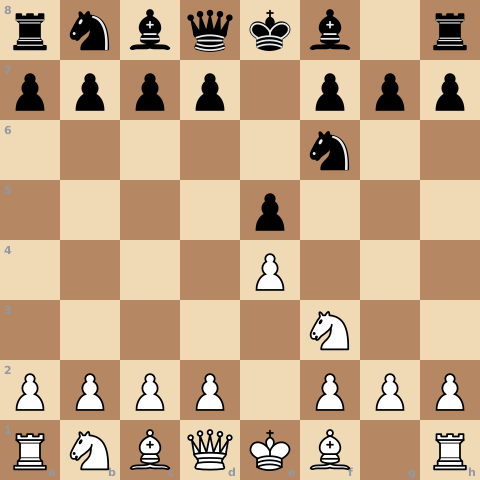
In our validated data, White's three genuine tries split as 3.Nxe5 (53%, the Classical main line), 3.Nc3 (24%, sidestepping the sharpest theory), and 3.d4 (18%, the Steinitz Attack). All three are covered in full here.
How to play the Petroff Defense: move by move
Against 3.Nxe5: the Classical main line
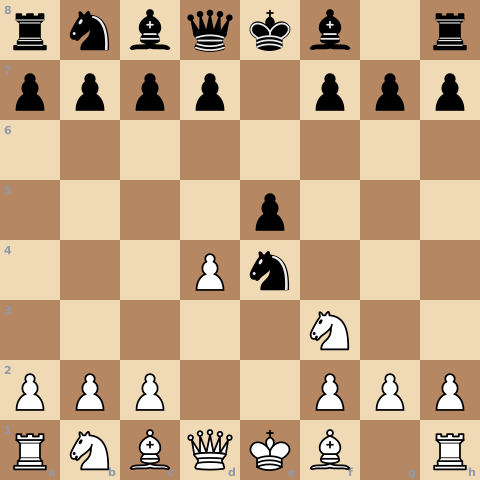
White's most common try simply takes the pawn. The critical detail, discovered by Alexander Petrov himself, is that Black must not recapture immediately with 3...Nxe4. Instead, 3...d6 kicks the knight back first. After 4.Nf3 Nxe4, Black has fully equalized material, and the position typically continues 5.d4 d5 6.Bd3 Bd6 7.O-O O-O 8.c4, both sides developing along nearly symmetrical lines before White finally tries to create something from the position.
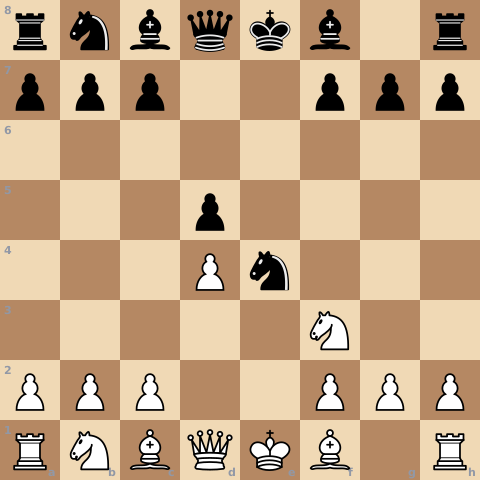
White also has a real, well-tested alternative on move five: 5.Nc3, trading knights and accepting doubled pawns in exchange for the open d-file and real central influence, a structurally different but equally sound plan.
Against 3.Nc3: sidestepping the sharpest theory
Rather than enter the deeply analyzed 3.Nxe5 lines, White sometimes just develops. Black's most natural response, 3...Nc6, often transposes directly into genuine Four Knights Game structures, either the Spanish setup after 4.Bb5 Bb4, or a Scotch Four Knights flavor after 4.d4. Both lead to rich, well-tested middlegames with real chances for both sides.
Against 3.d4: the Steinitz Attack
White's sharper alternative strikes the center immediately rather than taking the pawn. Black replies 3...Nxe4, and after 4.Bd3 d5 5.Nxe5, the position typically continues with an early knight trade on d7, reaching a structure similar in spirit to the Classical branch but with real, distinct differences worth knowing on their own terms.
Strategic ideas in the Petroff Defense
- The symmetry is temporary, not permanent. Both sides develop along near-identical lines early on, but the real content of every branch comes from who breaks the symmetry first and how.
- 3...d6 before 3...Nxe4 is the single most important move-order detail in the whole opening. This is the exact discovery that makes the Petroff sound, walking into 3...Nxe4 immediately is a real, historical trap.
- Doubled pawns are a recurring, deliberate trade-off, not an accident. Several branches see one side accept doubled pawns for an open file and real central influence, a genuine, standard exchange rather than a structural weakness.
- The Petroff's drawish reputation is real but not automatic. Caruana's three decisive results with it in the 2018 Candidates Tournament are direct evidence that accurate, ambitious play produces real winning chances.
- Know all three of White's tries, not just the most common one. 3.Nxe5 is the majority choice, but 3.Nc3 and 3.d4 together make up nearly half of what you'll actually face.
Who should play the Petroff Defense?
The Petroff is a strong fit for players who want a genuinely solid, well-tested answer to 1.e4 without taking on the deep theoretical demands of the Ruy Lopez, Italian Game, or Scotch Game as the alternative. It rewards understanding a handful of recurring structural ideas, doubled pawns for open lines, symmetrical development, the timing of central breaks, rather than memorizing forcing tactical sequences.
It's a weaker fit if you're specifically looking for a sharp, tactical weapon that punishes inaccurate play immediately. The Petroff's real strength is long-term soundness, not immediate complications.
Common mistakes in the Petroff Defense
- Playing 3...Nxe4 immediately after 3.Nxe5, without 3...d6 first. This is the exact historical mistake Alexander Petrov's own analysis corrected. It remains the single most important detail to get right.
- Assuming every position is automatically safe because of the Petroff's reputation. Real chances exist in all three main branches, careless play can still lose regardless of the opening's overall soundness.
- Playing White and rushing central breaks before completing development. Several branches specifically reward patient, complete development before challenging the center.
- Treating doubled pawns as automatically bad. They come with genuine, standard compensation throughout this whole repertoire, open files and central influence, not just a structural cost.
Frequently asked questions
Is the Petroff Defense good for beginners?
It rewards understanding recurring structures rather than memorizing sharp tactics, which suits many players well. It isn't the most immediately punishing choice if you specifically want forcing, memorized attacking lines.
Is the Petroff Defense drawish?
It has that reputation when both sides play it safely, and plenty of games do end that way. But Fabiano Caruana's three decisive results with it in the 2018 Candidates Tournament, all wins, are real evidence against the idea that it's automatically a draw.
What's the biggest trap to know in the Petroff?
Playing 3...Nxe4 immediately after 3.Nxe5, without inserting 3...d6 first, is the exact historical mistake Alexander Petrov's own analysis fixed. It's the single most important move-order detail in the whole opening.
What's White's best try against the Petroff?
All three of White's real options, 3.Nxe5, 3.Nc3, and 3.d4, are genuinely tested and give real chances. 3.Nxe5 is the most common at just over half of all games, so it's worth knowing best, but a real repertoire needs answers to all three.
Where does the name "Petroff Defense" come from?
It's named for Alexander Petrov (1794-1867), the first great Russian chess master, who analyzed the opening deeply in the mid-19th century. The underlying idea is much older, appearing in the work of the Portuguese player Pedro Damiano around 1500, but Petrov specifically discovered the 3...d6 resource that makes the whole defense sound.
How can White avoid facing the Petroff at all?
Playing 2.Nf3 is what allows 2...Nf6 in the first place. Some players sidestep the whole defense by developing the bishop first instead, with the Bishop's Opening (2.Bc4), which never gives Black the chance to play it.
Related openings
- Scandinavian Defense — Another solid, well-tested way to meet 1.e4 that leads to structurally clear, well-understood positions rather than sharp tactics.
- Caro-Kann Defense — A different flavor of solidity against 1.e4, building a firm structure rather than the Petroff's immediate central counter-attack.
Practice every real line against master-game replies, with a plain-English explanation on every move.
Practice Petroff Defense free →