The Grunfeld Defense: A Complete Guide
The Grunfeld Defense arises after 1.d4 Nf6 2.c4 g6 3.Nc3 d5. It's one of the sharpest, most respected defenses to 1.d4. Black lets White build a big classical center, then immediately trades it off and spends the rest of the game attacking what's left of it. This guide covers a complete Black repertoire, built from 67,266 real games across four combined datasets, answering White's major systems with one coherent, well-tested plan.
Quick facts
| Moves | 1.d4 Nf6 2.c4 g6 3.Nc3 d5 |
| Played as | Black |
| Best for | Roughly 1800–2400 rated players |
| Style | Aggressive, flexible |
| Games analyzed | 67,266 real games across four combined datasets |
| Lines covered here | 24 |
What is the Grunfeld Defense?
Most defenses to 1.d4 either contest the center directly or avoid the confrontation with a fianchetto and a slower buildup. The Grunfeld does both, in sequence. 2...g6 fianchettoes the bishop first, and then 3...d5 immediately strikes at the center anyway, inviting White to build an imposing pawn mass. Black then plans to trade that center off and attack it for the rest of the game.
This hypermodern, genuinely fighting approach has real, serious elite pedigree. The opening is named after Ernst Grünfeld, who introduced it into international play at Vienna in 1922, defeating future World Champion Alexander Alekhine in his very first game with it. Garry Kasparov became one of its most notable modern practitioners, playing it in his World Championship matches against both Anatoly Karpov (1986, 1987, and 1990) and Vladimir Kramnik (2000).
How to play the Grunfeld Defense: move by move
Every line below starts 1.d4 Nf6 2.c4 g6 3.Nc3 d5. From here, White has several genuinely common systems in the real-game data, and this repertoire answers each with real, tested continuations.
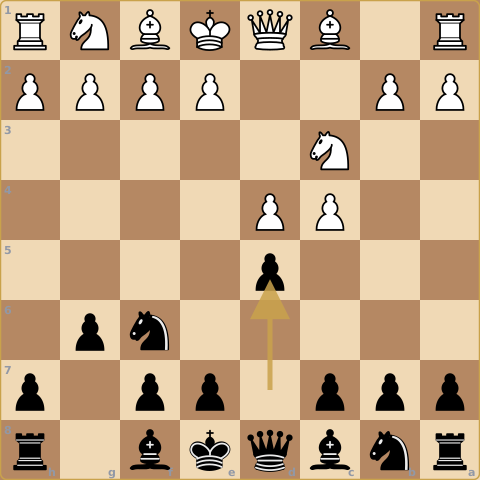
The Exchange Variation: 4.cxd5
The main line, and the most theoretically important branch in the whole opening. Black recaptures with 4...Nxd5, recapturing with the knight and centralizing it, and White continues 5.e4, grabbing a big center and kicking the knight away. Black's characteristic response is 5...Nxc3, trading the knight for White's knight and damaging White's pawns in the process, the entire strategic point of the whole opening in a single exchange, converting the center White just built into a real, structural target.
After 6.bxc3, Black's plan is immediate and concrete. 6...Bg7 completes the fianchetto, and then comes the thematic central strike: 7...c5!, hitting White's d4-pawn head-on and putting maximum pressure on the very center White just doubled its pawns to build. That pressure keeps building with ...Nc6, ...Bg4, and ...Qa5, all piling onto d4 and c3 until White's center starts to look more like a liability than an asset.
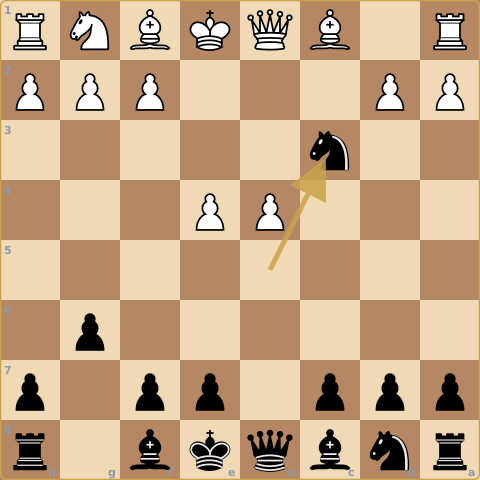
White's flexible try: 4.Nf3
Rather than resolving the central tension immediately, White develops naturally and keeps options open. This move order is also where the Fianchetto Variation most commonly arises, when White follows up with g3, "mirroring Black's own setup" for a slower, more strategic battle rather than an early central confrontation.
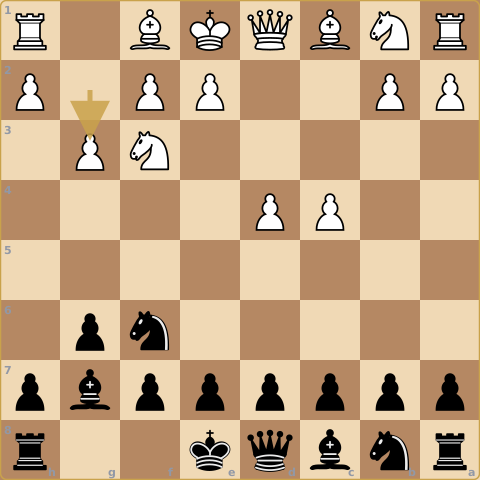
White's other major tries: 4.Bg5, 4.e3, and 4.Bf4
Several other real systems show up with genuine frequency in the data. 4.Bg5 develops actively and attacks the newly-developed knight on f6 before White commits to a specific central plan. 4.e3 is a quiet, solid move that supports the center without committing to anything sharp, while 4.Bf4 develops the bishop actively and adds pressure. All three are fully covered in this repertoire alongside the main Exchange Variation.
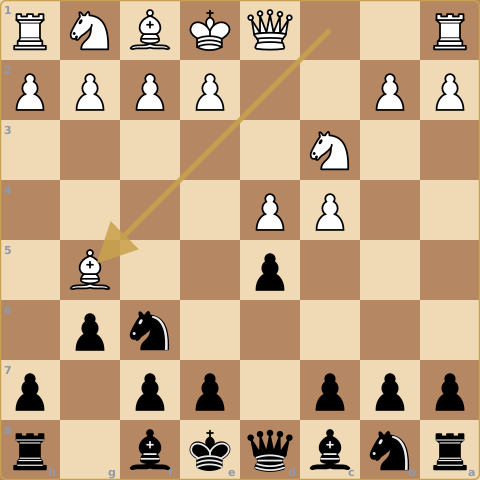
Strategic ideas in the Grunfeld Defense
A handful of ideas repeat across this entire repertoire:
- Letting White build a big center is deliberate, not passive. The whole point of the Grunfeld is that a large center becomes a real, structural target the moment Black trades into it, this is a genuine strategic choice, not falling behind.
- ...Nxc3 is the opening's defining exchange. Trading the knight to damage White's pawn structure is the single move that converts White's central space into a long-term weakness rather than a lasting advantage.
- ...c5 is the follow-up that actually cashes in on that exchange. After 6.bxc3, doubling White's pawns isn't the end of the plan by itself. Black plays 6...Bg7 and then 7...c5!, striking straight at d4 and piling on with ...Nc6, ...Bg4, and ...Qa5. Without that follow-through, White's center can simply consolidate.
- The Fianchetto Variation is a genuinely different, slower battle. Rather than the sharp central confrontation of the Exchange Variation, White's own fianchetto leads to a more strategic, patient middlegame, recognizing which system is on the board matters more than having one fixed reaction.
- This opening has real, sustained elite pedigree, not just theoretical soundness. Kasparov's repeated use of it at World Championship level, across matches against two different opponents, is a meaningfully different kind of endorsement than an opening merely being "considered sound."
- The Grunfeld rewards genuine central understanding over passive equality-seeking. Both sides get real chances in most lines, which is exactly why it's remained a serious weapon at the highest levels of chess for a century.
Who should play the Grunfeld Defense?
The Grunfeld Defense is a strong fit for players roughly 1800 to 2400 rated, with a style best described as aggressive and flexible. If you want a genuinely fighting, hypermodern way to meet 1.d4, one with real, sustained use at World Championship level, the Grunfeld is one of the most respected ways to get there.
It's also a strong match if you're comfortable with sharp, theoretically dense positions where precise central play matters more than general principles alone. This isn't an opening that rewards playing on autopilot.
It's a weaker fit if you specifically want a lower-theory, lower-risk opening. The Grunfeld's whole identity depends on real, specific understanding of the central tension it creates. It genuinely rewards players who already have strong tactical and positional foundations, rather than those looking for a simple, low-maintenance system.
The King's Indian Defense starts identically and then diverges: it keeps the centre closed and plays for a long-term attack rather than trading immediately. If the Grünfeld's early liquidation doesn't suit you, that's where to look next.
Common mistakes in the Grunfeld Defense
- Avoiding the central trade out of instinct. ...Nxc3 in the Exchange Variation is the entire strategic point of the opening, declining it or delaying it gives up the structural target the whole repertoire is built around.
- Treating White's systems as interchangeable. The sharp Exchange Variation and the slower Fianchetto Variation lead to genuinely different kinds of middlegames, knowing which one is actually on the board matters more than having one fixed reaction ready for both.
- Underestimating how much precision the resulting positions demand. Letting White build a big center is only a good trade if Black follows through with accurate play afterward, treating the opening's early moves as the hard part while coasting afterward misses where the real challenge lies.
- Assuming elite pedigree means the opening is easy to play well. Kasparov's success with the Grunfeld reflects how thoroughly he studied it, not how forgiving the opening is without real preparation.
Frequently asked questions
Is the Grunfeld Defense good for beginners?
It's better suited to players roughly 1800 and up. Its appeal is genuine fighting chances and real elite pedigree, but the central tension it creates rewards players who already have strong tactical and positional foundations.
Why is it called the Grunfeld Defense?
It's named after Ernst Grünfeld, who introduced it into international play at Vienna in 1922, defeating future World Champion Alexander Alekhine in his very first game with it.
Did Kasparov really play the Grunfeld at World Championship level?
Yes, he was one of its most notable modern practitioners, using it in his World Championship matches against Anatoly Karpov in 1986, 1987, and 1990, and against Vladimir Kramnik in 2000.
What is the point of the Exchange Variation's central exchanges?
Black deliberately lets White build a big pawn center, then trades a knight for White's knight on c3, damaging White's pawn structure in the process. This converts White's central space from an asset into a genuine long-term structural target for the rest of the game.
What's the difference between the Exchange Variation and the Fianchetto Variation?
The Exchange Variation leads to a sharp, immediate central confrontation after 4.cxd5. The Fianchetto Variation, reached via 4.Nf3 followed by g3, is a slower, more strategic battle where White mirrors Black's own fianchetto setup instead of resolving the center right away.
Practice every real line against master-game replies, with a plain-English explanation on every move.
Practice Grunfeld Defense free →