How to Play the London System
The London System is a chess opening for White built around one repeatable setup: 1.d4, Nf3, Bf4, e3, c3, and Nbd2, played in roughly that order almost regardless of what Black does in response. Unlike most openings, where Black's replies force you down completely different paths, the London barely changes shape from game to game. That's exactly why it's one of the most recommended openings for players learning to play 1.d4. This guide covers the full setup, built and verified from 15,453 real master games, in 30 complete lines.
Quick facts
| Moves | 1.d4 (followed by Nf3, Bf4, e3, c3, Nbd2) |
| Played as | White |
| Best for | Roughly 400–1400 rated players |
| Style | Solid, positional, low-theory |
| Games analyzed | 15,453 real master games |
| Lines covered here | 30 |
What is the London System?
The London System is a queen's-pawn opening for White that begins with 1.d4 and quickly develops the dark-squared bishop to f4, usually before playing e3, so the bishop never gets stuck behind its own pawn chain the way it does in many other 1.d4 openings. From there, White follows up with a near-identical sequence of developing moves (Nf3, e3, c3, Nbd2, and a bishop to d3) no matter what setup Black chooses.
That's the entire appeal of the London System in one sentence: you're not learning an opening that branches into dozens of unrelated positions. You're learning one plan. Most 1.d4 openings force White to make a real decision on nearly every move, depending on exactly what Black plays: meet the King's Indian one way, the Grünfeld another, the Queen's Gambit Declined a third. The London sidesteps almost all of that. Whether Black plays a Nimzo-Indian-style setup, a Queen's-Indian-style fianchetto, or a classical ...d5, White's first six or seven moves look almost identical every time.
This makes the London especially well suited to players who don't want to spend hours memorizing separate responses to every possible defense. It won't produce the sharpest, most forcing attacks in chess. Its whole identity is "solid and low-risk" rather than "aggressive." But for a player who wants one dependable plan against nearly anything Black throws at them, it's hard to find an opening with a better ratio of reliability to study time.
The London has also seen real elite-level use in the last decade. Magnus Carlsen has played and won with it repeatedly as World Champion, against some of the strongest players in the world, which has done a lot to shed its older reputation as a purely "beginner's" opening. It's low-maintenance, not low-quality.
How to play the London System: move by move
Every line below starts the same way: 1.d4 Nf6 2.Nf3 e6 3.Bf4. Get the bishop out before it's blocked in, develop the knight, and only then decide the rest based on what Black does. (The exact same setup is reached if Black plays 1...e6 before 2...Nf6. The move order barely matters, which is itself part of the London's appeal.)
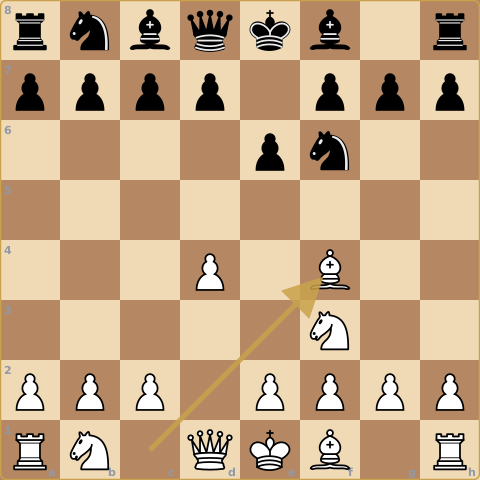
The core setup: 4.e3, 5.c3, 6.Nbd2
After 3.Bf4, White's next several moves are close to automatic: e3 supports the center now that the bishop is already out, c3 adds further central support and rules out any annoying ...Nb4 or ...Bb4 tricks, and Nbd2 develops the last knight toward a natural post, often eyeing e5 later. This backbone barely changes regardless of which of the three plans below Black chooses.
Black's plan 1: the central challenge, 4...c5
The single most ambitious try against the London, Black strikes directly at d4 rather than developing quietly first. White responds with the same natural sequence (e3, c3, Nbd2), and the position often continues with Black developing a knight to c6, adding real pressure on the center. If Black eventually trades on d4, White recaptures with the e-pawn, keeping a strong, mobile center and a comfortable position. One line in this repertoire runs all the way to a queenside pawn move by Black (...b6), with White fully developed and the center completely intact, a position that shows up again and again in real games at this level.
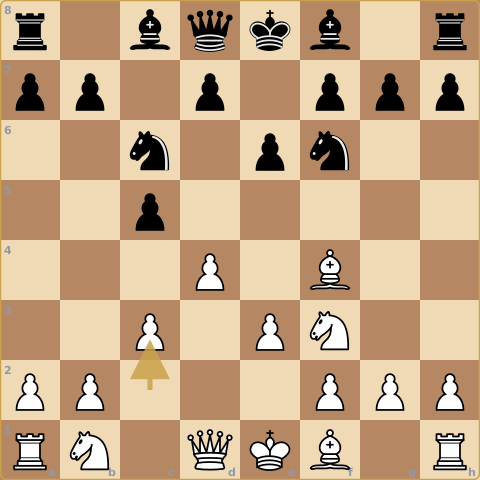
A sharper try within this same plan is 6...Nh5, where Black offers to trade off White's dark-squared bishop by attacking it directly. What White plays next depends on the exact move order, and it's worth knowing both real lines precisely rather than blending them together:
- If Black has already played ...Nc6 before ...Nh5 (the more common order), White meets the attack with 7.Bg5, sidestepping the knight while landing on a genuinely more active square. With the knight already gone from f6, the bishop now aims straight down an open diagonal at Black's queen on d8. Black's most natural follow-up here is ...Qb6, adding pressure of its own on b2 and d4.
- If Black plays an early ...Qb6 before ...Nh5, White first meets the queen with Qc1, and only then, once ...Nh5 arrives, retreats with Bg3 instead of counter-attacking. This time Black really can trade on g3 with ...Nxg3, and White recaptures 8.hxg3, toward the center, opening the h-file for the rook. It's a fair trade that still favors the side that developed faster.
Same idea (Black harasses the bishop with ...Nh5), two different concrete continuations, depending entirely on whether the queen or the knight moved first.
Black's plan 2: the fianchetto setup, 4...b6
Here Black tucks the bishop into the corner with a plan similar to the Queen's Indian Defense, ...b6 followed by ...Bb7, aiming the bishop at White's center from a distance rather than contesting it directly. White's response barely changes: Nbd2, Bd3 (aiming straight at h7), and a useful little precaution, h3, which simply takes the g4 square away from Black's pieces before it can matter. This plan often leads to some of the deepest, most thoroughly tested lines in the whole repertoire. One sequence runs a full 10 moves deep, both sides fully developed and castled, reaching a position that's shown up in high-level games again and again.
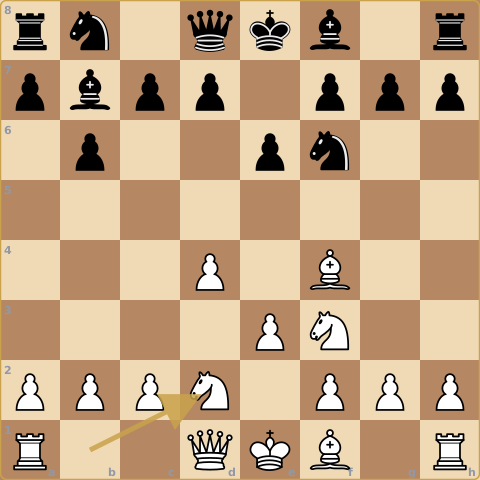
One tactical wrinkle worth knowing inside this plan: if Black tries ...Qb6, eyeing both the b2 pawn and the d4 pawn at once, White has two clean answers depending on the exact position, either Qb3, meeting the threat head-on, or Qc1, sidestepping it entirely while staying flexible. Both fully neutralize the idea without conceding anything.
Black's plan 3: the classical center, 4...d5
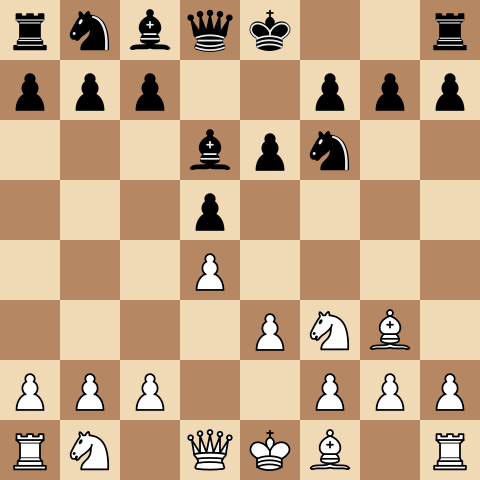
The most straightforward response: Black meets White's center with a pawn of their own rather than developing around it. After 4.e3, the game typically continues with Black developing the bishop to d6, eyeing White's kingside. White immediately tucks the f4-bishop back to 5.Bg3, out of reach of a future ...Nh5, before turning to the same c3 and Nbd2 moves used in the other two plans and continuing normal development and castling.
Strategic ideas in the London System
The London isn't built around a single tactical trick. Its strength is structural reliability. A few ideas come up repeatedly across almost every line:
- The bishop goes to f4 before e3, every time. This single move-order detail is the entire reason the London avoids the "bad bishop" problem that affects many other queen's-pawn openings, where the dark-squared bishop gets permanently boxed in behind its own pawns.
- c3 and Nbd2 form the backbone of White's center, giving the position enough support that Black rarely gets a genuinely favorable central break.
- h3 is a small but real precaution, ruling out ...Ng4 ideas before they ever become relevant, a quiet move that prevents problems rather than solving them after the fact.
- Castling comes relatively late in several lines, sometimes not until move 7 or later, because there's rarely any urgency. The position stays safe enough that White can finish developing everything else first.
- Recaptures toward the center are almost always correct in this system. When central pawn tension resolves, White typically wants pieces or pawns recapturing toward, not away from, the center, keeping the position mobile.
Who should play the London System?
The London System is one of the most commonly recommended chess openings for beginners learning to play 1.d4, and the data backs that up directly. It's rated a strong fit for players roughly 400 to 1400, with a style best described as solid, positional, and low-theory. If you want an opening where you're not relearning a new plan every time your opponent tries something different, and you'd rather spend your limited study time getting genuinely comfortable with one setup than memorizing shallow responses to a dozen different defenses, this is close to the ideal starting point.
It's also a strong fit if you're someone who tends to run out of preparation time before a game, or who plays against a wide range of opponents at different levels and doesn't want a separate plan for each one. Because the setup barely changes based on Black's reply, you can spend your study time getting deeply familiar with a small number of ideas rather than thinly spread across many.
It's a weaker fit if what you're actually looking for is sharp, forcing, tactical chess from move one. The London's whole identity is patience and reliability over early fireworks. For that kind of game, an opening like the Italian Game or the Vienna Game (both also on this site) is a better match.
Common mistakes to watch for in the London System
- Playing e3 before Bf4. This is the single most common way to accidentally "un-London" your own opening. If the e-pawn moves first, the bishop is now blocked in behind it, and you've given up the entire structural point of the setup for nothing.
- Panicking against ...Qb6. New players sometimes over-defend or make an awkward concession when Black eyes the b2 pawn with an early queen move. As shown above, both Qb3 and Qc1 handle this cleanly. There's no need to weaken your position to deal with it.
- Forgetting the h3 precaution. It looks like a "waiting move," but skipping it invites exactly the kind of ...Ng4 annoyance it exists to prevent.
- Assuming there's only one way to meet ...Nh5. The right response depends on move order. If Black's knight has already developed to c6, Bg5 counter-attacks the queen rather than retreating passively. If Black played an early ...Qb6 first, White meets ...Nh5 with Bg3 instead and simply recaptures on g3 when Black takes there. Mixing the two up is the actual mistake to avoid.
- Rushing to castle out of habit. Several of the deepest, best lines in this repertoire have White castling relatively late, sometimes not until move 7 or later, because there's rarely any real urgency. Finishing development first and castling once the position calls for it tends to work out better than castling on autopilot the moment it's legal.
Worth noting directly: across all 30 verified lines in this repertoire, not a single one involves a forced check for either side. That's not an accident. It's a direct reflection of what the London actually is: a structurally sound, low-tactics opening where the winning ideas come from a small, steady space and development edge, not from sharp calculation. If you're a player who finds tactical complications stressful rather than exciting, that's a real, meaningful point in this opening's favor, not just a side note.
Frequently asked questions
Is the London System good for beginners?
Yes, it's one of the most frequently recommended openings for new players precisely because it doesn't require memorizing different responses to different defenses. The core setup (d4, Nf3, Bf4, e3, c3, Nbd2) stays close to identical regardless of what Black plays, which makes it unusually low-maintenance to actually learn.
What is the main idea of the London System?
Develop the dark-squared bishop to f4 before playing e3, so it never gets blocked in behind its own pawns, then build a solid, supported center with c3 and develop naturally with Nbd2 and Bd3, adjusting only slightly based on Black's setup.
Is the London System still played at a high level?
Yes. It's shed most of its old reputation as a purely beginner's opening. Magnus Carlsen has played and won with it repeatedly as World Champion, and it remains a legitimate practical weapon well into master-level chess, not just a training-wheels system.
How do you meet the London System as Black?
The most ambitious approach is an early ...c5, striking directly at White's center rather than developing quietly around it. This site's London System repertoire covers White's best responses to that plan and two others (...b6 and ...d5) in full, engine-verified detail.
Does the London System have any real weaknesses?
Its biggest tradeoff is ambition. It rarely produces the sharp, forcing attacks that openings like the Italian Game or the Sicilian can. What it trades away in tactical fireworks, it makes up for in reliability and low preparation cost, which is exactly why it suits the rating range and style it's rated for here.
Related openings
- Italian Game — A sharper, more tactical alternative for White if you'd rather fight for the center directly against 1...e5 instead of playing a system.
- Alapin Variation — The same low-theory, one-plan philosophy as the London, applied to White's answer against the Sicilian Defense instead of 1...d5/...Nf6.
Practice every real line against master-game replies, with a plain-English explanation on every move.
Practice London System free →