The Bishop's Opening: A Complete Guide
The Bishop's Opening arises after 1.e4 e5 2.Bc4, one of the oldest openings in chess. Rather than develop the knight first with the more common 2.Nf3, White brings the bishop out immediately, eyeing f7 directly and keeping real flexibility for what follows. This guide covers a complete repertoire built from 21,663 real, individually validated games, every line replayed and checked move by move against the actual game record.
Quick facts
| Moves | 1.e4 e5 2.Bc4 |
| Played as | White |
| Best for | Players who want a flexible weapon against 1...e5 that sidesteps the Petroff Defense |
| Style | Flexible, solid, a genuine move-order weapon |
| Games analyzed | 21,663 real, individually validated games |
| Lines covered here | 21 |
What is the Bishop's Opening?
After 1.e4 e5, most systems develop the knight first with 2.Nf3. The Bishop's Opening does something older and more direct: 2.Bc4 develops the bishop immediately, aiming at f7 and keeping the f-pawn free for a possible future f4, an affinity it shares with the King's Gambit and the Vienna Game.
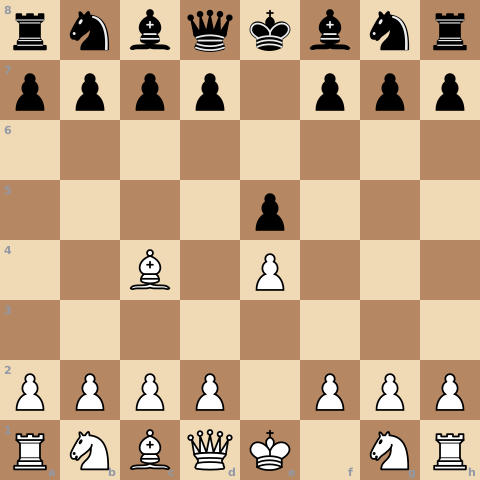
The single biggest practical reason to choose this move order: it completely sidesteps the Petroff Defense, since Black never gets the chance to meet a knight on f3 with ...Nf6. In our validated data, Black's three real replies split as 2...Nf6 (73%, the Berlin Defense to this opening, attacking e4 directly), 2...Nc6 (18%), and 2...Bc5 (6%), all covered here.
How to play the Bishop's Opening: move by move
Against 2...Nf6: the main branch
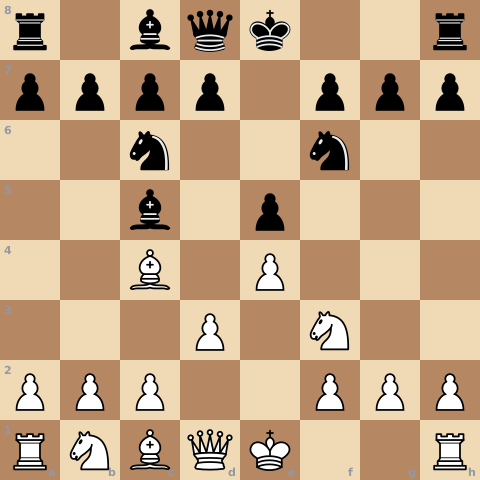
Black's most common reply attacks e4 immediately. White replies 3.d3, defending solidly, and the position branches three ways depending on Black's next move: 3...Nc6, developing naturally and often transposing toward genuine Italian Game structures after 4.Nf3 Bc5; 3...c6, preparing an immediate central strike with ...d5; or 3...Bc5, developing the bishop before the knight.
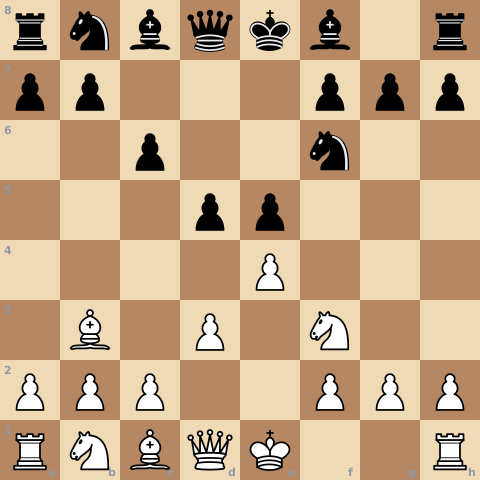
Against the 3...c6 branch, White continues 4.Nf3 d5 5.Bb3, retreating the bishop before Black's central pawn can attack it, reaching rich, well-tested positions with real tactical chances in several sub-lines.
Against 2...Nc6 and 2...Bc5
Black's other two tries transpose entirely into the coverage above. Since Nf6 and Nc6 don't interact with each other, whether Black plays 2...Nc6 first or develops it later after 2...Nf6 3.d3, the same positions get reached either way, just in a different order. The same is true of an immediate 2...Bc5. This is a genuinely useful thing to recognize: rather than three separate systems to learn, this whole opening is one coherent set of ideas that Black can arrive at through several different move orders.
Strategic ideas in the Bishop's Opening
- Bishop before knight is the whole identity of this opening. Developing to c4 immediately, before Nf3, is what sidesteps the Petroff and keeps the flexibility this repertoire is built around.
- Recognize the transpositions. Several branches head directly into genuine Italian Game or Vienna Game structures. Knowing this connection is a real part of understanding this opening well, not a coincidence to ignore.
- The f-pawn stays free for a reason. Unlike 2.Nf3, this move order keeps the option of a later f4 alive, a genuine, shared idea with the King's Gambit and Vienna Game.
- This is a practical, move-order weapon as much as a theoretical one. Real elite players, including Peter Lekó against Vladimir Kramnik in a World Championship match, have chosen it specifically to avoid a well-prepared opponent's defense.
- Know all three of Black's real replies. 2...Nf6 is the clear majority at 73%, but 2...Nc6 and 2...Bc5 together make up more than a quarter of what you'll actually face.
Who should play the Bishop's Opening?
The Bishop's Opening is a strong fit for players who want a genuinely flexible weapon against 1...e5, one that keeps real transposition options into systems you might already know, while specifically sidestepping the Petroff Defense. It rewards understanding move-order connections rather than memorizing one single forcing sequence.
It's a weaker fit if you're specifically looking for a hidden theoretical edge over 2.Nf3. Modern analysis generally treats the resulting positions as balanced with accurate play, this opening's real value is practical and move-order-based.
Common mistakes in the Bishop's Opening
- Treating this purely as a way to reach the Italian Game, without appreciating its own independent value. The Petroff-avoidance alone is a real, practical reason to choose this move order on its own terms.
- Assuming the position must be less critical than 2.Nf3 lines simply because this opening is less common today. The resulting positions are genuinely balanced and reward careful play.
- Rushing central expansion before completing development. Several of the richest lines here specifically reward patient, complete development first.
- Missing the real transposition possibilities. Recognizing when a line heads into genuine Italian Game or Vienna Game territory is a real, practical skill this opening rewards.
Frequently asked questions
Is the Bishop's Opening good for beginners?
Its flexibility can make it a genuinely good fit, one early move keeps multiple later plans available, meaning less to memorize upfront than committing to a single sharp system right away.
Why play the Bishop's Opening instead of just 2.Nf3?
The single biggest practical reason is sidestepping the Petroff Defense entirely, since 2.Bc4 never gives Black the chance to play it. It also keeps real flexibility to transpose into Italian Game or Vienna Game structures on your own terms.
What's the best way for Black to meet the Bishop's Opening?
2...Nf6, directly attacking the e4 pawn, is the most common and most thoroughly tested response in our data at 73% of games, though 2...Nc6 and 2...Bc5 are both real, sound alternatives.
Where does the name "Bishop's Opening" come from?
Simply from the defining move, 2.Bc4, developing the bishop before the knight. It's one of the oldest openings ever analyzed, studied by Lucena and Ruy Lopez in the 16th century and championed by Philidor in the 18th. By the 19th century it had picked up the nickname "The Truth."
Related openings
- Italian Game — The Bishop's Opening frequently transposes directly into genuine Italian Game structures, worth knowing both to recognize the connection.
- Vienna Game — Another flexible way to meet 1...e5 that shares the Bishop's Opening's affinity for keeping the f-pawn free for a future f4.
- Petroff Defense — The exact defense the Bishop's Opening is often chosen specifically to avoid, worth understanding what you're sidestepping.
Practice every real line against master-game replies, with a plain-English explanation on every move.
Practice Bishop's Opening free →