The Danish Gambit: A Complete Guide
The Danish Gambit arises after 1.e4 e5 2.d4 exd4 3.c3, and it's one of the sharpest tries White has against 1...e5: rather than simply recapture the pawn on d4, White offers a second one to blow the position open immediately. This guide covers a complete White repertoire against it, built from 1,676 real, individually validated games spanning 1863 to 2026, every single line replayed and checked move by move against the actual game record, not assumed from move-order patterns.
Quick facts
| Moves | 1.e4 e5 2.d4 exd4 3.c3 |
| Played as | White |
| Best for | Players already comfortable with tactics and real material sacrifices, not a first opening |
| Style | Aggressive, tactical |
| Games analyzed | 1,676 real, individually validated games |
| Lines covered here | 19 (across both accepting and declining the gambit) |
What is the Danish Gambit?
After 1.e4 e5 2.d4, Black almost always captures with 2...exd4, since declining hands White an undisputed center for nothing. Most openings in this family (the broader Center Game complex) just recapture immediately with 3.Qxd4. The Danish Gambit does something more ambitious: 3.c3 offers a second pawn, rather than a third one. If Black accepts, White gets both bishops developed with real tempo and a direct shot at f7, the classic weak point in any position where the king hasn't castled, before Black can even finish getting pieces out.
This is a genuine gambit in the classical sense, real material given up for real, concrete attacking chances, not a trick that only works if the opponent doesn't know the theory. In our own validated data, Black accepts the second pawn with 3...dxc3 42.2% of the time and declines with 3...d5 another 33.2%, the two branches worth knowing well. Decline it accurately and White doesn't get anything for free. Accept it and get greedy for a third pawn, and you're walking directly into one of the most famous trap sequences in the whole opening.
A recurring theme worth understanding from the start: this repertoire isn't built around a single forced sequence. Black has real, respectable options at nearly every point, accept the pawns or decline them, grab a third pawn or develop soundly instead, and each choice leads to a genuinely different kind of position. What stays consistent is White's plan: develop fast, keep the initiative, and make Black prove they can survive being behind in development with an exposed king.
How to play the Danish Gambit: move by move
Every line below starts 1.e4 e5 2.d4 exd4 3.c3, offering the second pawn before Black has to make any real decision. From here, the real-game data splits cleanly into two branches worth understanding on their own terms.
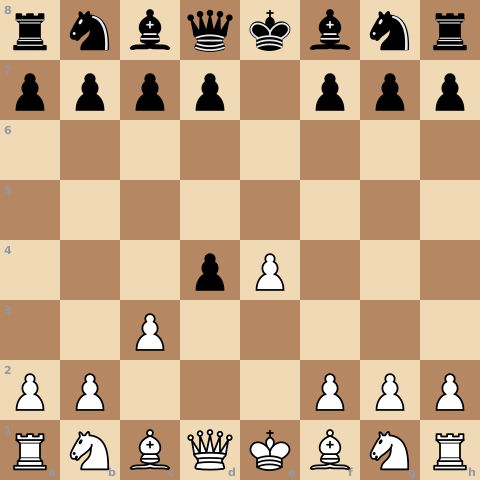
Branch 1: Black accepts, 3...dxc3
The sharpest, most tested branch, and the single most common individual reply at 42% of games. White's main try is 4.Bc4, played in 72% of games that reach this point, developing with immediate pressure toward f7 rather than a quieter alternative like 4.Nc3. From here, Black's most common choice, at 39% of games, is the greediest one: 4...cxb2, grabbing a third pawn. White recaptures with 5.Bxb2, and the bishop now sits on a monster diagonal aimed straight at Black's king.
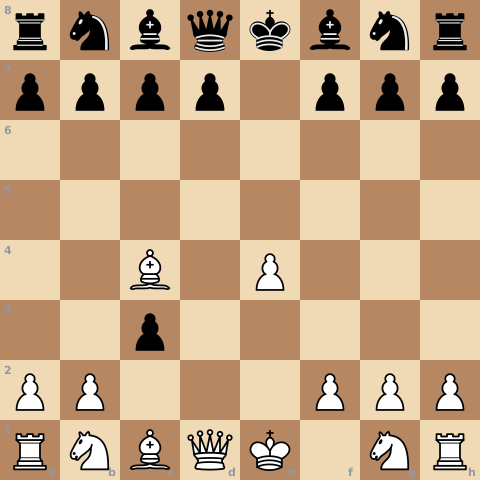
This is where the opening's most famous trap lives. After 5...d5 6.Bxd5 Nf6, attacking the bishop while developing, White doesn't retreat, 7.Bxf7+ takes on f7 with check instead. Black has to recapture with the king, 7...Kxf7, and with the king walked into the open, 8.Qxd8 simply wins the queen. Black's only real practical try is 8...Bb4+, forking king and queen, but after 9.Qd2 Bxd2+, White has traded a bishop for an outright queen, a decisive material result, not just a positional edge.
Black doesn't have to walk into this. Declining the third pawn with an early 4...Bb4+ or 4...Nc6 instead of 4...cxb2 avoids the trap entirely and leads to calmer, still-comfortable positions where White keeps a real lead in development without needing tactics to prove it.
Branch 2: Black declines, 3...d5
The other major try, at 33% of games, striking back in the center immediately instead of accepting material. White responds 4.exd5, played in 80% of games here, and Black recaptures with 4...Qxd5 the large majority of the time, though this costs a real tempo: the moment White plays Nc3 (or develops the knight elsewhere), the queen becomes a target.
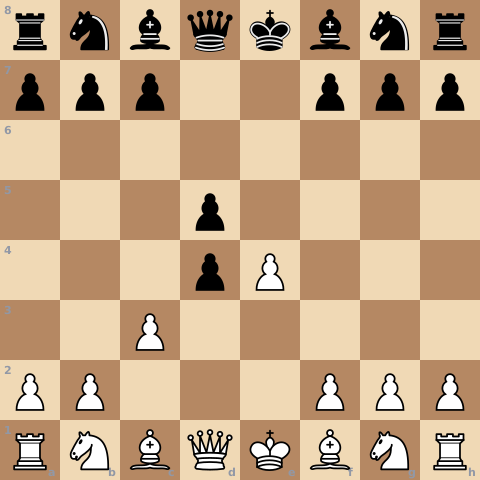
White continues 5.cxd4, restoring a full classical center, and the main line runs 5...Nc6 6.Nf3 Bg4, pinning White's newly-developed knight, 7.Be2 Bb4+ 8.Nc3, blocking the check with the last piece that needed developing anyway.
This branch runs genuinely deep, real, well-tested theory through move 15 or later in several of the lines covered here, all built around the same core idea: White reaches full development and genuine central control, with the bishop pair as a lasting asset, regardless of the exact move order Black chooses to get there.
Strategic ideas in the Danish Gambit
A handful of ideas recur across both branches, recognizing them explicitly is worth more than memorizing 20 separate lines as unrelated sequences:
- The lead in development is the point, not a side effect. Every pawn given up buys real time, time you should spend developing and attacking, not chasing the pawns back immediately.
- f7 is the target, always. Whether it's the direct bishop sacrifice in the main trap line or just sustained pressure in the quieter branches, Black's exposed king is what all this compensation is actually for.
- A third pawn is the single most tempting, most dangerous choice Black can make. 4...cxb2 is genuinely the most common try in our data, and it's also the exact move that runs into the opening's most famous trap. Know this line precisely.
- Declining with 3...d5 is completely sound, and White doesn't get anything for free against it. The resulting positions still favor White in development and central control, but there's no shortcut, real, patient play is required.
- The bishop pair matters throughout the Declined branch specifically. Several of the deepest lines here end with White holding both bishops on an open board, a real, lasting structural asset independent of any immediate tactics.
- This is a repertoire that rewards calculation, not memorization alone. Real tactics decide several of these lines. Understanding why the moves work matters more here than in a quieter, more positional opening.
Who should play the Danish Gambit?
The Danish Gambit is a strong fit for players who are already comfortable calculating forcing lines and accepting real material sacrifices for attacking chances. This isn't a first opening, it rewards a player who can already spot when a king is exposed and knows how to press that kind of advantage.
It's also a genuinely good complement to a quieter, more positional main weapon. If your regular repertoire is built around something like the London System, the Danish Gambit is worth keeping in your back pocket for the days you want a real fight instead of a slow buildup.
It's a weaker fit if you're newer to chess or specifically looking to avoid complications. Down two pawns against an opponent who defends accurately, particularly one who declines correctly with 3...d5, you don't get anything for free, and the resulting positions demand real calculation rather than a memorized plan.
Common mistakes in the Danish Gambit
- Playing White and rushing to win the pawns back instead of prioritizing the attack. The whole point of the gambit is the lead in development. Trading it away for material defeats the purpose of choosing this opening in the first place.
- Playing Black and accepting all three pawns without calculating first. 2...exd4, 3...dxc3, and 4...cxb2 in sequence is exactly the path that runs into the opening's most decisive trap. Know what comes next before playing it.
- Playing White and retreating the bishop passively when it's attacked, instead of looking for the more forcing option the position often allows. The bishop sacrifice on f7 is a real, thematic idea in this opening, not a one-off trick.
- Playing Black and declining the gambit with something other than the well-tested 3...d5. Passive declines give up the center's tension without actually solving the problem the gambit poses.
- Assuming the opening only works if the opponent doesn't know it. The Accepted branch's real compensation, and the Declined branch's genuine central control and development lead, both hold up against accurate defense. This isn't purely a trap.
Frequently asked questions
Is the Danish Gambit sound?
With accurate play from Black, particularly declining with 3...d5, White doesn't get a guaranteed advantage. But it creates real, practical problems for Black to solve over the board, and it's remained a genuinely active weapon right through to today, our data shows a real resurgence in the 2020s specifically.
What happens if Black just takes all three pawns?
That's the single most tested, most dangerous line in the whole repertoire for Black. In our validated data, this exact sequence, 2...exd4, 3...dxc3, 4...cxb2, runs into a bishop sacrifice on f7 that wins the queen outright, one of the most famous traps in the opening.
Is the Danish Gambit good for beginners?
It's better suited to players already comfortable calculating forcing lines and accepting real material sacrifices, rather than as a first opening. Something like the London System is a gentler starting point.
What's the best way for Black to meet the Danish Gambit?
Declining with 3...d5 is the most solid, well-tested approach in our data, striking back in the center immediately rather than accepting pawns that come with real attacking compensation for White.
Where does the name "Danish Gambit" come from?
It's named for Martin Severin From, a Danish player who played it at the 1867 Paris tournament, the first major international event a Dane had entered. The idea itself is older: the Swedish player Hans Lindehn was already playing 3.c3 regularly by the late 1850s, and beat a young Wilhelm Steinitz with it in 1864, three years before Paris.
Related openings
- Scotch Game — Another direct, early central strike against 1...e5, a natural, less committal alternative if you want central play without offering a second pawn.
- Italian Game — A calmer, more positional way to meet 1...e5 for the days you'd rather build an edge gradually than sacrifice material for it outright.
Practice every real line against master-game replies, with a plain-English explanation on every move.
Practice Danish Gambit free →