The Alapin Variation: A Complete Guide
The Alapin Variation arises after 1.e4 c5 2.c3, and it's one of the most popular ways for White to meet the Sicilian Defense without stepping into the enormous body of theory that the main-line Open Sicilian demands. This guide covers a complete White repertoire against it, built from 82,257 real master games, a large, rigorously verified dataset, answering all three of Black's genuinely common replies with one coherent plan rather than a separate deep theoretical battle for each one.
Quick facts
| Moves | 1.e4 c5 2.c3 |
| Played as | White |
| Best for | Roughly 900–2000 rated players, especially club and tournament players |
| Style | Solid, positional |
| Games analyzed | 82,257 real master games |
| Lines covered here | 25 (across 3 real Black replies) |
What is the Alapin Variation?
The Sicilian Defense (1...c5) is the single most popular reply to 1.e4 at every level of chess, and the traditional main-line response, the Open Sicilian, starting with 2.Nf3 followed by 3.d4, carries with it one of the largest, most demanding bodies of opening theory in the entire game. The Alapin Variation exists specifically to sidestep that theory. Rather than opening the position immediately, White plays 2.c3, preparing to meet Black's next move with d4, building a full classical center on White's own terms instead of reacting to whatever sharp system Black has prepared against the Open Sicilian.
This isn't a passive or purely defensive choice. It's a deliberate, well-respected way to reach genuinely comfortable, well-understood positions while carrying dramatically less memorization burden than the alternative. Many players who reach a strong club level specifically adopt an anti-Sicilian system like the Alapin at some point precisely because keeping up with the Open Sicilian's theoretical demands across every single sub-variation becomes a genuine time cost, not because the Open Sicilian is somehow worse in principle. The repertoire here is built around the exact same idea in every single line: develop naturally, complete the center with d4, and let the resulting structure do the work, regardless of which of Black's three common replies actually shows up over the board.
A recurring structural theme worth understanding from the start: in a large share of this repertoire's real, verified lines, White ends up recapturing on d4 with the c3-pawn, which leaves White with an isolated queen's pawn on d4 rather than a fully connected center. That trade-off is deliberate, not an accident to avoid. In exchange for the isolated pawn, White typically gets rapid piece activity, an open c-file and often an open e-file to operate on, and active diagonals for the light-squared bishop (heading to c4 or d3) and the dark-squared bishop (often to g5). This is a completely standard, well-understood tradeoff in classical chess, not a structural weakness this repertoire is quietly hoping you won't notice.
How to play the Alapin Variation: move by move
Every line below starts 1.e4 c5 2.c3, meeting Black's Sicilian with the Alapin's defining idea before Black even gets to choose a specific system. From here, the real-game data reveals three genuinely common Black replies, each covered in full.
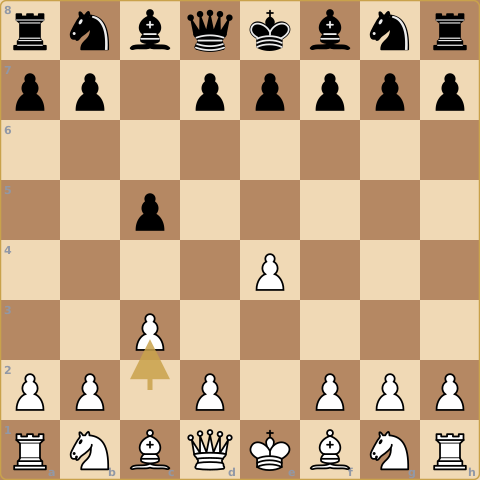
Reply 1: The natural developer, 2...Nf6
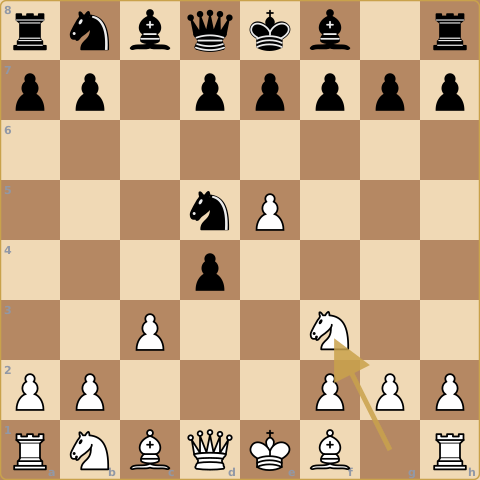
The single most flexible response, Black develops a piece rather than committing the center immediately. White's answer is direct: 3.e5, pushing the pawn forward rather than defending it, gaining space and kicking the knight in the same move. Black retreats with 3...Nd5, still eyeing White's center from a distance, and the position continues with 4.d4 cxd4 5.Nf3, developing before recapturing. This is exactly the branch that most often leads to the isolated d4 pawn described above, since White typically recaptures on d4 with the c3-pawn a move or two later, trading structural symmetry for faster piece activity. It's one of the richest branch points in the whole repertoire. From here Black has several real, common continuations: 5...Nc6, developing and adding pressure on White's center; 5...e6, the quieter, more solidifying choice; and 5...d6, challenging White's advanced e5 pawn directly. Each appears with genuine frequency in the data and each leads to its own well-tested structure, with White's development plan staying consistent across all three.
Reply 2: The immediate center strike, 2...d5
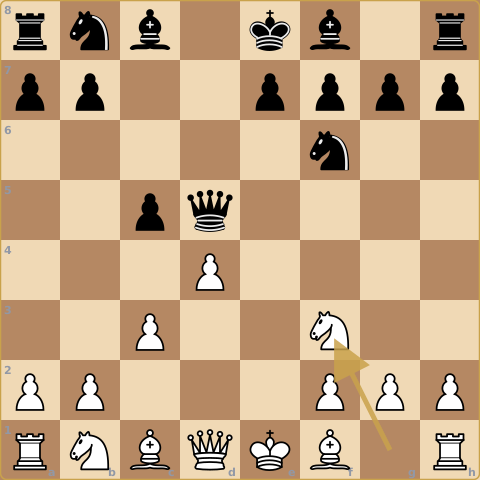
Black meets White's center plan with an immediate central strike instead of developing first. White responds simply: 3.exd5, opening the position, and Black recaptures with 3...Qxd5, bringing the queen out early. It's worth being precise about what happens next and why: this early queen sortie doesn't actually get chased around by tempo-gaining knight moves the way it might in similar lines elsewhere, because White's own c3-pawn already occupies the square a knight would normally use to attack the queen from c3. With that square unavailable, White simply develops smoothly instead: 4.d4, completing the classical center now that development allows it, and 5.Nf3, developing the kingside knight toward its most natural square. The queenside knight typically joins in later via Na3, heading toward the active c4 square (or b5), a genuinely thematic maneuver in this repertoire, rather than the more familiar Nc3 that simply isn't available here. Black has three genuinely common answers to White's setup: the natural ...Nf6 or ...Nc6, or the more active ...Bg4, pinning White's newly-developed knight. This branch runs genuinely deep, with real, distinct continuations depending on which of these three Black chooses.
Reply 3: The solid setup, 2...e6
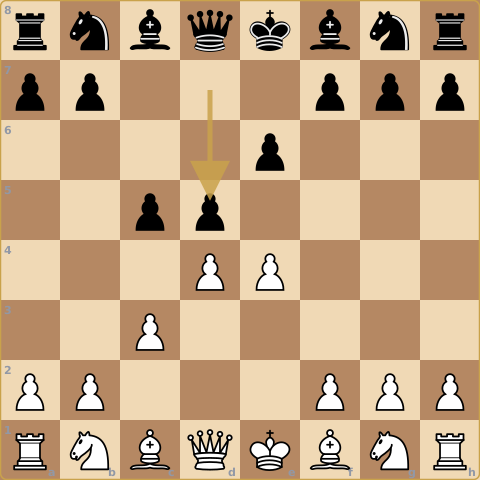
The quietest of the three replies, Black solidifies the position and prepares further development without committing the center either way yet. White continues with the same core plan, 3.d4, and Black has two genuinely common follow-ups in the data: 3...d5, striking the center directly, or 3...cxd4, simply resolving the tension immediately rather than adding to it. The 3...d5 branch is worth naming precisely, since it genuinely transposes into real, well-known French Defense territory: this repertoire's verified continuation is 4.exd5, which leads directly into the French Defense's Exchange Variation structure. (For context, if White instead pushes 4.e5, the game would transpose into the French Defense's Advance Variation instead. That's not what this repertoire recommends here, but it's worth recognizing if you already know the French, since it's the same underlying structural family either way.) Either way White responds, the plan doesn't change: complete natural development and let the classical center do its work, the same governing idea as the other two replies.
Strategic ideas in the Alapin Variation
A handful of ideas recur across all three of Black's replies, since White's underlying plan barely changes regardless of what Black tries, recognizing them explicitly is worth more than treating each of the 25 lines here as a separate thing to memorize on its own:
- c3 exists for one specific reason: to make d4 possible without losing the center to a trade. Every other idea in this repertoire follows from successfully completing that classical center.
- The isolated queen's pawn on d4 is a deliberate trade, not a weakness to fear. In a large share of this repertoire's lines, White ends up recapturing on d4 with the c-pawn, giving up a fully connected center for real, ongoing compensation: an open c-file, often an open e-file too, and active diagonals for both bishops (c4 or d3 for the light-squared bishop, g5 for the dark-squared one). Playing these positions well means using that activity, not quietly hoping the isolated pawn goes unnoticed.
- Against 2...Nf6, e5 is an active choice, not just "the only move." Pushing forward and gaining space while kicking the knight is a genuinely aggressive, principled decision, not simply defending the e4 pawn passively.
- The queen-recapture line (2...d5) trades Black's central pawn tension for a comfortable, well-supported center for White. Rather than a series of forced attacks on the queen, the real advantage is structural: White completes a full classical center and develops naturally while Black's early queen sortie hasn't accomplished much beyond recapturing a pawn, and may even need to move again later to avoid getting in the way of Black's own development.
- This whole system is about controlled, low-theory soundness, not raw aggression. The Alapin won't produce the sharpest tactical fireworks in chess, but it reliably avoids being caught in someone else's deep opening preparation, which over a long tournament or a long online session is often worth more than a handful of extra sharp lines.
- The same c3-then-d4 idea works regardless of Black's move order. Whether Black develops first, strikes the center immediately, or plays the quiet ...e6, White's actual plan is remarkably consistent, which is exactly what makes this a genuine repertoire rather than three separate openings bundled under one name.
- Recapturing correctly after central exchanges matters more than chasing tactics that aren't really there. In more than one line here, the real advantage White gets is a sound, comfortable structure, not a forced sequence of attacking moves. Recognizing the difference between genuine tactical pressure and simply having a good position is part of what separates confident Alapin play from constantly looking for a knockout blow that isn't on the board.
Who should play the Alapin Variation?
The Alapin Variation is a strong fit for players roughly 900 to 2000 rated, with a style best described as solid and positional. If you're tired of the Sicilian Defense forcing you into a memorization arms race just to survive the opening as White, the Alapin offers a genuine, respected way out: one coherent plan that holds up against all three of Black's common replies, rather than a separate deep theoretical battle for each one.
It's also a strong match if you're a player who values understanding a position over memorizing forced lines. Since the same core idea (complete the center with d4, develop naturally, let the structure work in your favor) carries across this entire repertoire, you're learning one plan deeply rather than three plans shallowly. That matters more in practice than it might sound: an opponent who has memorized a specific Open Sicilian refutation to your exact intended setup can neutralize months of preparation in one game, while an opponent facing the Alapin has to actually out-play you in a structure neither of you has necessarily seen before.
It's a weaker fit if you specifically want the sharpest, most theoretically loaded fight against the Sicilian available to White. The Open Sicilian genuinely does offer more forcing, more thoroughly analyzed tactical battles, at the direct cost of the enormous preparation burden the Alapin exists to avoid.
Common mistakes in the Alapin Variation
- Playing d4 before c3 is actually ready to support it. The entire structural point of this variation is preparing the center properly first. Rushing it defeats the purpose of choosing the Alapin over the Open Sicilian in the first place, and can leave the center weaker than either the Alapin or the Open Sicilian would on their own.
- Treating 3.e5 against ...Nf6 as purely defensive. It's an active, space-gaining decision that also kicks the knight. Passive play here gives up the tempo advantage the move is specifically designed to create, and the resulting extra central space tends to pay off for the rest of the middlegame, not just the opening.
- Missing that this line is about a sound center, not a forced tempo chase. Once Black's queen recaptures on d5, White's plan is to complete development naturally (d4, then Nf3) rather than treat every move as an attack on the queen. The real advantage here is a well-supported center and comfortable development, not a series of forced queen moves.
- Assuming "low-theory" means "low-effort." The Alapin genuinely reduces the memorization burden compared to the Open Sicilian, but it still rewards understanding the structures behind all three of Black's real replies, not just the first few moves.
- Looking for a forced tactical shot where the real advantage is structural. Not every line here ends with a concrete attack. Several of the deepest, best lines simply reach a comfortable, well-developed position. Playing on with patience in those positions is often the correct plan, not a sign nothing is happening.
Frequently asked questions
Is the Alapin Variation good for beginners?
It's a strong fit slightly above absolute-beginner level, rated well for roughly 900 to 2000. Its main appeal is reducing the enormous memorization burden of the Open Sicilian while still reaching genuinely sound, comfortable positions, and unlike some low-theory systems, it doesn't ask you to give up real winning chances in exchange for that simplicity.
Why do players choose the Alapin instead of the Open Sicilian?
The Open Sicilian carries one of the largest bodies of opening theory in chess. The Alapin reaches solid, well-understood positions with dramatically less memorization required, while still giving White real chances for an advantage, and it holds up against a wide range of opponent preparation, since there's simply less specific theory for an opponent to have studied against it in the first place.
What are Black's main replies to the Alapin Variation?
Three genuinely common responses show up in real games: 2...Nf6 (developing naturally, met with an active e5 push that genuinely attacks the knight), 2...d5 (striking the center immediately, met with an exchange and a solid center for White), and 2...e6 (the quietest option, transposing into French Defense Exchange Variation structures once White plays 4.exd5 after the central tension resolves).
Is the Alapin Variation considered passive or drawish?
Not by reputation. While it's lower-theory than the Open Sicilian, White retains real winning chances in every line, particularly against 2...Nf6, where the active e5 push genuinely gains space and forces Black onto the back foot immediately.
Does 2...e6 really transpose into the French Defense?
Yes, genuinely, not just in a loose thematic sense. After 2...e6 3.d4 d5, this repertoire's verified continuation is 4.exd5, which leads directly into the French Defense's Exchange Variation. If White instead played 4.e5 (not what this repertoire recommends, but a real possibility worth knowing), the game would transpose into the French Advance Variation instead. Either way, a player who already knows French Defense structures has a real head start in this specific branch of the Alapin.
Does the Alapin Variation avoid Sicilian theory entirely?
Not entirely, but substantially. The Alapin has its own body of theory too, particularly in the 2...Nf6 and 2...d5 lines covered here, but it's a fraction of the size of the Open Sicilian's. The ideas also transfer much more readily from one line to the next, since White's underlying plan barely changes across all three of Black's replies, unlike the Open Sicilian, where entirely different structures can arise from Black's different sixth-move choices alone.
Related openings
- London System — The same low-theory, one-plan philosophy as the Alapin, applied against 1...d5/1...Nf6 instead of the Sicilian, pairs naturally into a complete, low-maintenance White repertoire.
- Italian Game — White's answer to 1...e5, completing coverage of Black's three most common replies to 1.e4 alongside the Alapin and French Advance.
Practice every real line against master-game replies, with a plain-English explanation on every move.
Practice Alapin Variation free →