The Slav Defense: A Beginner's Guide
The Slav Defense begins 1.d4 d5 2.c4 c6, and it's one of the most trusted, structurally sound ways for Black to meet 1.d4 without ever having to give up the center. This guide covers a complete Black repertoire against it, built from 61,842 real master games, answering White's real systems with one coherent, engine-verified plan rather than a scattered collection of separately-memorized responses.
Quick facts
| Moves | 1.d4 d5 2.c4 c6 |
| Played as | Black |
| Best for | Roughly 700–1700 rated players |
| Style | Solid, positional |
| Games analyzed | 61,842 real master games |
| Lines covered here | 28 (across 4 real White systems) |
What is the Slav Defense?
The Slav Defense answers White's Queen's Gambit (2.c4) with 2...c6 rather than the more common 2...e6. The difference matters more than it looks: c6 supports the d5 pawn with another *pawn*, not a piece, which means Black's light-squared bishop never gets locked in behind its own pawn chain the way it famously can in the Queen's Gambit Declined. It's the exact same underlying philosophy as the Caro-Kann Defense against 1.e4: support the center with a pawn, keep the bishop free. Just applied one move later, against 1.d4 instead. This isn't a coincidence or a loose comparison; both openings solve the identical structural problem (a light-squared bishop with no good square once the center locks) using the identical solution, which is exactly why players who know one often pick up the other quickly.
The repertoire here follows the classical approach: after 3.Nf3 Nf6 4.Nc3, Black plays the characteristic 4...dxc4, grabbing the pawn Black is offered, then follows up with 5...Bf5 the moment White plays a4 to stop ...b5. Getting that bishop out to f5 before playing ...e6 is, in this repertoire's own words, "the single most important move in the whole Slav." It solves Black's one real structural question in a single move, exactly the same idea that makes the Caro-Kann so reliable.
How to play the Slav Defense: move by move
Every line below starts 1.d4 d5 2.c4 c6, though the real game data shows White reaching this same position through several different move orders (3.Nf3 first, or 3.Nc3 first, or even 1.Nf3 before 2.d4), all genuinely common, all covered, and all converging into the same core systems.
System 1: The Classical / Czech Variation, 3.Nf3 Nf6 4.Nc3, and the characteristic dxc4
This is the classical main line, and where the repertoire's core identity lives. After 4.Nc3, Black plays 4...dxc4, accepting the pawn White offers, "the characteristic Slav idea," as the repertoire itself puts it. White's natural follow-up is 5.a4, immediately ruling out ...b5 so Black can't simply hold onto the extra pawn long-term, and Black responds with the key move of the entire opening: 5...Bf5. This whole position, reached by 5...Bf5, is known as the Czech Variation, the recognized main line of the Slav.
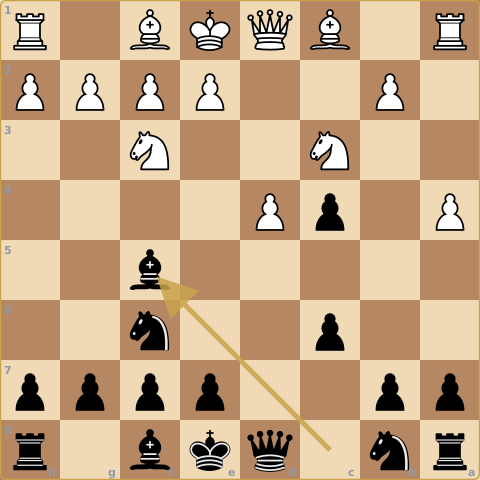
From this point, White has two genuinely distinct real tries in the data:
- 6.e3, developing naturally and continuing with Bxc4, O-O, and a normal fight to win the pawn back with a comfortable position either way (the Dutch Variation). One line runs a full 12 moves deep into a fully mirrored development race, both sides completely safe.
- 6.Ne5, a sharper, more ambitious try that attacks Black's structure directly. The point of this move is specific: White wants to recapture the c4-pawn with the knight (7.Nxc4) rather than the bishop, keeping the light-squared bishop free for other duties and rerouting the knight to a strong square in the process. Black counters with 6...Nbd7!, completing development while specifically preparing the central freeing break ...Qc7 and ...e5, rather than just reacting defensively. After 7.Nxc4, this repertoire covers two genuinely verified continuations in the data: the queenside 7...Qc7, following through on that same plan toward ...e5 (this exact line, 7...Qc7 8.g3 e5, is recognized as the Carlsbad Variation), or the more immediate 7...Nb6, attacking the knight directly and gaining a tempo instead. Both are fully covered here rather than left as a surprise.
System 2: The queen-move approach, 3.Nf3 Nf6 4.Qc2
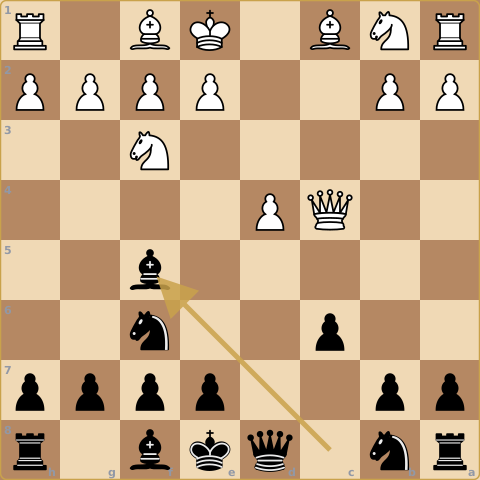
Rather than developing the queenside knight immediately, White brings the queen to c2, keeping options flexible and preparing to meet ...dxc4 without losing time to a4. Black meets this the same way, grabbing the pawn with ...dxc4, and after White recaptures with the queen, continuing with the same ...Bf5 idea, reaching a position with real, specific theory of its own in the data (including a further branch between a quiet g3 setup, fianchettoing the bishop and castling behind it, and a more direct Nc3 continuation that transposes back toward the main system's ideas). Either way, Black's plan doesn't need to change. The whole point of building this repertoire around the ...Bf5 idea is that it holds up regardless of exactly which square White develops the queen or knights to first.
System 3: The Exchange Slav, 3.Nc3 Nf6 4.cxd5
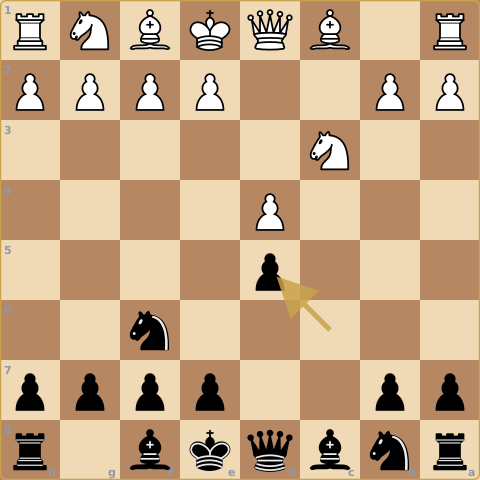
Rather than letting the central tension continue, White simply trades on d5 immediately. Black recaptures with 4...cxd5, "keeping the position symmetrical and solid," in the repertoire's own description. This is the quietest, most drawish-looking branch in the whole opening, and it's exactly that reputation that makes it worth knowing on sight, so a genuinely equal, low-risk position doesn't come as a surprise partway through a game. Some players specifically choose the Exchange Slav as White precisely because they want a safe, well-understood position with reduced risk on both sides, particularly in must-not-lose situations. Recognizing that motivation is part of playing the resulting position well, not just recapturing correctly.
System 4: The Tolush-Geller Gambit, 3.Nc3 Nf6 4.Nf3 dxc4 5.e4
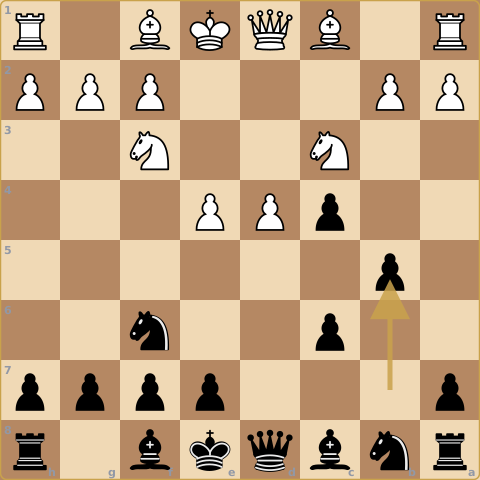
Instead of the calm a4 approach, White can offer a real pawn sacrifice with 5.e4, trying to open the position quickly before Black finishes developing. This repertoire's answer is direct: 5...b5, "holding onto the extra pawn rather than giving it back," a genuinely sharp, real gambit line rather than a quiet transposition, fully covered here rather than left as a surprise the first time it shows up over the board.
Strategic ideas in the Slav Defense
A handful of ideas repeat across nearly every line in this repertoire, and recognizing them explicitly is worth more than treating each of the 28 lines as a separate thing to memorize:
- ...c6 supports the center with a pawn, not a piece. That's the entire point of the opening. Every other idea in this repertoire follows from this one structural decision.
- Grabbing the pawn with ...dxc4 is correct, not greedy. It's described as "the characteristic Slav idea" for a reason. Black isn't trying to hold onto material forever, just to gain a tempo and a moment of initiative before returning it under good terms.
- ...Bf5 before ...e6 is non-negotiable, exactly like the Caro-Kann. This is the single move that keeps the light-squared bishop from ever becoming a long-term liability.
- a4 is White's standard prevention of ...b5, know it on sight. Once you see it, the plan is already decided: get the bishop out immediately with ...Bf5.
- The Exchange Slav isn't a mistake to avoid. It's a legitimate, quiet system to recognize. Some players choose it specifically for its solid, low-risk reputation. Treat it as a real branch worth knowing, not an aberration.
- When White attacks with Ne5, complete development rather than reacting defensively. The natural ...Nbd7 response keeps Black's plan on track without needing to improvise a new idea just because White's playing more actively than the calm e3 approach.
Who should play the Slav Defense?
The Slav Defense is a strong fit for players roughly 700 to 1700 rated, with a style best described as solid and positional. If you've been burned by the "bad bishop" problem in other 1.d4 defenses, or you simply want a reliable, structurally sound answer to 1.d4 that doesn't require memorizing forcing tactics just to survive the opening, the Slav is one of the most respected ways to get there.
It's also a strong match if you already play (or are considering) the Caro-Kann against 1.e4, since both openings share the exact same underlying idea (support the center with a pawn, free the bishop early), learning one genuinely reinforces the other rather than asking you to hold two unrelated philosophies in your head. That overlap is worth more than it might sound: the actual pattern-recognition (get the bishop out before the pawn chain locks it in) transfers directly from one opening to the other, so time spent mastering it in one repertoire pays off in the other too.
It's a weaker fit if you're looking for maximum imbalance and sharp tactical chaos in every single line. While the 5.e4 gambit branch does get genuinely sharp, the Slav's overall identity is soundness and structure first, not chaos for its own sake.
Common mistakes in the Slav Defense
- Playing ...e6 before ...Bf5. Exactly the same structural mistake as in the Caro-Kann. It locks the bishop behind its own pawn chain for the rest of the game, giving up the entire point of choosing the Slav over the Queen's Gambit Declined in the first place.
- Hesitating to take on c4. ...dxc4 is the correct, characteristic move of this whole opening, not a risky gamble. Declining it gives up the repertoire's entire plan for no reason, and no real safety in exchange.
- Treating the Exchange Slav as an opponent's mistake. It's a completely legitimate, intentional system some players choose specifically for its solid reputation. Meeting it with the standard ...cxd5 recapture is correct, not a sign anything's gone wrong.
- Giving the pawn back too early against 5.e4. The repertoire's answer is to hold onto it with ...b5, not return it immediately. Treat this as the real, sharp decision it is, not a moment to simplify the position away out of caution.
- Assuming every move-order transposes safely without checking. White can reach the same core positions through several different move orders (3.Nf3 first, 3.Nc3 first, even 1.Nf3 before 2.d4), and while this repertoire covers all of them, it's worth actually recognizing that they're the same underlying position rather than treating an unfamiliar move order as something entirely new to figure out from scratch.
Frequently asked questions
Is the Slav Defense good for beginners?
It's a strong fit slightly above absolute-beginner level, rated well for roughly 700 to 1700. Its appeal is structural soundness rather than raw simplicity. It rewards understanding one coherent plan (support the center, free the bishop, take the pawn) more than memorizing forced lines, and that understanding tends to keep paying off the longer and more seriously you play it.
What's the difference between the Slav Defense and the Queen's Gambit Declined?
Both meet 2.c4 after 1.d4 d5, but the Queen's Gambit Declined answers with 2...e6, while the Slav answers with 2...c6. That single difference is what lets the Slav's light-squared bishop get out to f5 before the pawn chain closes in. It's the exact structural issue the Queen's Gambit Declined's own bishop can run into, and the entire reason many players choose the Slav over it specifically.
Why does Black take the pawn with ...dxc4 in the Slav?
Because it's a real, sound way to gain a tempo, White has to spend a move (usually a4) preventing Black from permanently holding the extra pawn, and that tempo is exactly what lets Black get the light-squared bishop out safely with ...Bf5 before committing to ...e6. Declining the pawn doesn't lose outright, but it gives up this repertoire's specific, verified plan for no real benefit in return.
Is the Exchange Slav bad for Black?
No, it's simply the quietest, most symmetrical branch of the whole opening. Some players choose it specifically because it leads to a genuinely equal, low-risk position, and recapturing with ...cxd5 is the correct, standard response.
Is the Slav Defense harder to learn than the Queen's Gambit Declined?
Not fundamentally. The total number of lines is similar, but the Slav's core idea (get the bishop out, then take the offered pawn) repeats across most of its branches, the same way the Caro-Kann's core idea does. That kind of repetition tends to make an opening easier to genuinely learn, even when the raw move count looks comparable on paper.
Related openings
- Caro-Kann Advance — The exact same strategic philosophy (support the center with a pawn, keep the bishop free) applied against 1.e4 instead of 1.d4, the natural pairing for a complete Black repertoire.
- London System — See how White approaches 1.d4 d5 structures from the other side of the board, useful context for understanding what your opponents may be trying to do against you.
Practice every real line against master-game replies, with a plain-English explanation on every move.
Practice Slav Defense free →