Is the King's Gambit Sound? Engine Analysis & Refutation
TL;DR
- Bobby Fischer declared the King's Gambit "busted" in a real 1961 article, "A Bust to the King's Gambit," recommending 3...d6 as Black's strongest reply.
- Modern engine analysis broadly supports Fischer's core claim: 3...d6 gives Black a real, lasting edge with best play.
- But in this site's own dataset of 16,167 real games, Fischer's recommended 3...d6 is only played 17% of the time. The line most real players actually choose, 3...g5, is played nearly twice as often, 28%.
- That gap matters: a move being theoretically best and a move being what real opponents will actually play are two different, both-useful facts, and this article treats them as separate rather than collapsing one into the other.
- Deep into the sharpest main line, real games converge hard: 97% and then 88% at consecutive branch points, among the most forced sequences on this entire site.
What "Busted" Actually Means, and What It Doesn't
In 1961, a young Bobby Fischer published an article titled "A Bust to the King's Gambit," arguing that 3...d6, quietly preparing ...g5 while ruling out a specific tactical idea for White, gave Black a real, lasting advantage against the whole opening. Decades of engine analysis since then have broadly confirmed the core of his claim: with precise play, 3...d6 does hold up as a genuine, verified strong response.
That's a real, checkable result. But it answers a narrower question than "is the King's Gambit playable", it answers "does Black have a theoretically best response, if both sides play perfectly." Those are different questions, and this site's own real game data shows exactly how different.
What Real Players Actually Do
1. e4 e5 2. f4
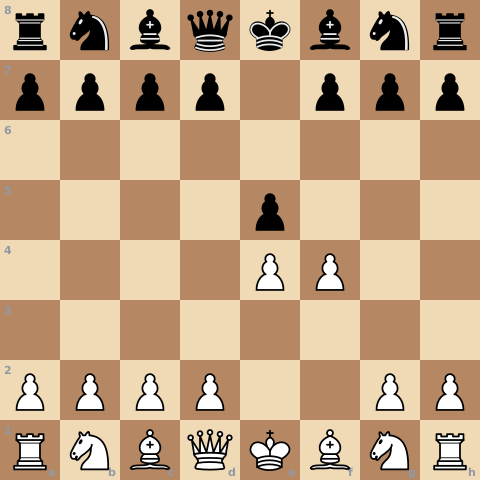
Black's response splits two real ways in this dataset: accepting the gambit outright with 2...exf4 (the pawn on e5 captures the newly-offered pawn on f4, the clear main choice, 53%), or striking back immediately with the Falkbeer Countergambit, 2...d5 (pushing the d-pawn two squares, a real, respected alternative, 22%).
Following the accepted line:
3. Nf3
Played in 72% of real games, ruling out an early check and developing naturally. This is where Fischer's whole argument centers, and where the real data gets interesting.
Black's options here split three ways:
- 3...g5 (pushing the g-pawn one square to defend the extra pawn), the classical way to hold the extra pawn, 28% of real games, the single most common choice.
- 3...d5 (pushing the d-pawn two squares), challenging the center directly, a modern, well-respected alternative, 17%.
- 3...d6 (pushing the d-pawn one square), Fischer's own recommended "bust," 17%, tied for second, not the most common choice at all.
Fischer's engine-verified best move is real and defensible. It is not, in this data, what most real opponents at this level actually play. Someone preparing to face the King's Gambit purely on Fischer's recommendation would still be unprepared for the majority of real games, where 3...g5 shows up more often than 3...d6 does.
Into the Sharpest Line
Following the more commonly played 3...g5:
4. h4
The main choice at 49%, pushing the h-pawn two squares to challenge the g5 pawn before Black can consolidate it. From here, the data becomes about as forced as this site's entire library gets:
4...g4
Pushing the g-pawn one more square to attack White's knight, played in 97% of real games reaching this position, nearly automatic, the whole point of grabbing g5 in the first place.
5. Ne5
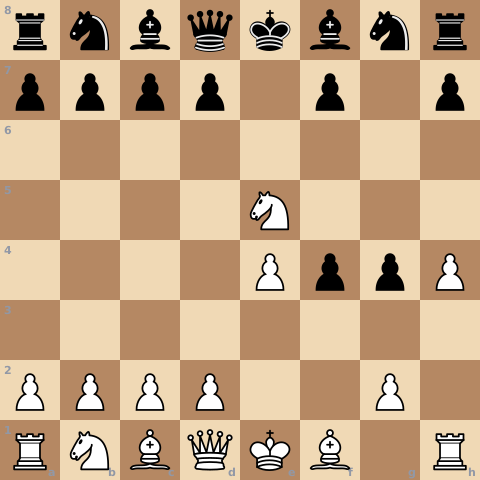
The knight jumps forward to e5, out of the attacked pawn's reach and into a genuinely active square, played in 88% of real games, one of the most famous single moves in the entire history of chess opening theory, the Kieseritzky Gambit. Two consecutive branch points at 97% and 88% is a genuinely rare level of convergence, real players overwhelmingly agree on what to do here, even if they disagree earlier about whether to play 3...g5 or 3...d6 in the first place.
So, Is It Sound?
Both things are true at once, and this site's own data backs both: Fischer's engine-supported claim about 3...d6 holds up as a real, verified result, and real players at this rating level mostly aren't playing that line anyway, they're heading into the sharp, nearly-forced Kieseritzky structure instead, where practical chances run both ways regardless of what a silicon evaluation says about the position on move three.
"Busted" in the engine-analysis sense and "unplayable" in the practical sense are not the same claim. This repertoire covers both realities: the Fischer's Defense line Bobby himself recommended, and the far more commonly faced Kieseritzky structure that most real opponents will actually steer toward.
Read the full King's Gambit repertoire →
Try It Yourself for Free
Every line above, both Fischer's engine-approved defense and the sharp, nearly-forced Kieseritzky structure most real opponents actually play, is fully interactive on this site. All 36 openings, including the King's Gambit, are completely unlocked during this site's open beta, no card, no limit, no account required to start, with your progress tracked for free if you create one.
Every line checked the same way, against real game data, not against what sounds right.
Browse all 36 openings free →