The Catalan Opening: A Complete Guide
The Catalan Opening arises after 1.d4 Nf6 2.c4 e6 3.g3. It's one of the most respected long-term positional weapons in all of chess. White adds a long-range kingside fianchetto to the usual Queen's Gambit ideas, pressuring Black's queenside for the entire game rather than just the opening. This guide covers a complete White repertoire, built from 51,499 real, individually validated games across four combined datasets, answering all of Black's genuinely major replies.
Quick facts
| Moves | 1.d4 Nf6 2.c4 e6 3.g3 |
| Played as | White |
| Best for | Roughly 1400–2200 rated players |
| Style | Positional |
| Games analyzed | 51,499 real, individually validated games across four combined datasets |
| Lines covered here | 27 |
What is the Catalan Opening?
After 1.d4 Nf6 2.c4 e6, most White repertoires develop a piece toward the center directly. The Catalan does something more patient: 3.g3 prepares a fianchetto onto the long a1-h8 diagonal, combining the central control of the Queen's Gambit with the long-range pressure of a hypermodern bishop. The result is a genuinely different kind of advantage than most 1.d4 openings offer, not a quick tactical edge, but a small, persistent pressure that can last deep into the middlegame and even the endgame.
The Catalan's origin is genuinely deliberate, not organic. It was commissioned for the 1929 Barcelona tournament, where organizers specifically asked Savielly Tartakower to create a new opening system as a tribute to Catalonia's chess history, and it's carried real weight ever since. Vladimir Kramnik, Viswanathan Anand, and Magnus Carlsen have all employed the Catalan in their own World Championship title games, a level of sustained elite use that few openings can match.
How to play the Catalan Opening: move by move
Every line below starts 1.d4 Nf6 2.c4 e6 3.g3. From here, Black has several genuinely major replies in the real-game data, and this repertoire answers each with real, tested continuations.
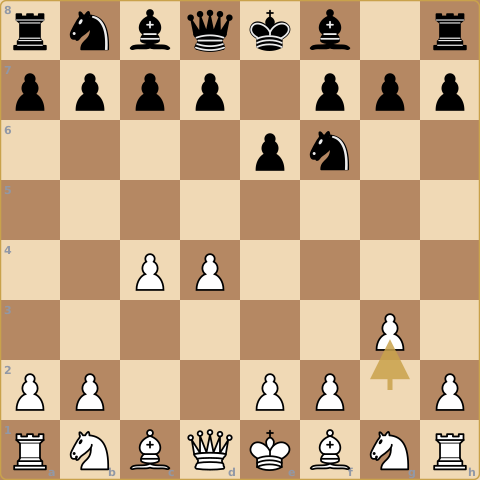
The sharp try: 3...Bb4+
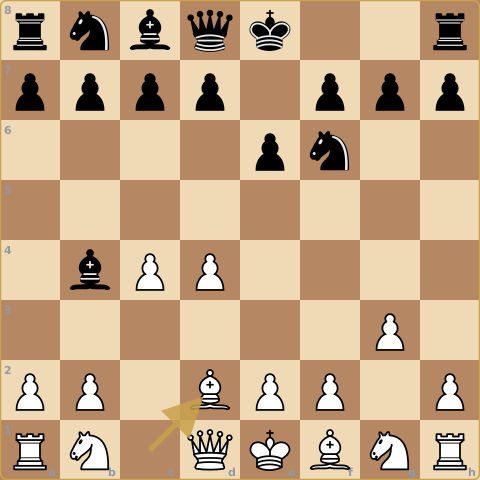
Black checks immediately, before committing to a central plan. White responds with 4.Bd2, blocking the check and offering a trade rather than moving the king or interposing a different piece.
The main systems: 3...d5
Black strikes in the center directly, the most common continuation in the data. White completes the fianchetto with 4.Bg2, and from here Black makes the opening's defining decision: 4...Be7, developing solidly and preparing to castle rather than resolving the central tension, leading into the Closed Catalan, or 4...dxc4, resolving the tension immediately by grabbing the pawn, leading into the Open Catalan, one of the most thoroughly analyzed structures in the entire opening.
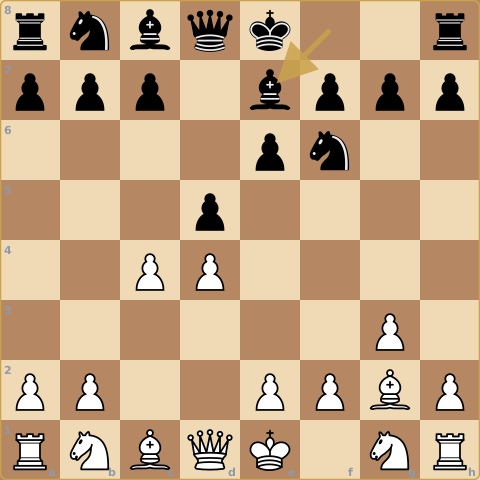
The Open Catalan is where the fianchettoed bishop really earns its keep. Once Black's d-pawn leaves d5 to grab on c4, White's bishop on g2 has a completely clear run down the long diagonal, all the way to b7 and the rook sitting on a8 behind it. That's exactly why White is happy to let the pawn go in the first place: the bishop's pressure genuinely paralyzes Black's queenside development, since ...b6 or ...Bb7 both walk straight into it. Recovering the pawn itself is straightforward. White typically continues 5.Nf3, developing before the recapture, followed by 6.Qc2 or the more direct 6.Qa4+, or sometimes Ne5 instead, hitting c4 from a different angle. The pawn comes back one way or another, the bishop's diagonal is the real, lasting prize.
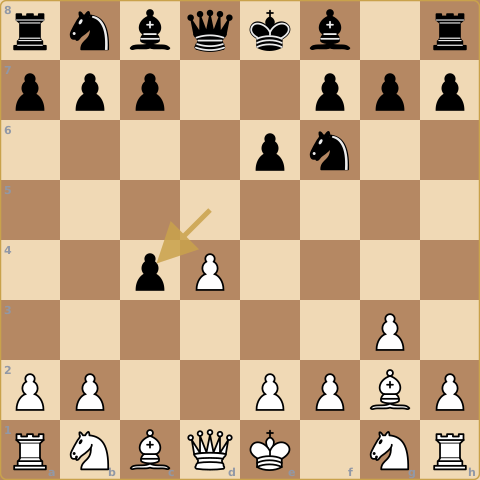
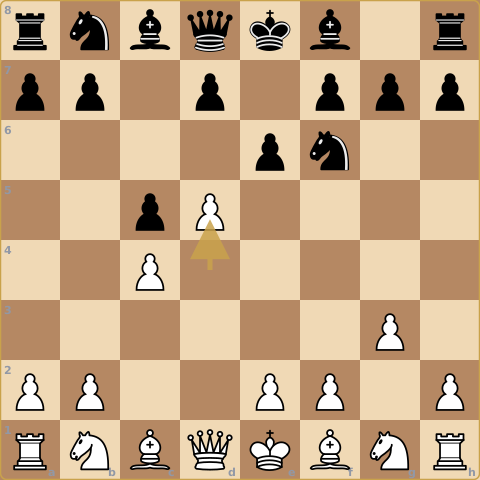
The Benoni-flavored try: 3...c5
Rather than striking in the center directly, Black challenges from the other side. White responds with 4.d5, "pushing forward and gaining space rather than trading," leading into structures that share real strategic similarities with the Benoni Defense.
Strategic ideas in the Catalan Opening
A handful of ideas repeat across this entire repertoire:
- The Catalan's pressure is long-term, not immediate. Unlike sharper 1.d4 systems, the fianchettoed bishop's influence on the long diagonal often matters most well into the middlegame or even the endgame, patience is part of the opening's whole identity.
- 3...Bb4+ is a genuine, forcing check, not a minor inconvenience. White's king really is in check the moment the bishop lands on b4, and 4.Bd2 is the standard, correct response.
- The g2-bishop is the Catalan's real long-term weapon. Once it's aimed down the open a1-h8 diagonal, it isn't just a developed piece, it can genuinely paralyze Black's queenside. In the Open Catalan specifically, White lets the c4-pawn go precisely because the resulting open diagonal, bearing down on b7, c6, and the a8-rook, is worth more than the pawn itself.
- The Open and Closed Catalan are genuinely different structures. Whether Black grabs the pawn with ...dxc4 or develops solidly with ...Be7 leads to real, different middlegames, recognizing which one is on the board matters more than having one fixed follow-up plan.
- This opening has real, sustained World Championship pedigree. Kramnik, Anand, and Carlsen all used it in their own title matches, a meaningfully stronger endorsement than an opening merely being "considered sound" by analysts.
- 3...c5's Benoni-flavored structures reward familiarity with that opening's own ideas. Recognizing the strategic overlap between the two can transfer real understanding from one to the other.
Who should play the Catalan Opening?
The Catalan Opening is a strong fit for players roughly 1400 to 2200 rated, with a style best described as positional. If you want a genuinely patient, long-term way to press for an advantage as White, one with real, documented elite pedigree across multiple World Championship matches, the Catalan is one of the most respected ways to do it.
It's also a strong match if you enjoy technical, grinding positions where a small, persistent edge can be nursed for many moves rather than resolved quickly. This is not an opening built around early tactical fireworks.
It's a weaker fit if you specifically want sharp, immediate complications as White. While 3...Bb4+ does introduce some early tactical decisions, the Catalan's overall identity is patient, positional pressure, not a quick knockout.
If the fianchetto isn't what you're after, the Queen's Gambit Declined reaches similar central structures through more classical development, and carries a great deal less theory.
Common mistakes in the Catalan Opening
- Treating 3...Bb4+ as a minor inconvenience rather than a real check. It's a genuine, forcing check and needs to be met precisely with 4.Bd2 rather than brushed off.
- Confusing the Open and Closed Catalan. These are genuinely different structures depending on whether Black plays ...dxc4 or ...Be7, treating them as interchangeable means missing real, specific plans for each.
- Expecting a quick tactical advantage. The Catalan's real strength is long-term positional pressure, playing it while looking for immediate complications misunderstands what the opening is actually built to deliver.
- Underestimating 3...c5's Benoni-flavored structures. These lead to real, distinct positions worth understanding on their own terms, not just a sideline to brush past on the way to the more common 3...d5 lines.
Frequently asked questions
Is the Catalan Opening good for beginners?
It's a strong fit slightly above absolute-beginner level, rated well for roughly 1400 to 2200. Its appeal is patient, long-term positional pressure rather than sharp tactics, which rewards some existing positional understanding more than raw memorization.
Why is it called the Catalan Opening?
It was commissioned for the 1929 Barcelona tournament, where organizers specifically asked Savielly Tartakower to create a new opening system as a tribute to Catalonia's chess history, one of the few openings in chess with such a deliberate, documented origin.
Has the Catalan Opening really been played at World Championship level?
Yes, Vladimir Kramnik, Viswanathan Anand, and Magnus Carlsen have all employed the Catalan in their own World Championship title games, a level of sustained elite use that few other openings can match.
What's the difference between the Open and Closed Catalan?
The Open Catalan arises when Black plays 4...dxc4, resolving the central tension by grabbing the pawn, one of the most thoroughly analyzed structures in the whole opening. The Closed Catalan arises from 4...Be7, where Black develops solidly instead, keeping the central tension unresolved for longer.
How does White regain the pawn in the Open Catalan?
There's no rush, and that's the whole point. White typically plays 5.Nf3 first, developing before worrying about material, then follows up with 6.Qc2 or 6.Qa4+, or sometimes Ne5 instead, to win the c4-pawn back. Even before it's recovered, the open a1-h8 diagonal is already doing real work against Black's queenside, which is exactly why White doesn't mind letting the pawn sit for a few moves.
Practice every real line against master-game replies, with a plain-English explanation on every move.
Practice Catalan Opening free →