The Bogo-Indian Defense: A Complete Guide
The Bogo-Indian Defense arises after 1.d4 Nf6 2.c4 e6 3.Nf3 Bb4+. It's a solid, flexible answer for Black whenever White avoids the Nimzo-Indian by developing the knight to f3 instead of c3. The two openings are natural twins: if White plays 3.Nc3, Black meets it with 3...Bb4 and the Nimzo-Indian. If White sidesteps that with 3.Nf3 instead, Black meets it with 3...Bb4+ and the Bogo-Indian. Either way, Black ends up with the same harmonious, dark-square-focused plan against 1.d4. This guide covers a complete Black repertoire, built from 35,711 real, individually validated games across two combined datasets, answering both of White's genuinely major responses.
Quick facts
| Moves | 1.d4 Nf6 2.c4 e6 3.Nf3 Bb4+ |
| Played as | Black |
| Best for | Roughly 1200–2000 rated players |
| Style | Positional, solid |
| Games analyzed | 35,711 real, individually validated games across two combined datasets |
| Lines covered here | 22 |
What is the Bogo-Indian Defense?
When White plays 3.Nf3 instead of 3.Nc3, specifically to sidestep the Nimzo-Indian Defense, Black has a real, genuine resource available: 3...Bb4+ checks immediately, since there's no knight on c3 to block the diagonal. This is a real, forcing check that demands an immediate response, leading into solid, flexible positions rather than the sharper theory of the full Nimzo-Indian. It's worth seeing the two openings as one coherent system rather than separate ones to learn: whichever knight move White chooses, Black answers with the same active bishop check on b4, keeping the same dark-square strategy either way.
The opening is named after Efim Bogoljubov, the Russian-born grandmaster who represented Germany and became the first FIDE World Champion in 1928, twice challenging Alexander Alekhine for the World Championship title itself, in 1929 and 1934. Worth being precise here: the Bogo-Indian itself has never actually been played in a World Championship match, and Bogoljubov's own personal record with his namesake opening was a losing one. Its real value isn't tied to a single famous game. It's a genuinely sound, still widely played system today, currently the third most common response after 1.d4 Nf6 2.c4 e6 3.Nf3, behind only the Queen's Indian and the Queen's Gambit Declined.
How to play the Bogo-Indian Defense: move by move
Every line below starts 1.d4 Nf6 2.c4 e6 3.Nf3 Bb4+. From here, White has two genuinely major, theoretically independent ways to block the check, and this repertoire answers both with real, tested continuations.
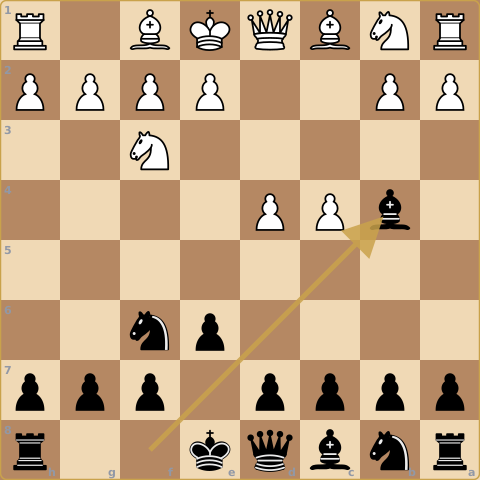
The main line: 4.Bd2
White's most popular response, blocking the check with the bishop and offering a trade. Black's most common reply in the data is 4...Qe7, keeping the bishop and preparing to meet a trade with a recapture that keeps development flexible, known as the Nimzowitsch Variation, avoiding an immediate exchange while keeping real options open.
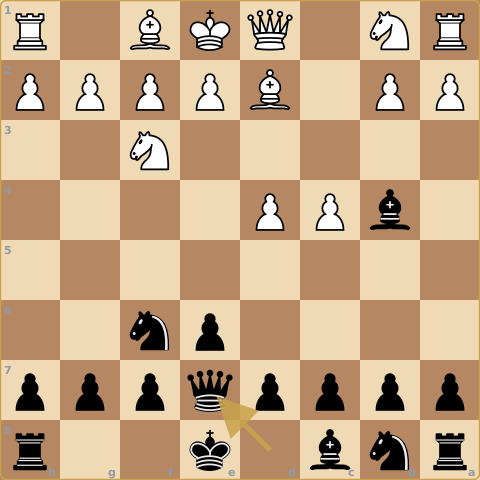
Black's plan from here is concrete. Once the dark-squared bishops come off on d2, Black follows up with ...d6 and the central strike ...e5!, locking down the center and freeing the remaining minor pieces to find active squares. It's a quiet-looking plan, but a genuinely purposeful one: the trade removes White's own dark-squared bishop from the board first, then Black claims real central space while that imbalance still favors Black's remaining pieces.
The alternative: 4.Nbd2
Rather than offering a trade, White blocks the check with a knight, keeping both bishops on the board. Black responds with 4...O-O, castling into safety before deciding on the bishop's future, a natural, flexible choice that doesn't commit to anything premature.
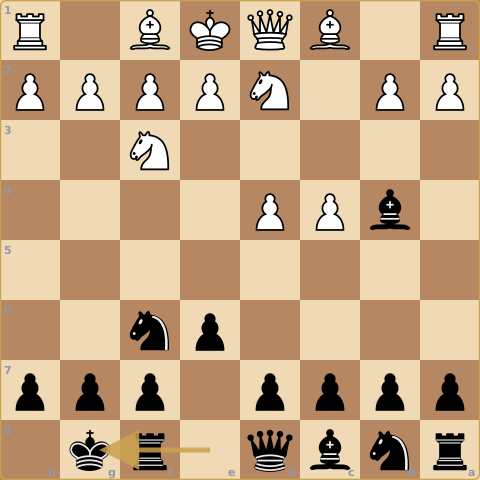
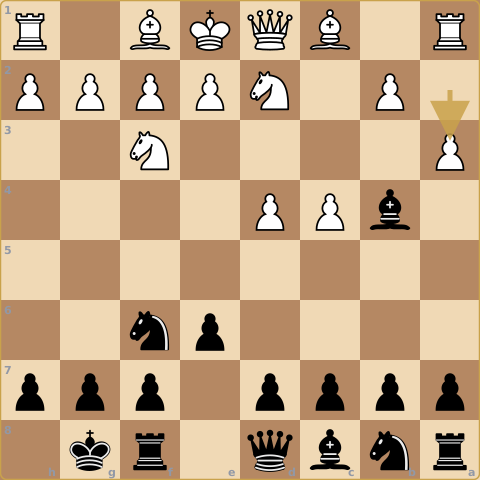
White typically continues with one of three real tries: 5.a3 (asking the bishop to decide right away), 5.g3 (preparing to fianchetto while keeping the tension on b4 for now), or 5.e3 (supporting the center and preparing to develop the last bishop).
Strategic ideas in the Bogo-Indian Defense
A handful of ideas repeat across both of White's responses:
- 3...Bb4+ is a genuine, forcing check, not just an aggressive-looking placement. With no knight on c3 to block, the bishop really does deliver check the moment it lands on b4, demanding an immediate response from White.
- The Bogo-Indian and the Nimzo-Indian are two halves of one system. Black plays the same active bishop check on b4 whether White develops the knight to c3 (the Nimzo) or f3 (the Bogo), giving Black one coherent, dark-square-focused answer to 1.d4 regardless of which knight move White chooses.
- 4.Bd2 and 4.Nbd2 lead to genuinely different structures. Whether White offers a bishop trade or keeps both bishops changes the resulting middlegame meaningfully, recognizing which one is on the board matters more than having one fixed follow-up plan.
- ...d6 and ...e5 are the real follow-through in the 4.Bd2 Qe7 line. Once the dark-squared bishops are traded on d2, claiming the center with these two moves is what actually cashes in on that trade, activating Black's remaining pieces rather than just settling into a quiet, equal-looking position.
- This opening's value doesn't depend on a single famous result. Unlike some openings with a dramatic signature game, the Bogo-Indian's real strength is its consistent, ongoing popularity as a sound, practical way to sidestep sharper Nimzo-Indian theory.
- Keeping the bishop with ...Qe7 preserves real flexibility. Rather than resolving the tension immediately, this approach keeps Black's options open about exactly how and when to trade or retreat the bishop.
- Castling early in the 4.Nbd2 line is about safety first, decisions second. Committing to a specific plan for the bishop can wait until White's own follow-up (a3, g3, or e3) clarifies the position.
Who should play the Bogo-Indian Defense?
The Bogo-Indian Defense is a strong fit for players roughly 1200 to 2000 rated, with a style best described as positional and solid. If you want a genuine, forcing way to meet 3.Nf3 that sidesteps the sharpest Nimzo-Indian theory while still reaching solid, well-tested positions, the Bogo-Indian offers real, practical value.
It's also a strong match if you value consistency and soundness over a dramatic signature moment. This opening's real appeal is its ongoing, sustained popularity as a practical choice, not a single famous upset.
It's a weaker fit if you specifically want the sharpest, most theoretically loaded way to meet 1.d4. The Bogo-Indian's whole identity is solidity and flexibility, a real step back from the sharper complications of the full Nimzo-Indian Defense.
Common mistakes in the Bogo-Indian Defense
- Treating 3...Bb4+ as merely aggressive rather than genuinely forcing. It's a real check. White must respond to it immediately, which is exactly why the move works as a way to disrupt White's smooth development.
- Confusing the 4.Bd2 and 4.Nbd2 lines. These are genuinely different, theoretically independent systems, treating them as interchangeable means missing real, specific plans for each.
- Rushing to resolve the bishop's fate too early in the 4.Bd2 line. 4...Qe7 keeps real flexibility about when and how to trade, committing prematurely gives up that flexibility for no real benefit.
- Settling for a quiet trade on d2 without following through. The point of the Nimzowitsch Variation isn't just avoiding an immediate exchange, ...d6 and ...e5 afterward are what actually turn that trade into real central activity.
- Overrating the opening's connection to Bogoljubov's own World Championship matches. The opening itself has never actually been played in a World Championship match, and Bogoljubov's personal results with it were modest, its real credibility comes from its sustained modern popularity, not a single dramatic moment.
Frequently asked questions
Is the Bogo-Indian Defense good for beginners?
It's a strong fit for players roughly 1200 to 2000. Its appeal is a clear, forcing move followed by solid, well-tested positions rather than the sharpest possible theory, making it more approachable than the full Nimzo-Indian Defense.
Why is it called the Bogo-Indian Defense?
It's named after Efim Bogoljubov, the Russian-born grandmaster who represented Germany and won the first FIDE-organized championship title in 1928, a separate, lesser-recognized title from the actual World Championship, which Alekhine held throughout. Bogoljubov went on to twice challenge Alekhine for the real World Championship title, in 1929 and 1934, losing both matches. He is believed to have originated the opening and played it regularly in the 1920s.
Was the Bogo-Indian Defense ever played in a World Championship match?
No, despite being named after a two-time World Championship challenger, the opening itself has never actually appeared in a World Championship match. Its real value comes from its sustained, ongoing popularity as a sound practical choice, not from a single famous title-match game.
How does the Bogo-Indian differ from the Queen's Indian?
It comes down to which bishop gets developed first, and how. The Bogo-Indian develops the dark-squared bishop actively, checking immediately on b4 before White can settle in. The Queen's Indian instead fianchettoes the light-squared bishop with 3...b6, aiming it down the long diagonal toward g2 rather than confronting White with an immediate check. Both are real, sound ways to meet 3.Nf3, but they develop different pieces first and create genuinely different kinds of pressure.
What's the difference between 4.Bd2 and 4.Nbd2?
4.Bd2 blocks the check with the bishop and offers a trade of dark-squared bishops, most often met with 4...Qe7 to keep the bishop and preserve flexibility, with the eventual plan of trading on d2 and following up with ...d6 and ...e5 to claim the center. 4.Nbd2 blocks with a knight instead, keeping both bishops on the board, and is typically met with 4...O-O, castling first before deciding on the bishop's future.
Practice every real line against master-game replies, with a plain-English explanation on every move.
Practice Bogo-Indian Defense free →