Why the Sicilian Najdorf Isn't Recommended Under 1500 Elo (And What to Play Instead)
TL;DR
- The Sicilian Najdorf's own recommended range on this site is 1600–2400 Elo, explicitly starting above the 1500 mark.
- At one key decision point, White has 13 genuinely different, real options in this repertoire's own data, more than three times as many as the widest branch point in either the Pirc Defense or the Trompowsky Attack (4 options each).
- This is a real, verifiable complexity difference, not a win-rate claim. This site's data doesn't track outcomes by rating band, so this article doesn't claim the Najdorf "loses games," only that it demands handling more distinct real possibilities than other 1.e4 defenses at an equivalent point in the opening.
- Five real, lower-recommended alternatives exist on this site for a 1.e4 player under 1500: the Caro-Kann (800+), Scandinavian (400+), Pirc (750+), Modern Defense (900+), and Petroff (800+).
What "Not Recommended" Actually Means Here
This site assigns every opening a researched Elo range based on how sharp the resulting positions are and how much precise preparation they demand, not a vague sense of "this is hard." The Sicilian Najdorf's range starts at 1600, the highest floor of any 1.e4 defense on this site, and that number reflects something real and checkable in its own data, not an arbitrary cutoff.
One honest limitation, stated plainly: this is not a claim about win rate. This site's data tracks what moves real players actually chose, not who won afterward. If you're looking for "the Najdorf loses X% more often under 1500," that's a different, harder claim to verify honestly, and this article doesn't make it.
The Real Complexity, By the Numbers
1. e4 c5 2. Nf3 d6 3. d4 cxd4 4. Nxd4 Nf6 5. Nc3 a6
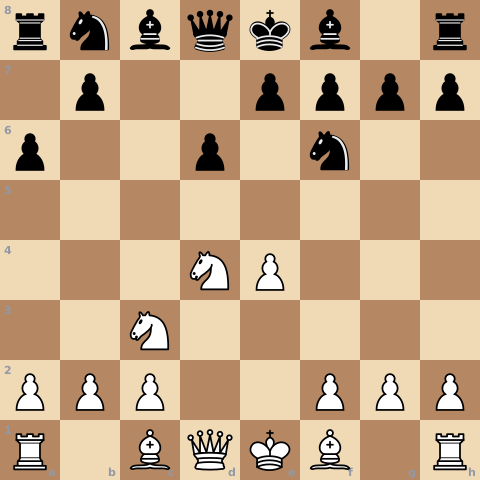
That's the Najdorf's defining sequence, five moves in, ending with Black's pawn pushing to a6, prepares queenside flexibility rather than committing to a specific structure immediately. It's what happens after this point that makes the difference.
At the very next decision, White's repertoire in this site's own data branches into 13 distinct, genuinely real options, reflecting five entirely different major systems (the English Attack, 6.Bg5, 6.Be2, 6.Bc4, and 6.f3) and their own sub-variations. Compare that to two other 1.e4 defenses covered on this site:
- Pirc Defense: widest real branch point is 4 options.
- Trompowsky Attack: widest real branch point is 4 options.
- Sicilian Najdorf: widest real branch point is 13 options.
That's not a stylistic difference, it's a genuinely different amount of real material to know before you're prepared for what a real opponent might actually play. A player still building their opening intuition is far more likely to face an unfamiliar branch in the Najdorf than in either of those other two defenses, purely because there are more real, commonly-played branches to be unfamiliar with.
This is the honest, verifiable reason a 1600+ recommendation exists here, not because the opening is theoretically unsound (it's the most-played, most respected Sicilian system in chess, played at every level up to world championship), but because handling that real branching well requires a level of preparation and comfort with sharp, book-heavy positions that most players haven't built yet below that range.
What to Play Instead Under 1500
This site covers six other 1.e4 defenses, and five of them carry a recommended floor well below 1500:
Caro-Kann Advance (800+ Elo, 61,922 real games) — solid, positional, with only one real decision Black faces early: 3...Bf5 (developing the bishop before it gets boxed in) or 3...c5 (striking the center directly) after 1. e4 c6 2. d4 d5 3. e5.
Scandinavian Defense (400+ Elo, 23,993 real games) — the most accessible option here by a wide margin: 1. e4 d5 2. exd5 Qxd5 (White's pawn captures Black's, then Black's queen recaptures), reaching a well-tested main line almost immediately.
Pirc Defense (750+ Elo, 32,086 real games) — genuinely flexible, with 3...g6 (preparing to fianchetto the bishop) played in 97.7% of real games reaching that position, close to forced.
Modern Defense (900+ Elo, 84,900 real games) — closely related to the Pirc, with White's central response played in 91.2% of real games, again close to forced.
Petroff Defense (800+ Elo, 50,005 real games) — a direct, symmetrical counter-attack, 2...Nf6 (developing the knight to counter-attack rather than defend) is the clear main choice at 53% of real games.
Each of these has a genuinely narrower real branching structure than the Najdorf at an equivalent depth, which is exactly why they carry a lower recommended floor. None of them are "worse" openings, they're simply asking less of you while your opening intuition is still developing.
Read the full breakdown of all seven 1.e4 defenses →
Try Any of These for Free
The Sicilian Najdorf and all five alternatives above are fully interactive on this site, real lines, real move-frequency data, and move-by-move coaching. All 36 openings are completely unlocked during this site's open beta, no card, no limit, no account required to start, with your progress tracked for free if you create one.
Every line checked the same way, against real game data, not against what sounds right.
Browse all 36 openings free →