Surviving the Danish Gambit: A Move-by-Move Defense
TL;DR
- The Danish Gambit is White's sharpest try against 1...e5, sacrificing two central pawns outright for rapid development, verified from 1,676 real games spanning 1863 to 2026, the smallest dataset on this site, but a genuinely deep, historic one.
- Declining either pawn offer costs Black the center for nothing in return, in real games, both captures are essentially forced.
- Accepting the second pawn (3...dxc3) is Black's most tested, most critical response, real games show it holds up with correct, careful play.
- A safer, if less tested, alternative exists: 3...d5, sidestepping the sharpest tactics by countering in the center immediately instead of grabbing material.
- A third pawn grab, 4...cxb2, is real and tempting, but in every single game in this dataset that reached it, White recaptured the same way, a small sample, but a completely uniform result.
What Black Is Actually Facing
The Danish Gambit isn't a trick or a bluff, it's a real, historically significant repertoire, and the two pawns White offers are genuinely gone if Black declines to take them. Understanding what each White move is threatening is the difference between surviving this opening and getting run over by it.
Move by Move
1. e4 e5 2. d4
White immediately challenges the center. In real games, Black essentially has to capture, ignoring this pawn lets White build an overwhelming, uncontested center for free.
2...exd4 3. c3
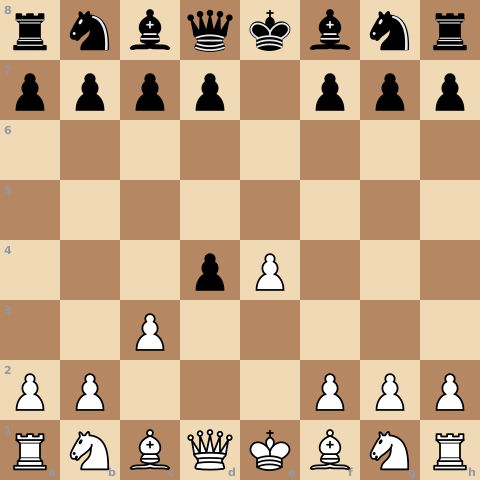
Black's pawn on e5 captured White's pawn on d4, and now White pushes the c-pawn to offer a second one. This is the gambit's entire idea. Rather than simply recapture and settle for a normal central structure, White offers a second pawn to rip open lines for rapid piece development. Here Black has a genuine choice, and this is the single most important decision in the whole opening.
3...dxc3 (the pawn on d4 captures the newly-offered pawn on c3), accepting the second pawn, is the most tested, most critical response in real games. Black ends up two pawns down, but with correct, careful defense, that material is real and holdable, this is not a case of "free pawns nobody actually keeps."
3...d5 (pushing the d-pawn two squares instead of capturing), declining the second pawn and countering in the center directly, is a real, respected alternative. It avoids the sharpest tactics entirely, at the cost of somewhat less-tested territory for Black to navigate.
Following the more critical, more common path:
4. Bc4
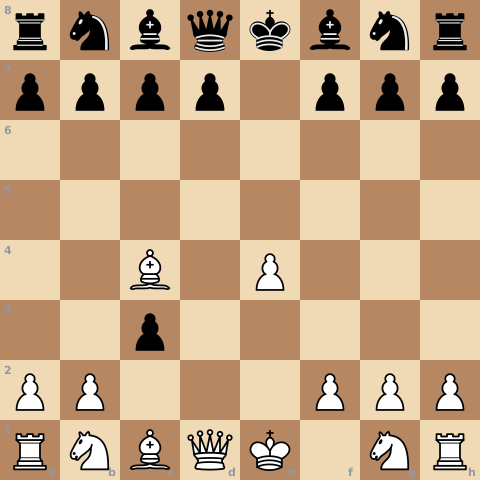
White develops the bishop to c4, aiming straight at f7, the classic weak point in any position where the king hasn't castled yet. This is where a third pawn grab becomes tempting, and where Black needs to think carefully rather than grab automatically.
4...cxb2 (the pawn on c3 captures White's pawn on b2) is real material, three pawns is a genuinely large material edge on paper. But it costs another full tempo while White's pieces keep pouring into the position. In this dataset, every single game that reached this exact position saw White respond the same way:
5. Bxb2
The bishop on c4 recaptures the pawn on b2. A small sample size, this dataset's total game count is modest, but a completely uniform result within it. White recaptures on b2 without exception, and Black is now down a full pawn on the board despite having grabbed three pawns worth of material at various points, since two of those gains came at the direct cost of development and king safety.
The real, respected alternative at this point is 4...Nc6 (developing the knight from b8 to c6 instead of grabbing a pawn), developing naturally instead of chasing a third pawn. It's quieter, less materially greedy, and considered a genuinely sound way to consolidate rather than gamble on holding everything White has offered.
The Honest Takeaway for Black
Surviving the Danish Gambit isn't about memorizing a single forced escape, it's about recognizing that this is a real, sound repertoire on White's side, and that greed past the second pawn tends to cost more in development than it gains in material. The most tested path, accepting the second pawn and defending carefully, holds up in real games. The safer path, declining with 3...d5, sidesteps the sharpest complications entirely. Either is a legitimate, defensible choice, what isn't defensible, based on this data, is grabbing a third pawn on autopilot.
Read the full Danish Gambit repertoire →
Practice Both Sides for Free
This site's Danish Gambit repertoire is built from White's perspective, real lines, real percentages, move-by-move coaching, which is exactly what makes it useful for understanding what Black is actually facing on the other side of the board. All 36 openings are completely unlocked during this site's open beta, no card, no limit, no account required to start, with your progress tracked for free if you create one.
Every line checked the same way, against real game data, not against what sounds right.
Browse all 36 openings free →