The Budapest Gambit: A Complete Guide
The Budapest Gambit arises after 1.d4 Nf6 2.c4 e5, a real, historic gambit developed by a trio of Hungarian masters and famous for a crushing 1918 upset over Akiba Rubinstein. Rather than settle into a slow Queen's Pawn game, Black strikes back immediately, offering the e5 pawn for real, rapid piece activity. This guide covers a complete repertoire built from 12,720 real, individually validated games.
Quick facts
| Moves | 1.d4 Nf6 2.c4 e5 |
| Played as | Black |
| Best for | Players who want an active, tactical, surprising way to meet 1.d4 |
| Style | Sharp, tactical, a genuine surprise weapon |
| Games analyzed | 12,720 real, individually validated games |
| Lines covered here | 21 |
What is the Budapest Gambit?
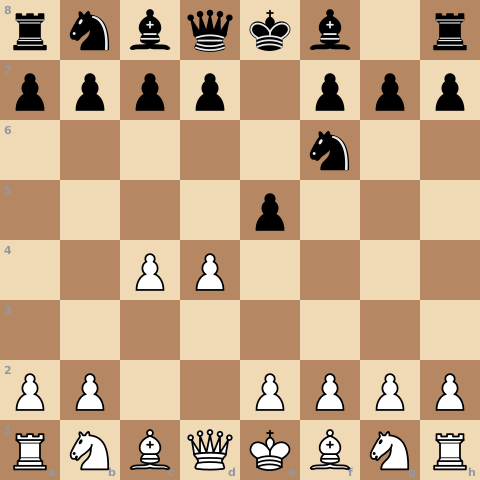
After 1.d4 Nf6 2.c4, most systems develop calmly. The Budapest Gambit does something more direct: 2...e5 offers a real pawn immediately, disrupting White's center and aiming for rapid, active piece play in exchange. In our validated data, White accepts with 3.dxe5 in 90% of games, leading directly into the opening's richest theory.
How to play the Budapest Gambit: move by move
The main line: 4.Nf3 Bc5
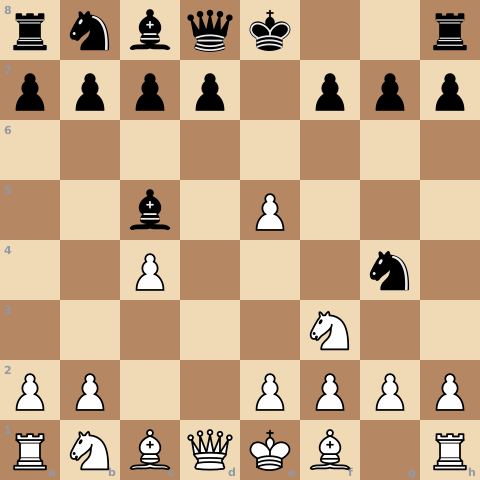
After 3.dxe5 Ng4, attacking the pawn immediately, White's most common defense is 4.Nf3 Bc5, developing actively and eyeing the vulnerable f2 square. Real, well-tested theory continues for many moves from here, both sides typically castle, complete development, and eventually trade down in the center once Black wins the pawn back with ...Ngxe5.
The classical treatment: 4.Bf4
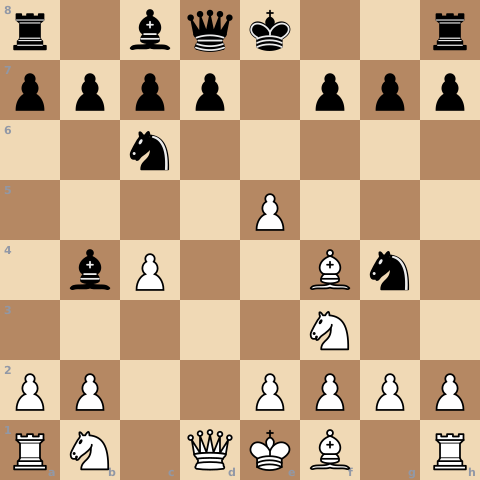
White's other main try, 4.Bf4, develops the bishop actively while defending the extra pawn directly. After 4...Nc6 5.Nf3, Black plays the thematic 5...Bb4+, a real, recurring check throughout this whole branch that gains tempo and disrupts White's development.
The sharper Alekhine Variation: 4.e4
White's most aggressive option, 4.e4, gives the pawn straight back to build a dominant classical center. After 4...Nxe5 5.f4, kicking the knight again, the position becomes genuinely sharp, with real tactical chances for both sides, this repertoire covers Black's main replies in full depth.
Strategic ideas in the Budapest Gambit
- Winning back the pawn is only the start, not the whole point. Real, lasting piece activity is the actual compensation, not simply restoring material equality.
- The Bb4+ check is a genuinely recurring theme. It shows up throughout the 4.Bf4 branch specifically, gaining tempo and disrupting White's development at a key moment.
- Know all three of White's replies to 3...Ng4. 4.Nf3 (40%) and 4.Bf4 (37%) are both real, common defensive tries, while the sharper 4.e4 (10%) demands its own real preparation.
- This opening rewards real tactical awareness. It works because the ideas are genuinely sound, not purely because opponents are unprepared for it.
- Development matters as much as material. Rubinstein's own famous 1918 loss came from exactly this, falling behind in development while the material question was still being resolved.
Who should play the Budapest Gambit?
The Budapest Gambit is a strong fit for players who want a genuinely active, tactical way to meet 1.d4 without learning deep Queen's Gambit or Indian Defense theory, and who are comfortable giving up a pawn for real, concrete activity. It's also a genuine surprise weapon, most club-level opponents won't have deep preparation against it.
It's a weaker fit if you're specifically looking for a fully sound, engine-approved equalizing system. Modern analysis generally credits White with a real, if modest, edge with accurate defense, this doesn't make the opening unplayable, but it's worth knowing what you're taking on.
Common mistakes in the Budapest Gambit
- Playing Black and grabbing tactical chances without regard for actually winning the pawn back or maintaining real activity. The gambit's compensation depends on concrete follow-through, not just having offered material.
- Playing White and getting drawn into premature complications instead of simply completing development. Rubinstein's own famous loss came from exactly this pattern.
- Playing Black and treating this purely as a surprise weapon without understanding the real ideas behind it. It works because the tactics are genuine.
- Assuming the Budapest is unsound simply because it's uncommon at the top level today. Modern engines credit White with only a modest edge, this remains a genuinely playable, practical choice.
Frequently asked questions
Is the Budapest Gambit good for beginners?
It rewards real tactical awareness and comfort giving up material for activity, which can make it a genuinely fun, instructive opening to learn, though it isn't purely a memorization-based choice.
Is the Budapest Gambit sound?
Modern engines generally credit White with a real, if modest, positional edge with accurate play, a conclusion that traces back to Rubinstein's own assessment after his famous 1918 loss. That doesn't make it unplayable, it remains genuinely effective below the very highest levels.
What's the most famous Budapest Gambit game?
Milan Vidmar's crushing 24-move win over Akiba Rubinstein in Berlin, 1918, played with an idea Hungarian master István Abonyi had shown him only minutes before the round began.
How should White meet the Budapest Gambit?
Accepting with 3.dxe5 is the overwhelming main choice in real games, at 90%. From there, 4.Nf3 and 4.Bf4 are both real, well-tested defensive setups, while 4.e4 offers a sharper, more forcing alternative.
Where does the name "Budapest Gambit" come from?
Directly from the city where it was born. The first known game was played in Budapest in 1896, and it was developed into a serious weapon around 1916 by a trio of Hungarian masters, István Abonyi, Zsigmond Barász, and Gyula Breyer.
Related openings
- Danish Gambit — Another real pawn sacrifice for rapid development and activity, worth comparing directly if you enjoy this style of play.
- Benko Gambit — Another respected Black gambit against 1.d4, offering material for long-term structural and positional compensation instead of immediate tactics.
Practice every real line against master-game replies, with a plain-English explanation on every move.
Practice Budapest Gambit free →